-
Ash Wednesday
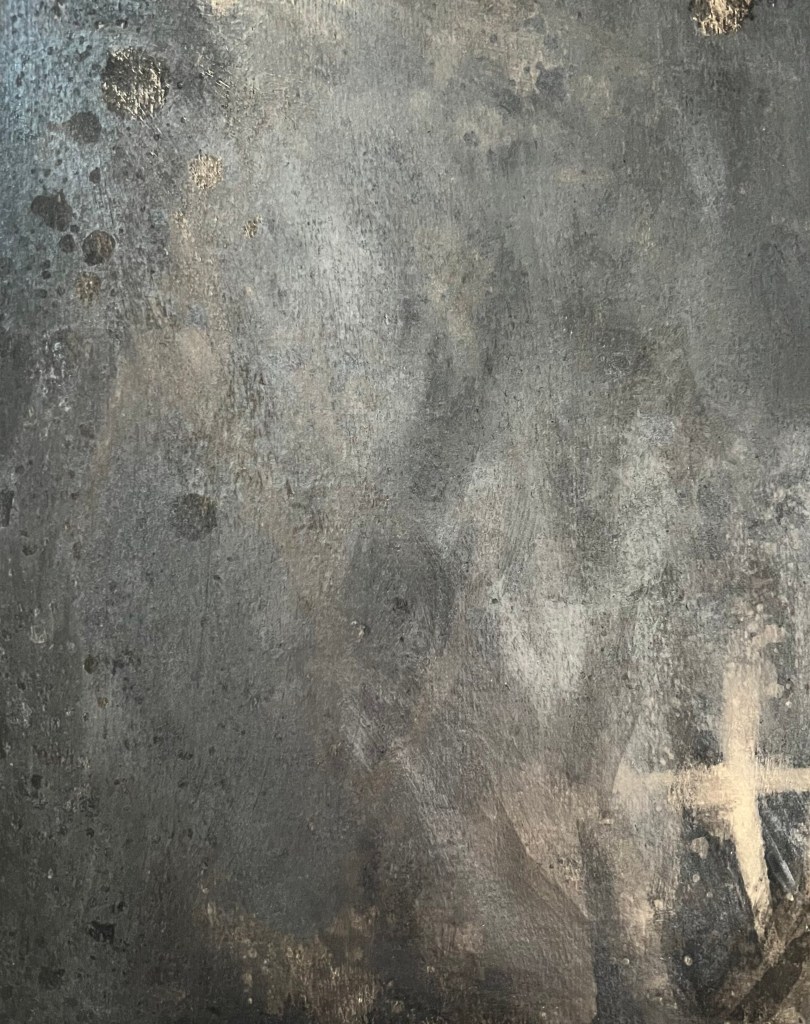
Resurrection: A Lectionary Journey by Michelle L Hofer – acrylic on paper, 8 x 10 inches, 2022 March 2, 2022 Lectionary Texts — Year C
Joel 2:1-2, 12-17
Isaiah 58:1-12
Psalm 51:1-17
2 Corinthians 5:20b-6:10
Matthew 6:1-6, 16-21
View Lectionary✨Judgment will come on a black and fearful day; a thick cloud of darkness will loom over everything. — Joel 2:2a✨
✨But still, You long to enthrone truth throughout my being; in unseen places deep within me, You show me wisdom. — Psalm 51:6✨
✨God has given us a charge to carry through our lives—urging all people on behalf of the Anointed to become reconciled to the Creator God. He orchestrated this: the Anointed One, who had never experienced sin, became sin for us so that in Him we might embody the very righteousness of God. — 2 Corinthians 5:20b-21✨
✨Some people store up treasures in their homes here on earth. This is a shortsighted practice —don’t undertake it. Moths and rust will eat up any treasure you may store here. Thieves may break into your homes and steal your precious trinkets. Instead, put up your treasures in heaven where moths do not attack, where rust does not corrode, and where thieves are barred at the door. For where your treasure is, there your heart will be also. — Matthew 6:19-21✨
✨Then, oh then, your light will break out like the warm, golden rays of a rising sun; in an instant, you will be healed. Your rightness will precede and protect you; the glory of the Eternal will follow and defend you. — Isaiah 58:8✨
Practicing Visio Divina:
- View the artwork
What do you see?
Note shapes – color – style – movement
What stands out for you?
What are you curious about?
What questions do you have?
Hold back any feelings – judgments – opinions - Read the accompanying scripture and look over the artwork again
What connections do you make?
Between the image and text?
What is coming to mind from your own experience?
What feelings are rising in you?
There are no right or wrong answers - Read the scripture again and explore the artwork a third time
What do you hear?
What is God saying to you?
What do you wish to speak to God?
What blessing or prayer is rising in you?
- View the artwork
-
Transfiguration Sunday
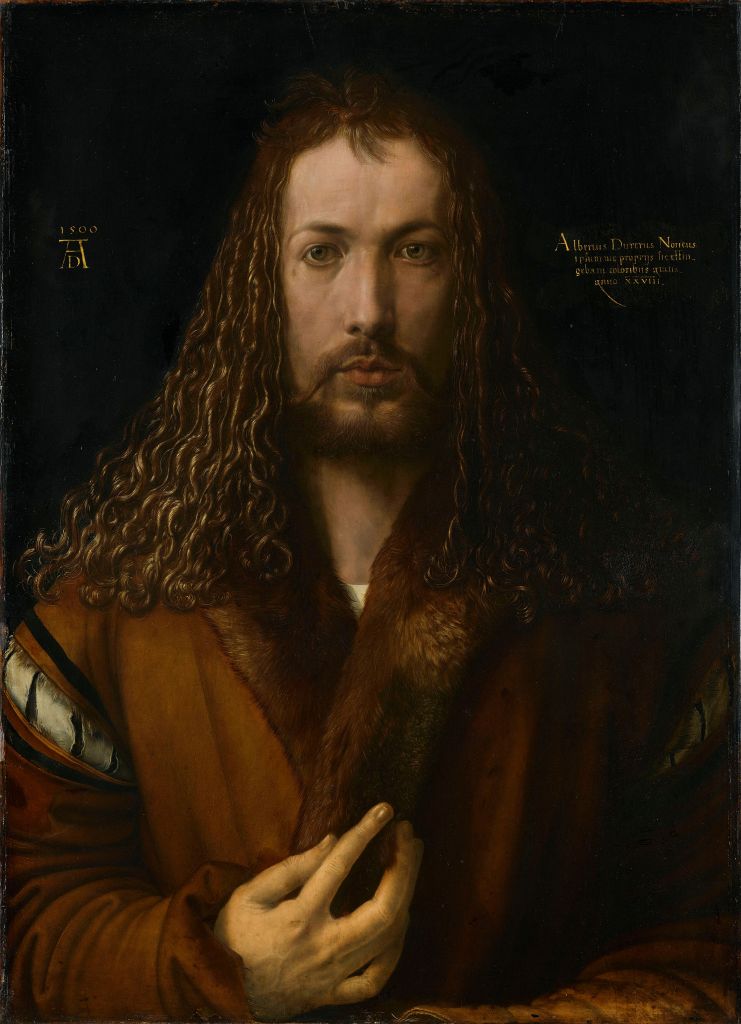
Self-Portrait at Twenty-Eight by Albrecht Dürer — oil on panel, 1500 February 27, 2022 Lectionary Texts — Year C
Exodus 34: 29-35
Psalm 99
2 Corinthians 3:12-4:2
Luke 9: 28-36 (37-43a)
View LectionaryIt really is the ultimate selfie, if you will, from a time when selfies were somewhat taboo. Dürer’s Self-Portrait at Twenty-Eight marks a significant transition in art-making. No artist had ever portrayed themselves alone or as boldly as Dürer does here. Sure, it was natural that artists should sketch themselves in the name of study and practice… maybe even paint their own face in a crowd of people now and then. Deeming oneself a worthy subject, as Dürer does here, is a first. Painting portraits of the rich and famous were one of the ways artists such as Dürer made a living. Always though, a person was depicted in profile or a three-quarter turn position. A full frontal pose was reserved for none other than the Son of God. This had been the tradition for centuries.
Dürer choosing to face the viewer head-on comes across as completely arrogant. Does he think he’s God or something? And why are we even looking at this image here in Visio Divina??
I’d like to give you some additional information that I hope will get you contemplating around the significance of an image such as this on a Sunday when we celebrate the Transfiguration.
What we know about Dürer from his journals is that he was a person of faith. Dürer saw his artistic ability as a gift given to him by God. He understood the use of this gift to be the fulfillment of his Divine calling. He wasn’t just cranking out masterpieces for the money or the status (though he did become quite wealthy thanks to the combination of his phenomenal engraving skills and the invention of the printing press).
When he painted this portrait at the mid-point of his life, it was a private matter. Few individuals saw this piece while he was alive. So what is this about then? One verse from this week’s lectionary texts is a clue for us: 2 Corinthians 3:18. Is Dürer communicating his own transformative journey of becoming Christ-like? That is a common interpretation of this portrait. If so, I can’t think of a more powerful way of illustrating that concept.
Now all of us, with our faces unveiled, reflect the glory of the Lord as if we are mirrors; and so we are being transformed, metamorphosed, into His same image from one radiance of glory to another, just as the Spirit of the Lord accomplishes it. — 2 Corinthians 3:18
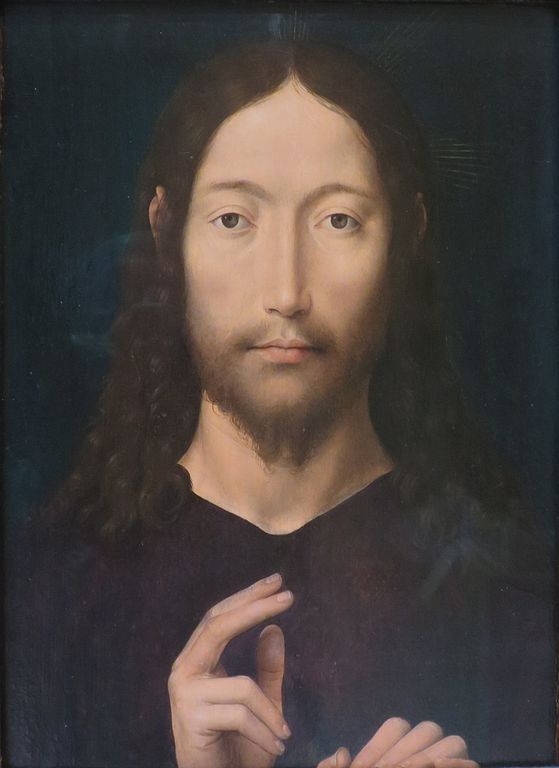
Christ Giving His Blessing by Hans Memling – oil on oak wood, 1487 This image of Christ by Hans Memling is similar to Dürer’s portrait. Note the gesture of blessing here. In Dürer’s portrait, his hand is gesturing the blessing towards himself. This too could be interpreted as an act of arrogance or we can see it as a way of Dürer communicating gratitude for his life, his salvation and the sacredness with which he regards his artistic gifts.
I’ll be honest, I was a little nervous about presenting this image to you this week. These feelings of apprehension rise out of the several thoughts. First, I am aware that for far too long, Western art has dominated Christian culture. It is a very “white Jesus” who has long been the standard “face of God” imagery. Those of us who are of white European descent often don’t think twice about this. Second, it feels arrogant/biased/naive of me to select the portrait of a white man for a Sunday as special as Transfiguration Sunday.
Ultimately, I decided in favor of this image. These visio divina selections absolutely should included images that create discomfort in us. It is good to explore such feelings and the thoughts behind them. If you are feeling anything uncomfortable, please take some time to explore what that is about. It may be of interest to know that you wouldn’t be the first person to find this portrait unsettling for one reason or another… a troubled museum goer managed to slash both of Dürer’s eyes and permanently damage this piece.
I would hope you might be open to the invitation to go deeper… beyond what the presentation of this portrait could represent on the surface. I encourage and invite you especially into the dark mysteries, the symbolisms hidden behind the figure. What might we discover there about ourselves, who we are, who we are called to be?
I personally hold the spiritual meaning of this portrait in high regard. It’s been a significant influence on the way I see myself, my artistic gifts and my own inner (and outer) journey of transformation. Some of you may know that I have been slowly working the past few years on a self-portrait very similar to Dürer’s. That process has been a practice of both meditation and a documentation of my own spiritual transformation.
Some things to ponder…
The detail of this portrait is exquisite. Dürer is documenting the full extent of his God-given talent. What are your God-given abilities? Do you regularity use them to their full potential?
Take a moment to explore the background of the portrait. It is painted entirely black. What spiritual symbolism do you find in this? What support do the lectionary texts provide to the concept of a figure emerging out of darkness?
What has been one point of significance in your own transformative journey?
I leave you with an adaptation of a beautiful prayer recorded by Dürer. On this Sunday of Transfiguration, I am substituting the word face where Durer uses voice…
Help us to recognize your [face], help us not to be allured by the madness of the world, so that we may never fall away from you, O Lord Jesus Christ. AMEN
2 Corinthians, Albrecht Dürer, art-making, becoming Christ-like, Christ Giving His Blessing, Christian art, discomfort, divine calling, Exodus, Hans Memling, Lectionary, Luke, meditation, prayer, Psalms, Self-Portrait at Twenty-Eight, selfie, spiritual practice, spiritual symbolism, talent, Transfiguration Sunday, transformation, Western art, white Jesus, Year C -
Seventh Sunday After Epiphany
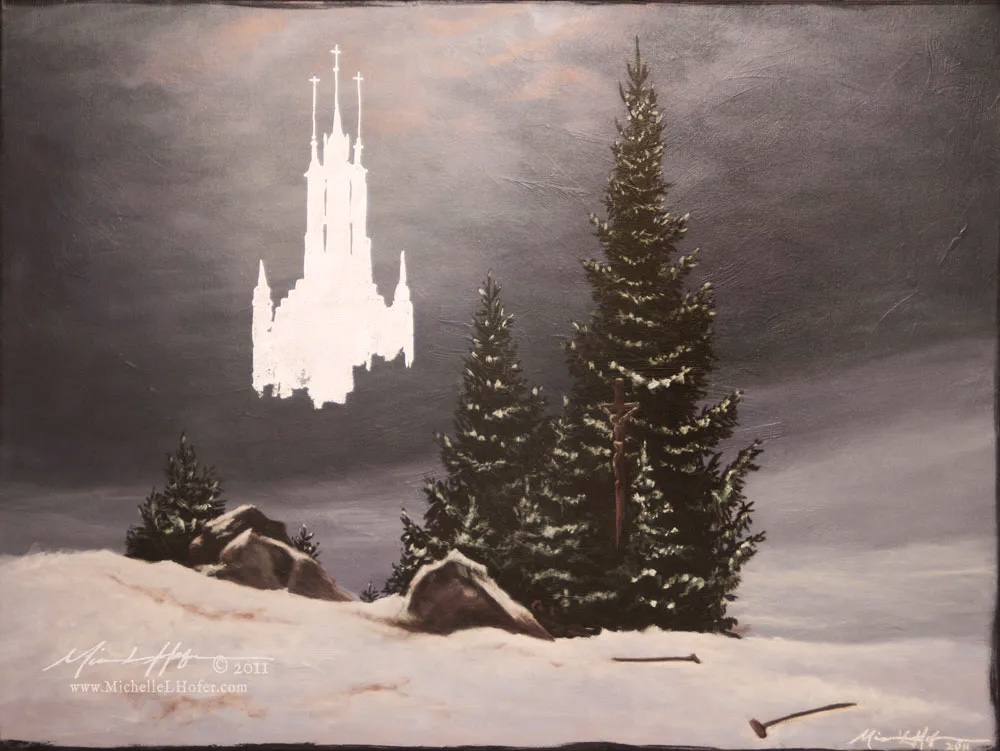
Winter Landscape with Church (after Caspar David Friedrich) by Michelle L Hofer — acrylic and metal leaf on canvas, 2011 February 20, 2022 Lectionary Texts — Year C
Genesis 45:3-11, 15
Psalm 37:1-11, 39-40
I Corinthians 15:35-38, 42-50
Luke 6:27-38
View LectionaryOur image this week is a landscape icon. And by that I mean a landscape painting infused with spiritual meaning. This is my version of Casper David Friedrich’s Winter Landscape, 1811. Friedrich was a Romantic Era German painter who saw nature as a place of worship.
Here we see a figure who, having cast his crutches in the snow, is now seated against a rock. (You may need to zoom to see them.) The person holds his hands in a gesture of prayer and gazes at the crucifix standing among the evergreens.
For Friedrich, landscapes were temples; his paintings themselves were altarpieces. His reverential mood demands from the viewer the silence appropriate to sacred spaces filled with divine presence. — Gardener’s Art Through the Ages
I don’t feel a need to elaborate much more on this piece of art. I would just really encourage you to allow yourself to enter into the scene. Relax your body, take a few deep breaths and begin to explore using the visio divina practice:
- View the artwork and read through each of the lectionary passages. Simply observe the piece looking over all areas of the art…
What do you see?
Note color, style, movement, etc.
Try to keep an open mind and hold back any thoughts of judgment/opinion. - Now take a second look over the art this time exploring feelings and thoughts that arise…
What about this piece has me curious?
What stands out for me? what am I drawn to?
What questions do I have?
What does this make me think of?
How does this make me feel? - Finally, read the lectionary passages again and view the art a third time. Now explore meaning…
Listen for anything the Spirit wishes to reveal.
Is there something you wish to speak to God?
Do you sense a prayer or blessing rising in you?
Believe in the Eternal, and do what is good— live in the land He provides; roam, and rest in God’s faithfulness. Take great joy in the Eternal! His gifts are coming, and they are all your heart desires! Commit your path to the Eternal; let Him direct you. Put your confidence in Him, and He will follow through with you. He will spread out righteousness for you as a sunrise spreads radiance over the land; He will deliver justice for you into the light of the high sun.
— Psalm 37:3-6 - View the artwork and read through each of the lectionary passages. Simply observe the piece looking over all areas of the art…
-
Sixth Sunday After Epiphany
February 13, 2022 Lectionary Texts — Year C
Jeremiah 17:5-10
Psalm 1
I Corinthians 15:12-20
Luke 6:17-26
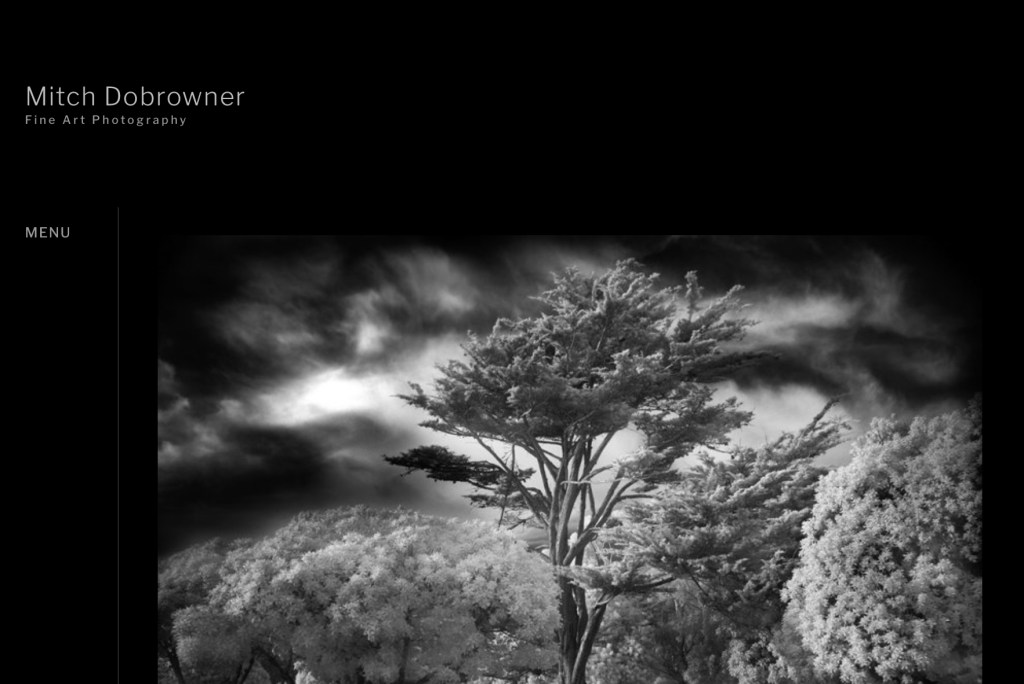
View LectionaryTrees planted by the water… resurrection… healing… blessing… my mind went quickly to the dreamy ethereal photography I learned of and tinkered with in college – black and white infrared photography. It’s an artistic medium illuminating the mystery and magic found in our natural world but invisible to the naked eye. While we see fantastic color and value, the infrared spectrum of light is radiating in frequencies that is detectable by sophisticated film. Even our best digital cameras do not dabble in the infrared realm. I’m hoping someone will be able to develop a great photo app that will mimic what can be captured on infrared film (there are a few that are close).
I myself happen to have a handful of infrared rolls of camera film hanging out in my fridge. They are not so easy to find these days, so I’ve been saving them for an opportune time. Perhaps I should receive what came to mind this week as a prompt to load up my camera and head out this spring or summer!
The cool thing about capturing the infrared spectrum on film is the bright glow it bestows on plants and trees. Leaves, grasses, stems appear shimmery white – a delightful magical effect in a basic black and white photo.
This week, I have not selected a single image for our lectionary reflection and spiritual seeing practice. Instead, I would like to direct you to an amazing gallery of infrared photographs of trees by Mitch Dobrowner. Here you will find a collection of wonderful images to sit with. Please browse as you contemplate the Scripture passages and question prompts below, or land on the image that most strikes you at first glance for visio divina.
For you to ponder…
Which tree best represents you and your life’s journey?
What in the texts gives you comfort? Where do you see it in the photo/s?
When you reflect on placing your trust in God as the Jeremiah passage mentions, which tree from the photographs is the kind of tree you would most like to be? Why?God’s blessings follow you and await you at every turn: when you don’t follow the advice of those who delight in wicked schemes, When you avoid sin’s highway, when judgment and sarcasm beckon you, but you refuse. For you, the Eternal’s Word is your happiness. It is your focus—from dusk to dawn. You are like a tree, planted by flowing, cool streams of water that never run dry. Your fruit ripens in its time; your leaves never fade or curl in the summer sun . No matter what you do, you prosper. — Psalm 1:1-3
-
Fifth Sunday After Epiphany

Vision of the Man in Sapphire Blue by Hildegard of Bingen — from the German copy (completed by Hildegard Abbey in Eibingen, 1927-33) of Book II of Hildegard’s illustrated volume, Scivias, mid 12th century. Hildegard’s original volume was lost in transport for safekeeping during World War II. February 6, 2022 Lectionary Texts — Year C
Isaiah 6:1-8, (9-13)
Psalm 138
I Corinthians 15:1-11
Luke 5:1-11
View Lectionary
If you are not familiar with Hildegard of Bingen, that’s ok. I have only begun to learn about her myself in the past year. Naturally, I am drawn to her illustrated visions. Hildegard is known (among many other things) for taking issue with the church back in her day. She rigorously confronted corruption of power with hard hitting (sometimes hilarious) accusations. Her illustrated visions, in direct contrast to the chaotic and disorderly human world she pushed against, give us a view of divine order and God’s power in presence and action.
Hildegard herself may not have painted the illuminations found in Scivias. Most likely she explained to a skilled visual artist who rendered them for her. Hildegard wrote concerning this image:Then I saw a bright light, and in this light, the figure of a man the color of a sapphire, which was all blazing with a gentle glowing fire. And that bright light bathed the whole of the glowing fire, and the glowing fire bathed the bright light; and the bright light and the glowing fire poured over the whole human figure, so that the three were one light in power of potential. — Hildegard of Bingen
In reading and reflecting on this week’s lectionary texts, both the mentions of God on the throne, in the temple plus the appearing of Christ to various individuals, Hildegard’s blue image of Christ came to mind.
Along with presenting Christ to us, Hildegard is illuminating the triune nature of God in this image. The fire she describes, depicted as the orb of gold with vibrating red-brown rings surrounding the figure, is representative of the Spirit. The outer ring of lavender with vibrating gold rings represents the Light and the Father. You will note the light interrupting the golden area flowing down and completely around Christ.
I have mentioned an early Christian concept in a previous post and we see it here also: Hildegard’s use of sphere representing heaven/the divine and rectangle-square (background) representing earth and further emphasizing Christ taking on the earthly form of a man.
If you do a quick search for “sapphire” in Scripture, you will find several visions describing God sitting on a throne made of sapphire. Related to this, one of my house church mates shares in our weekly art explorations how she finds blue to be a holy color. Long before finding Hildegard’s image, I had myself envisioned Christ in monochromatic blue tones.
Sapphire, which is a deep rich blue color (think pure primary blue) has long been a color said to exude compassion. Many people in sitting with the Vision of the Man in Sapphire Blue, say they experience Christ’s compassion in this image.
I was struck by the Luke passage where Jesus tells Simon to move out into the deep (blue) waters to let down his nets. As I look at the face, the open hands and Christ’s flush of sapphire, I sense an invitation also to go deeper… deeper into compassion and love …deeper into mystery and communion with the divine and triune God.Practicing Visio Divina
- View the artwork and read through each of the lectionary passages. Simply observe the piece looking over all areas of the art…
What do you see?
Note color, style, movement, etc.
Try to keep an open mind and hold back any thoughts of judgment/opinion. - Now take a second look over the art this time exploring feelings and thoughts that arise…
What about this piece has me curious?
What stands out for me? what am I drawn to?
What questions do I have?
What does this make me think of?
How does this make me feel? - Finally, read the lectionary passages again and view the art a third time. Now explore meaning…
Listen for anything the Spirit wishes to reveal.
Is there something you wish to speak to God?
Do you sense a prayer or blessing rising in you?
After speaking for a while, Jesus speaks to Simon, “Move out into deeper water, and drop your nets to see what you’ll catch.” Simon (perplexed): “Master, we’ve been fishing all night, and we haven’t caught even a minnow. But . . . all right, I’ll do it if You say so.” Simon then gets his fellow fishermen to help him let down their nets, and to their surprise, the water is bubbling with thrashing fish— a huge school. The strands of their nets start snapping under the weight of the catch, so the crew shouts to the other boat to come out and give them a hand. They start scooping fish out of the nets and into their boats, and before long, their boats are so full of fish they almost sink! — Luke 5:4-7
- View the artwork and read through each of the lectionary passages. Simply observe the piece looking over all areas of the art…
-
Third Sunday After Epiphany
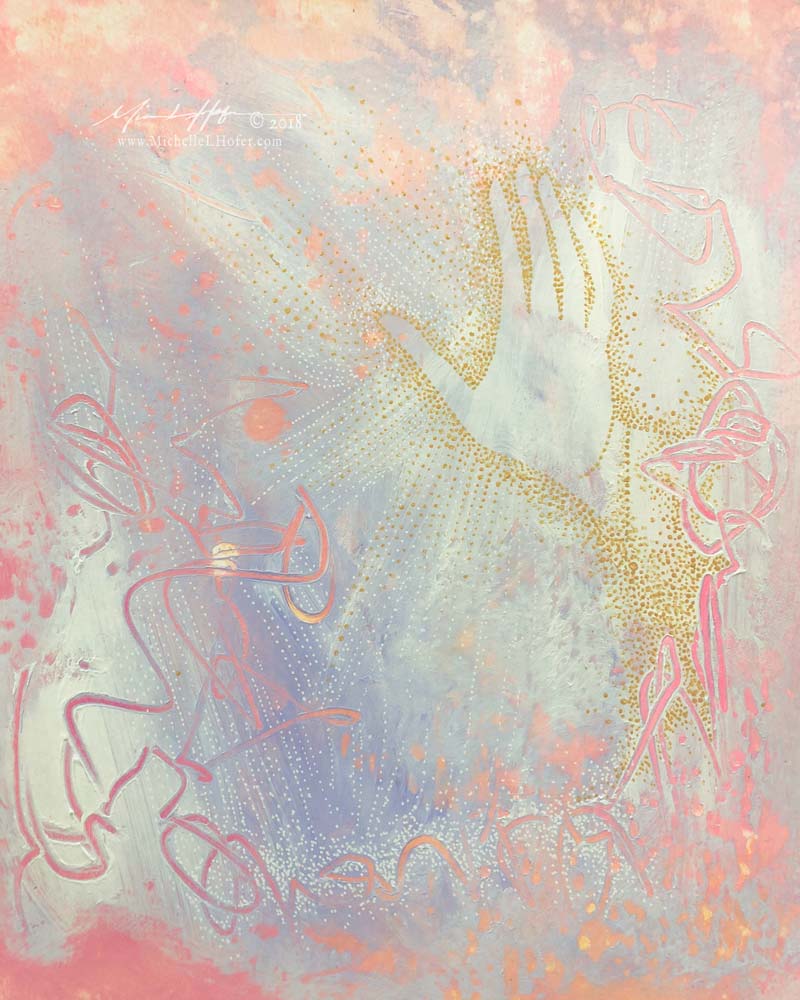
Untitled by Michelle L Hofer – mixed media on paper, 8 x 10 inches, 2018 January 23, 2022 Lectionary Texts – Year C
Nehemiah 8:1-3, 5-6, 8-10
Psalm 19
I Corinthians 12:12-31a
Luke 4:14-21The hands and hand gestures found in Christian icon art fascinate me. The form is consistently long and slender. There is a gentle quality to every gesture. The hands are welcoming and never forceful, confident and open. Even if the subject holds a spear or sword, the grip is easy. Hands do not differ according to gender of the subject — male, female and non-gender (angel) hands all appear universally the same.
Hand gestures in icon art originate out of the Greco-Roman oration tradition — a tradition familiar to the early Christians. Certain hand gestures have been assigned to specific icon subjects such as Christ raising two fingers (indicating an authority to speak). Mary is portrayed with both hands raised and open in a gesture of prayer.
The painting I bring you today features the open palm gesture indicating trust, sincerity and the absence of evil. This gesture is most often reserved for saint portraits. I have also seen this gesture demonstrated by Christ when healing someone. The stippling work is my way of showing Divine magic and energy.
I felt this image made for a nice symbolic connection to the texts this week… Ezra reading to the people and sending them home to celebrate…the Psalmist extolling the wisdom of Divine Law…Paul communicating the importance of each part within the body… and Christ proclaiming his mission in the world
- What do you see?
- What do you feel when looking at this image?
- What facets or characteristics of God come to mind with this image?
- Does this image bring to you a new understanding or perspective to something within the lectionary texts?
Go back to your homes, and prepare a feast. Bring out the best food and drink you have, and welcome all to your table, especially those who have nothing. This day is special. It is sacred to our Lord. Do not grieve over your past mistakes. Let the Eternal’s own joy be your protection! — Nehemiah 8:10
-
Second Sunday After Epiphany
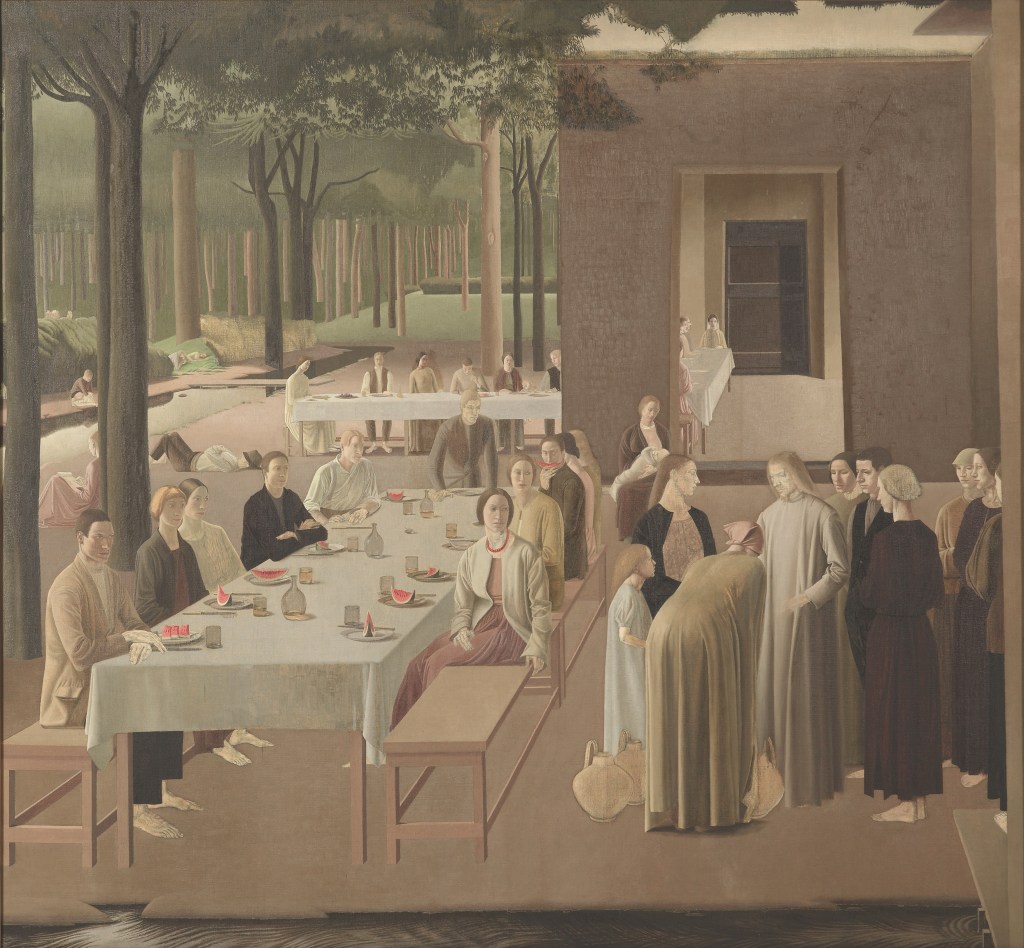
The Marriage at Cana, 1923, 6 x 6.5 feet, by Winifred Knights (1899-1947) from Art in the Christian Tradition, a project of the Vanderbilt Divinity Library, Nashville, TN. January 16, 2022 Lectionary Texts – Year C
Isaiah 62:1-5
Psalm 36:5-10
I Corinthians 12:1-11
John 2:1-11I’ll just admit up front here… My choice of image for this week’s texts is an obscure one. As I perused the art suggestions at the Vanderbilt Divinity Library, this one caught my attention. It struck me as something strange and different and that was my indicator to dig in.
The artist, a British woman, Winifred Knights, I had not heard of before. I was able to quickly get to know her via several well written articles following an art retrospective (an exhibit of an artist’s entire career) that took place in London in 2016 — a long overdue acknowledgment of her talent and unique approach to Christian art. Against cultural norms for women of the day, Winifred was able to attend art college in London and earned a scholarship to study in Rome where she took inspiration from certain Renaissance masters and the Italian countryside. The Marriage at Cana was a piece she began there, but never completed (note Christ’s incomplete hand and elements such as the jugs and many hands, feet and other features still in a sketched state).
Winifred painted only a handful of works in her short life (dying at age 47 of a brain tumor). She gained a excellent commission from Canterbury Cathedral to create an altarpiece on the life of Saint Martin of Tours. The project had Winifred wrestling over vision with the overseeing architect and took years to complete. The artist suffered a mental break after the Cathedral’s dean declared the coloration unsuitable and had it removed shortly after its installation (it has since been restored to its original alcove at Canterbury).
The Marriage at Cana spent years in the basement of the Tate Museum in London and later in an inaccessible stairwell until it was purchased for New Zealand. It is a strange modern interpretation of this well-known Biblical scene playing out as the guests eat dessert.
Watching the miracle unfold (though blocked from our view by the bent woman), the wedding guests’ facial expressions range from intensely curious to oblivious. Winifred herself appears at each of the three tables — she sits at center on the left side of the closest table. Her sister posed for the woman leaning over the jugs and other friends are here as well. Some guests wear modern clothing, others do not. Everyone is barefoot. A mother nurses her child.
The guest space spills out into a park where non-wedding guests relax and nap. A woman sketches. A stream flows at the bottom of the painting and through the park. Trees provide a canopy above. Colors are muted except for the the watermelon slices and one woman’s coral bead necklace.
This work is full of meaning and metaphor. The artist is exploring her personal life here as she sits at the closest table next to the man she was engaged to but later broke off the engagement. At the far table she sits next to her future husband. The woman nursing the baby is likely a reference to the close bond between Mary and Jesus. Mary is the woman wearing the bright beads — a symbol taken from Renaissance paintings indicating the droplets of Christ’s blood and his divine sacrifice.
I like this piece for its mysterious vibe. It invokes curiosity. It doesn’t all make sense, but then again neither does Christ’s response to his mother OR her instruction to the servants OR why this miracle in the first place… fine wine for a party that’s nearly over?
For you to ponder…
What do you make of the included park area and its relaxed folk?
How does this painting connect to the text in the Psalms passage?
Which facial expression/body language most aligns with where you find yourself spiritually these days?Your strong love, O True God, is precious. All people run for shelter under the shadow of Your wings. In Your house, they eat and are full at Your table. They drink from the river of Your overflowing kindness. You have the fountain of life that quenches our thirst. Your light has opened our eyes and awakened our souls.
Psalm 36:7-9 -
First Sunday After Epiphany
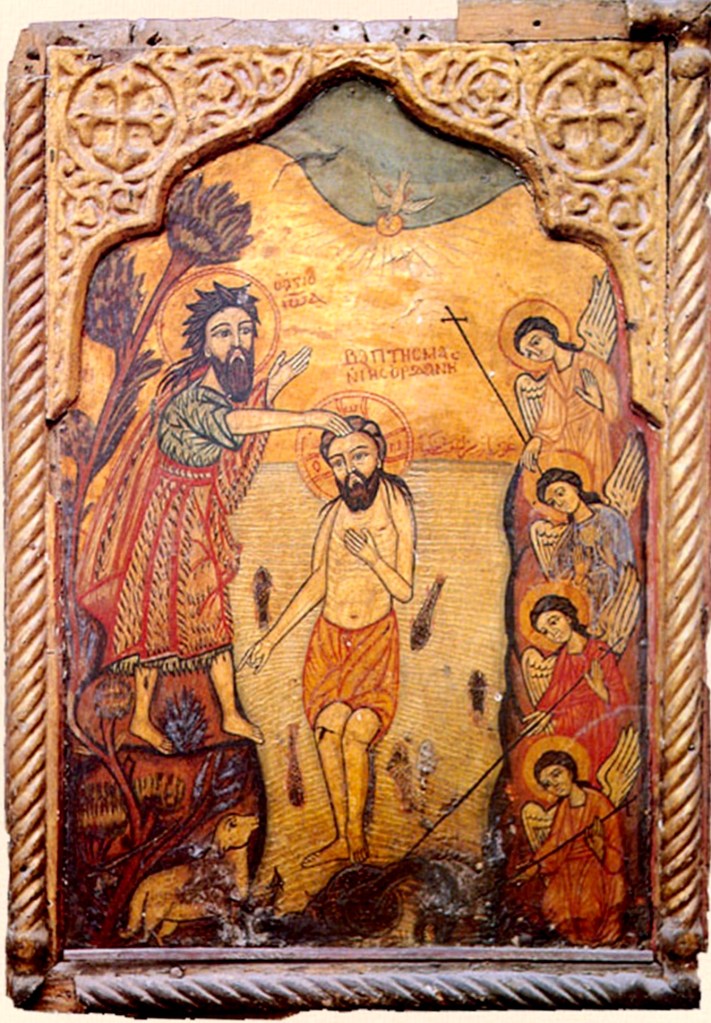
The Baptism of Jesus Christ from the Coptic Church of Saint Mercurius – Old Cairo, Egypt, before 19th century January 9, 2022 Baptism of the Lord – First Sunday after Epiphany Lectionary Texts — Year C
Isaiah 43:1-7
Psalm 29
Acts 8:14-17
Luke 3:15-17, 21-22It is perhaps too easy to focus our attention on the art and imagery of European Christians for theirs is an art of abundance and impressive extravagance. Christianity’s earliest visuals rise out of the Middle East and were greatly influenced by the cultures and religions present there.
For this Sunday’s texts, I have chosen an icon from Egypt’s Coptic Christian tradition. The Copts were actually the last generation of the ancient Egyptian culture and tradition. Ancient Egypt was of course one of the most artistically sophisticated cultures the world has ever known. When the Coptic people adopted the new religion of Christianity, they were quick to develop a visual style and iteration for their new faith and became highly influential in the development of Christian art across the centuries. Coptic Christian art, taking many cues from ancient Egypt, is distinguished by simple figures with especially large wide eyes. Note how John the Baptist is posed Egyptian style one foot ahead of the other, arms extended, body half turned to the viewer. The colors are bold and of high contrast. As the tradition grew, it incorporated elements from Islamic decoration as well. The frame of this icon is a perfect example of such.
Note the two crosses carved into the frame’s top. The Coptic cross is a known symbol throughout Egypt. It became a vandalous way to claim the ancient stone temples and structures for the the new faith. Crosses were zealously carved directly over the faces and figures of the Egyptian gods on columns and facades.
As typical in icons of Christ’s baptism, Christ is shown standing neck deep in the Jordan, or in this case, perhaps the Nile, Egypt’s long understood source of life and sustenance from the gods. Fish team around Christ symbolic of this living water. Christ stands on a dark serpent below the water – a symbol of his victory over death and Satan. It would also appear that at least one of the angels is spearing the snake with their staff. All angels are present to signify the worship and honor due Christ at this moment. I can’t quite see if the staff of the bottom angel is also spearing the enemy or stirring the waters.
A lamb watches on, reminding us of John’s words: “Behold the Lamb of God.” An thin long handled axe is found among the shrubbery behind the lamb, again a reminder of John’s words: “Even now the ax is lying at the root of the trees; every tree therefore that does not bear good fruit is cut down and thrown into the fire.”
Of course we see the rift in the sky between heaven and earth from which the dove descends. I do appreciate the addition of brightly colored orange legs flung behind the dove as it dive blesses God’s son.
A common criticism of icon art is that it lacks proper perspective as was developed and perfected in Renaissance art. I recently learned icons were purposely designed for you to experience the figures and scene moving outward coming towards you – God is coming to meet you. Art with depth and spatial perspective requires you to move in to make connection – you must enter into the work.What do you see?…
Do you find it easy or difficult to interact with art when the style is not realistic?
There is a beautiful expression of God’s tender love in the lectionary passages. What about this piece conveys that aspect of this baptismal scene?
How does the Egyptian perception of the Nile River as a source of life enrich your understanding of baptism? How might the incorporation of this insight be in itself an expansion of God’s family?But now thus says the Lord, he who created you, O Jacob, he who formed you, O Israel: Do not fear, for I have redeemed you; I have called you by name, you are mine. When you pass through the waters, I will be with you; and through the rivers, they shall not overwhelm you… Because you are precious in my sight, and honored, and I love you… Do not fear, for I am with you.
Isaiah 43:1-2, 4-5 -
Epiphany of the Lord

Word Made Flesh (She Who Shoes the Way) by Michelle L Hofer, mixed media collage, 2018 January 6, 2022 Lectionary Texts – Year C
Isaiah 60:1-6
Psalm 72:1-7, 10-14
Ephesians 3:1-12
Matthew 2:1-12Today we reflect on the Epiphany of Christ. Long is the tradition of celebrating the incarnation of God and his appearance to the Gentiles as represented by the Magi who visit after observing the star and following it to the child.
The art piece I present today is a sister piece to the one shared on Sunday, January 2. Here again I have cut and pasted from copies of German Bible text into this image of the Christ child with his mother. I am using the well-known Vladimir Madonna icon as my pattern for this piece. No other image of Mary and Jesus is so moving, conveying the tender relationship and strong bond between mother and child. It will forever be conjured in my mind when reading the words… “On entering the house, they say the child with Mary his mother; and they knelt down and paid him homage. Thank opening their treasure chests, they offered him gifts of gold, frankincense, and myrrh.” — Matt. 2:11
Working with text from the opening chapter of John’s gospel:
- The full page appears in the background
- Below Christ is text from verse 14: “And the Word became Flesh”
- Along Mary’s cloak are the words of verse 4: “in him was life, and the life was the light of all people.”
My ancestry is largely German and so using the German text is a connecting point to my heritage. In discussing the January 2nd art piece, Christ Jesus, with my house church group this past Sunday, my father shared how these collages remind him of a time as a boy spending the night with his grandparents. He asked his grandmother if she had anything to read. She handed him his grandpa’s German newspaper. “Do you have anything else?” my father asked unable to read German. She replied the only other option was their German Bible. My grade school taught German classes but I was not much of a success at retaining what I learned there. Working on this collage was a bit challenging in that regard. Thankfully, being able to reference verses in English, I could locate and select the bits of text I wished to feature for the collage.
Being able to translate something that previously made no sense to a new state of understanding and clarity – well that is Epiphany! This God made flesh who came to walk the earth brought immense clarity to who God is… a God now made visible and understandable on human terms. That is reason for much rejoicing my friends!
How about you?
What image takes shape in your mind’s eye when you read the gospel text for today?
What moments of epiphany from your own experience come to mind?
What do you most appreciate about a God who became a human?
What about this image of Mary and Jesus strikes you?Don’t be shy; don’t be doubtful; lift up your eyes and look around. They have gathered all around you, eager to come and be close to you. And your children will come back to this land: your sons from the farthest places of wandering, and your daughters gently carried home. And when you see it, your face will glow; your heart will race and be filled with joy; For great ships will arrive with gifts from across the sea, and the wealth of nations will make their way to you.
Isaiah 60:4-5

 Visio Divina
You must be logged in to post a comment.