-
Second Sunday After Christmas
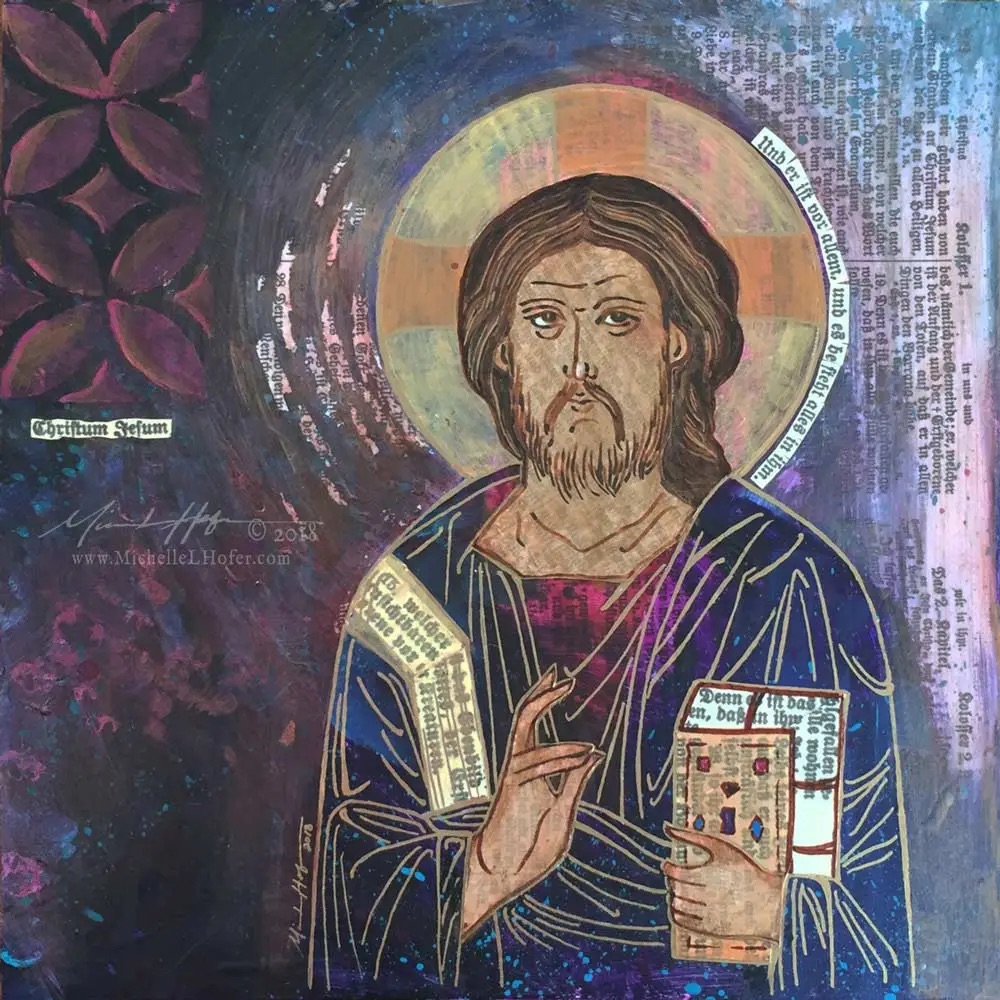
Christ Jesus by Michelle L Hofer – mixed media collage, 2018 January 2, 2022 Lectionary Texts — Year C
Jeremiah 31:7-14 or Sirach 24:1-12
Psalm 147:12-20 or Wisdom of Solomon 10:15-21
Ephesians 1:3-14
John 1:(1-9), 10-18The opening words of John’s gospel featured in this Sunday’s lectionary texts are ones I consider among the most beautiful in all the ancient Scriptures…
In the beginning was the Word, and the Word was with God, and the Word was God. He was with God in the beginning. Through him all things were made; without him nothing was made that has been made. The Word became flesh and made his dwelling among us. We have seen his glory, the glory of the one and only Son, who came from the Father, full of grace and truth. No one has ever seen God, but the one and only Son, who is himself God and is in closest relationship with the Father, has made him known. — John 1:1-3,14,18
I share with you today a piece I created rising from the ideas presented in John’s inspired writing. Having photocopied pages from a German Luther Bible I found in the paper bin of my local recycling center, I cut and pasted the Word into an image of Christ. I was working with text from Colossians chapter 1:
- His name “Christ Jesus” appears on the left side
- The vertical stripe called a clavus across Christ’s right shoulder, a symbol of imperial power and rank as worn by Roman era dignitaries, translates from the German: “He is the image of the invisible God, the firstborn of all creation.” — verse 15
- Along his halo is text from verse 17 — “He himself is before all things, and in him all things hold together.”
- Featured on the Gospel book held in his right hand are words summing up the good news: “For in him all the fullness of God was please to dwell…he has now reconciled in his fleshly body through death, so as to present you holy and blameless…” — verses 19,22
The small German Calvinist congregation I grew up instilled in me a great appreciation for Scripture — these words matter. The one and only visual held dear by this faith community was the open Bible on the preaching pulpit at the front of the church sanctuary – a symbol of the importance for the Word to remain central to one’s life. The lack of any other kind of imagery however, became an issue for me as I transitioned into adulthood and an artist desiring to express my faith in visual ways. Why couldn’t we SEE the “Word made flesh”?
Literally taking bits of Scripture – cutting, pasting and painting over them to create this image of Jesus is my way of embodying the words of John’s gospel. Doing this marked a new understanding and a growth point on my spiritual journey. It also symbolized a place of return and reunion between word and image 500 years after the iconoclasm of the Protestant Reformation led many groups to resist and even fear imagery. I may still consider the words of Scripture to be of great value, but it is the Christ (God made visible) who comes to teach us to live and breathe their meaning.
How about you?…
What images come to your mind as you read John’s opening words?
It is said that artists always reflect their own face when creating a portrait. I am sharing MY image of Christ with German text (I am of German ethnicity), but images of Jesus vary widely in the world – appearing as every different ethnicity.* Why might it be important to create or contemplate an image of Jesus that looks like oneself or reflects one’s own culture?
How does a wide variety of depictions further John’s concept of “Christ dwelling among us”?The redeemed will return home and shout for joy from the top of Mount Zion; they will shine with the sheer goodness of the Eternal — The harvests of grain, wine, and oil; the healthy flocks and herds. Their lives will be like a lush, well-watered garden. From that day on, they will never know sorrow.Young women will dance for joy; young men will join them, old ones too. For I will turn their mourning into joy. I will comfort My people and replace their sorrow with gladness. From the overflow of sacrifices, I will satisfy My priests; All My people will feast on My goodness. This is what the Eternal declares!
Jeremiah 31:12-14Calvinist Reformed, Christ Jesus, Christ Pantocrator, Christian Icon, collage art, depictions of Christ, Ephesians, ethnicity, German, God visible, Gospel of John, icon art, Jeremiah, John, Luther Bible, Michelle L Hofer, modern icon, Protestant Reformation, Psalms, Second Sunday After Christmas, Sirach, Wisdom of Solomon, Word made flesh, Year C -
First Sunday After Christmas
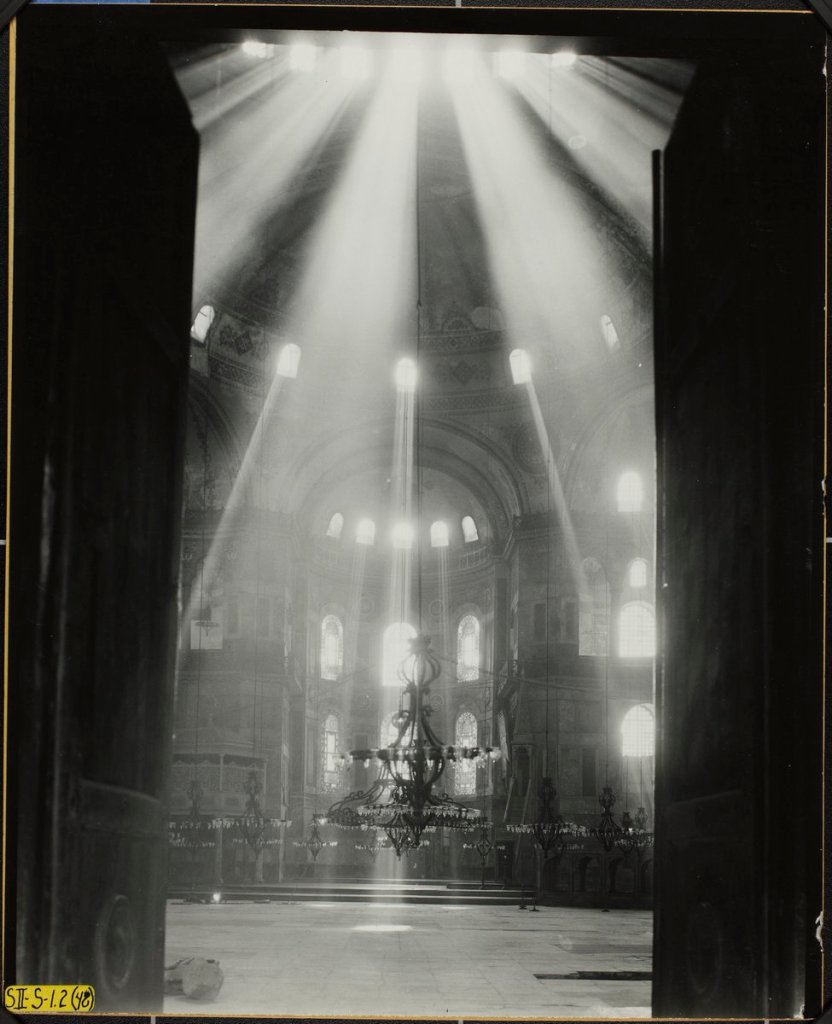
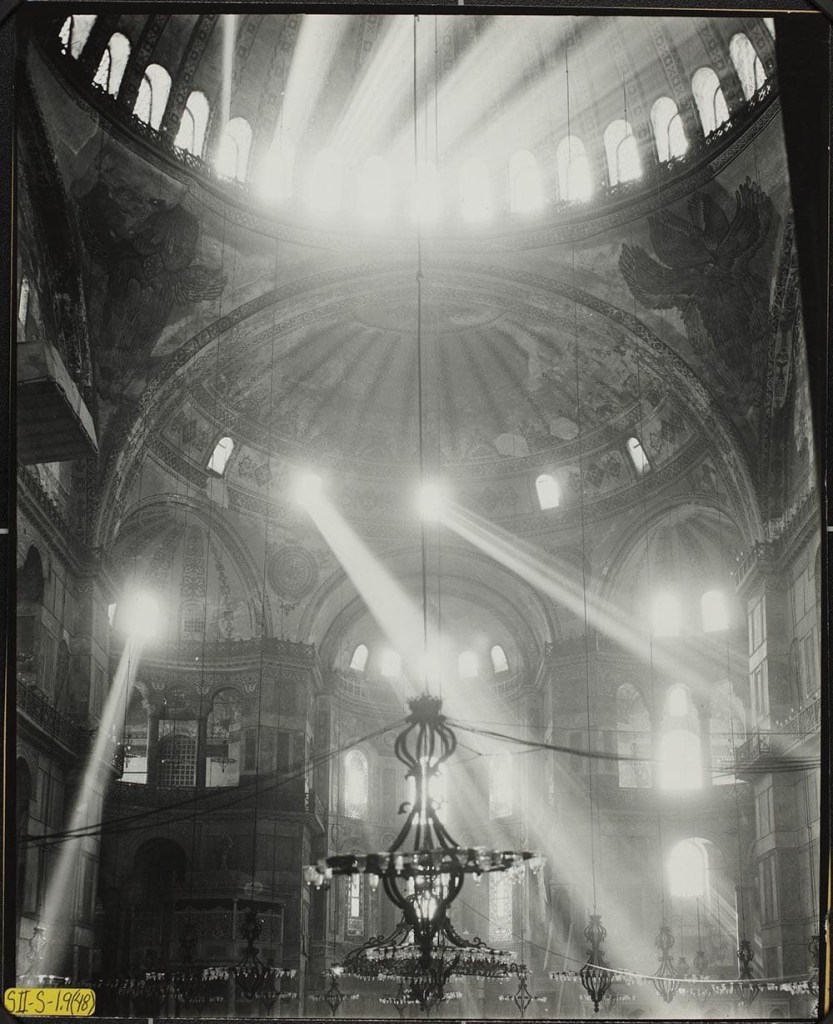
Light pouring into the Hagia Sophia Cathedral — photos by the Byzantine Institute 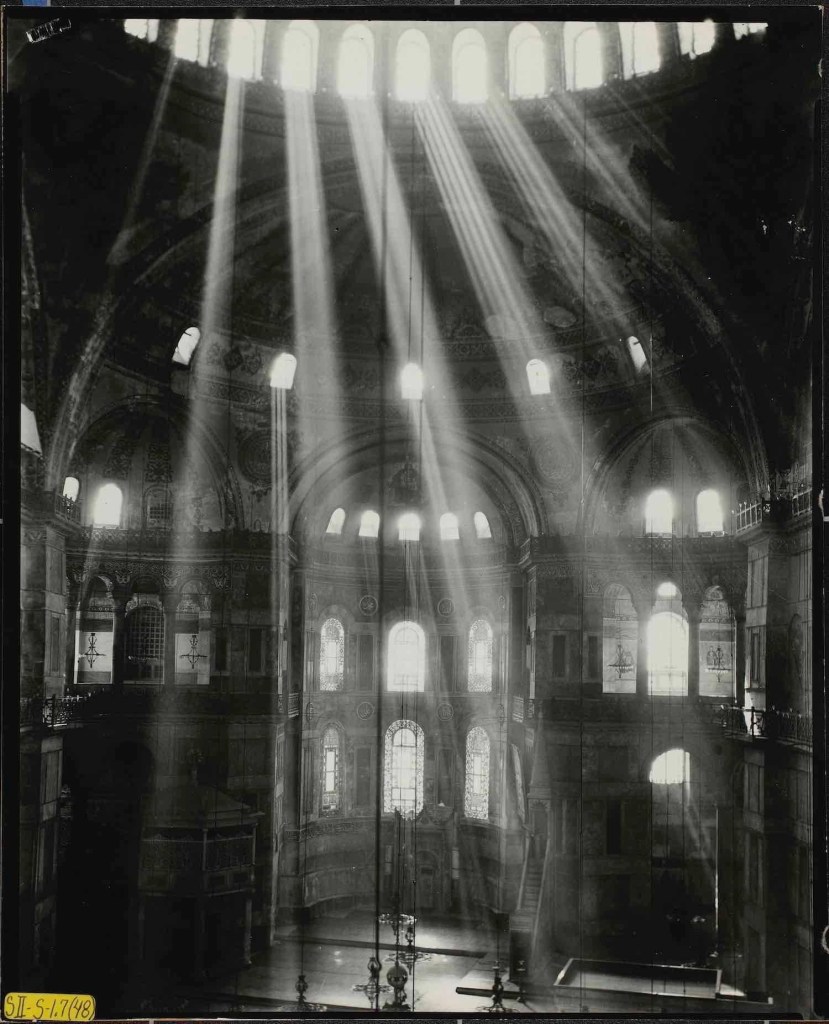
December 26, 2021 Lectionary Texts — Year C
1 Samuel 2:18-20,26
Psalm 148
Colossians 3:12-17
Luke 2:41-52Sancta (Hagia) Sophia is a sphere of light.
Thomas WhittemoreJust in the past week, scrolling through social media, I came across a post detailing how the ancient Christian cathedrals were masterfully constructed in a way that the space would most optimally be filled with light very specifically on the morning(s) following the longest night of the year, the winter solstice, in celebration of the True Light coming into the world.
The article by John Sanidopoulos details how this concept was incorporated by the two architects hired by Byzantine ruler Justinian in building the Hagia Sophia Cathedral in Istanbul. Photos taken by Thomas Whittemore’s Byzantine Institute who uncovered and restored the original mosaics in Hagia Sophia in the 1930’s reveal the stunning light displays symbolizing the birth of Christ.
Son of God love’s pure light.
Radiant beams from Thy holy face
With dawn of redeeming grace,
Jesus Lord, at Thy birth
Jesus Lord, at Thy birth
— lyrics from Silent NightBut now I am imagining worshiping in a space and experiencing this burst of natural light. How amazing! I have tremendous new appreciation for the architects who created such a space. It also saddens me for light and its symbolic presence in the worship space is not given much design consideration in this day and age.
Exploring the images…
What strikes you about these images?
What thoughts do you have about worship spaces, planning or construction?
Do some places/spaces evoke/invite worship while others do not?
Do you ever imagine such a space within yourself?
What might these beautifully captured beams of light symbolize in the spiritual life?Praise the Eternal!
Psalm 148:1-6
All you in the heavens, praise the Eternal;
praise God from the highest places!
All you, God’s messengers and armies in heaven:
praise God!
Sun, moon, and all you brilliant stars above:
praise God!
Highest heavens and all you waters above the heavens:
praise God!
Let all things join together in a concert of praise to the name of the Eternal,
for God gave the command and they were created.
God put them in their places to stay forever —
God declared it so, and it is final.birth of Christ, Byzantine Institute, Christian cathedral, Christmas, Colossians, First Sunday After Christmas, Hagia Sophia Cathedral, I Samuel, Istanbul, John Sanidopoulos, Justinian, light in worship, light symbolism, Longest Night, Luke, Psalms, rays of light, Silent Night, Thomas Whittemore, Winter Solstice, worship space, Year C -
Christmas
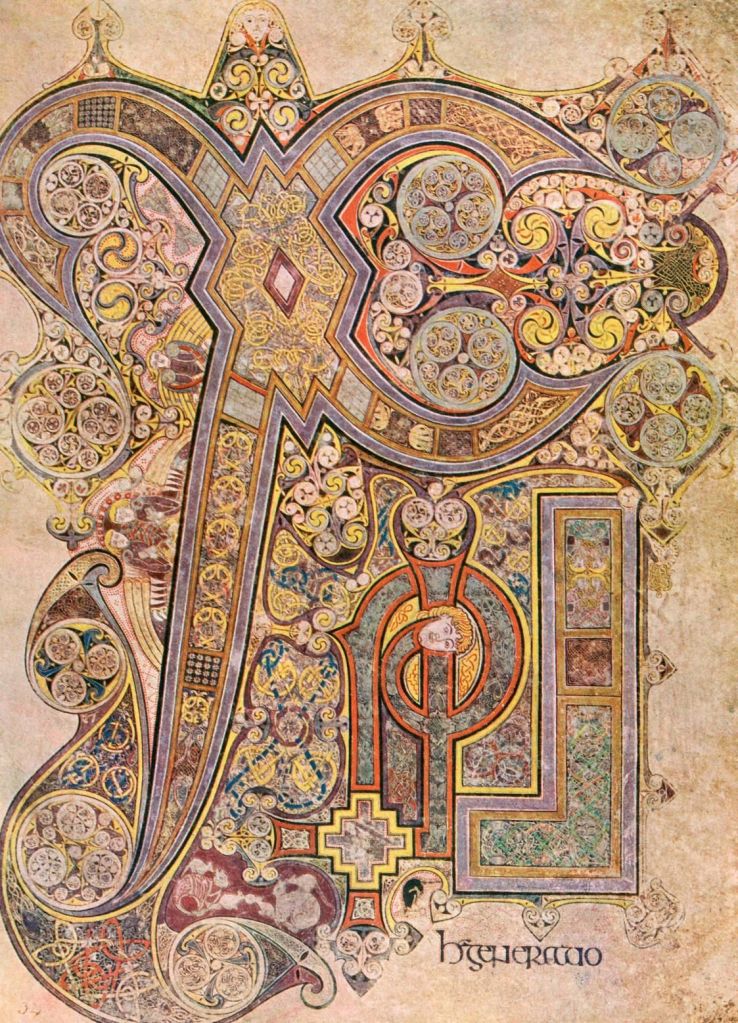
Folio034r — The Chi Rho Monogram, The Book of Kells December 24/25, 2021 Lectionary Texts — Year C
Isaiah 9:2-7
Psalm 96
Titus 2:11-14
Luke 2:1-4I’ve lived through many ages… I’ve seen suffering in the darkness. Yet I have seen beauty thrive in the most fragile of places. I have seen the book… the book that turned darkness into light. — Aisling, The Secret of the Kells
In a college library in Ireland sits one of the most valuable and impressive books in the world. It dates back to around the year 800, but so much is unknown about this rare jewel including who made it and where. There is no question however as to the why. The book, known as the Book of Kells, is a work of art every follower of Christ should be familiar with. Unfortunately, for many (myself included until recent years) it is not all that widely known.
Christian communities in the Middle Ages, especially those in the Celtic world, had a place known as the Scriptorium. Here, books and manuscripts were both kept and copied by monks (tediously by hand, of course). The newly converted Celtic Christian scribes started to get super fancy in their copying task turning the work into worship creating elaborate page designs and illustrations. This is known as illumination. No book was more attentively and creatively rendered among the Celts like a volume of the Gospels. The Book of Kells is the finest existing example of an illuminated Gospel.
There is one page in the Book of Kells that stands out as an artistic masterpiece. It is called the Chi Rho (pronounced KEE – row) page. It is a highly decorative monogram for Christ whose name is spelled ΧΡΙΣΤΟΣ. The X is Greek letter Chi and the P is letter Rho. The page is filled with unbelievable woven knotwork and spirals. All this intricacy is found on a parchment page approximately 13 by 9.5 inches in size.
Explore the art…
What do you notice?
What do you see?
What does all the knotwork and spirals represent for you?
How is the “blessed hope” mentioned in the Titus passage present in this image?If you want a fun way to learn about the Book of Kells, I highly recommend the animated movie, The Secret of the Kells. This is such a beautiful film that brings alive the magic and mystery surrounding Celtic illumination work (there are some fantastic myths and legends out there). I am not the first person who also feels this is an appropriate Christmas time movie with its theme of light dispelling the darkness.
It greatly interests me to create art based off of the Chi Rho page. While I have much grander visions of a very large work of art, as a beginning exercise, I am working on a small piece right now in my daily art making practice. It is helping me explore this masterpiece, but I am greatly challenged in working to simplify something so complex. It is work that allows for personal worship each day and I am thus enjoying it.
The people who had been living in darkness
ISAIAH 9:2,6
have seen a great light.
The light of life has shined on those who dwelt
in the shadowy darkness of death.
Hope of all hopes, dream of our dreams,
a child is born, sweet-breathed; a son is given to us: a living gift.
And even now, with tiny features and dewy hair, He is great.
The power of leadership, and the weight of authority, will rest on His shoulders.
His name? His name we’ll know in many ways —
He will be called Wonderful Counselor, Mighty God,
Dear Father everlasting, ever-present never-failing,
Master of Wholeness, Prince of Peace. -
Fourth Sunday of Advent
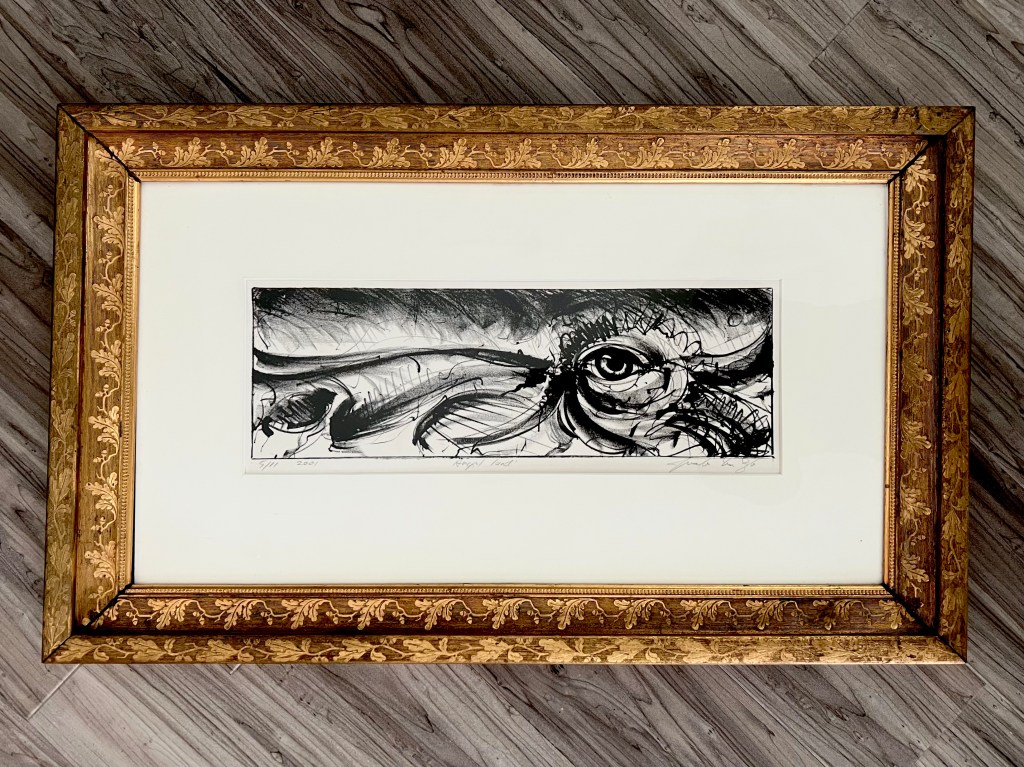
Angel Land by Jake Van Wyk, lithograph from stone, 16 x 6 inches, 2001 December 19, 2021 Lectionary Texts — Year C
Micah 5:2-5a
Psalm 80:1-7
Hebrews 10:5-10
Luke 1:39-55This week I am sharing one of my latest art acquisitions… an original lithograph purchased from my college professor who I visited recently in his new studio space. Jake beautifully set the print in this 1913 gold antique frame which I feel enhances the piece both visually and thematically.*
Jake has long been exploring themes that run parallel to my own work. In this case, the subject is angelic presence. It is depicted here as a large eye set in a landscape. It is an image that can be disturbing at first glance. Remember friends, not all art will give you warm, comfortable or inviting feelings. If you can be open to this, willing to accept and dig into what those uncomfortable feelings are about, you allow the work of art to take you deeper. Going deeper can lead to conversation or communion with the Divine.
I have chosen this piece for its alignment with an overarching theme present in the lectionary texts. This theme is one Mary gives praise and the Psalmist calls out for… being seen. In my own personal experience, one of God’s most comforting messages to me during low points is… I see you. The mighty angelic presence of the spiritual realm enfolding and surrounding our realities is one of the ways God sees.
God saw Israel and her land.
God saw Mary and her people.
God sees Christ and his sacrifice.
Everywhere the Eye of the Divine.
For you to ponder…
What is your initial reaction to Angel Land?
What do you see?
What are you being invited to contemplate and explore?
What questions do you have?Mary: My soul lifts up the Lord! My spirit celebrates God, my Liberator! For though I’m God’s humble servant, God has noticed me. Now and forever, I will be considered blessed by all generations. For the Mighty One has done great things for me; holy is God’s name! From generation to generation, God’s lovingkindness endures for those who revere Him.
LUKE 1:46-50*A word on behalf of artists like Jake and myself… It is critical to support artists and find ways to encourage the work they do. It is also important that what hangs on the walls of our homes be personally meaningful. I would encourage you to stop and take note of your own thoughts, approaches, tendencies around art, artists and your spaces. Resist the consumer driven urge to fill your walls with “decor” pieces. I realize that purchasing or commissioning original art is often considerably more expensive and can be time consuming to seek out. It is nowhere near the much lower cost and ease of purchasing something that was manufactured and sold in a store. Make a budget, set moneys aside, save up and purchase something you will treasure daily. Social media makes it easier than ever before to find art and contact artists – many of us are out there daily on the virtual street corners sharing our work. The time to overturn the present cultural devaluation of art and artists is now, friends. And as always, much much gratitude to those of you who walk with us and support us.
-
Third Sunday of Advent
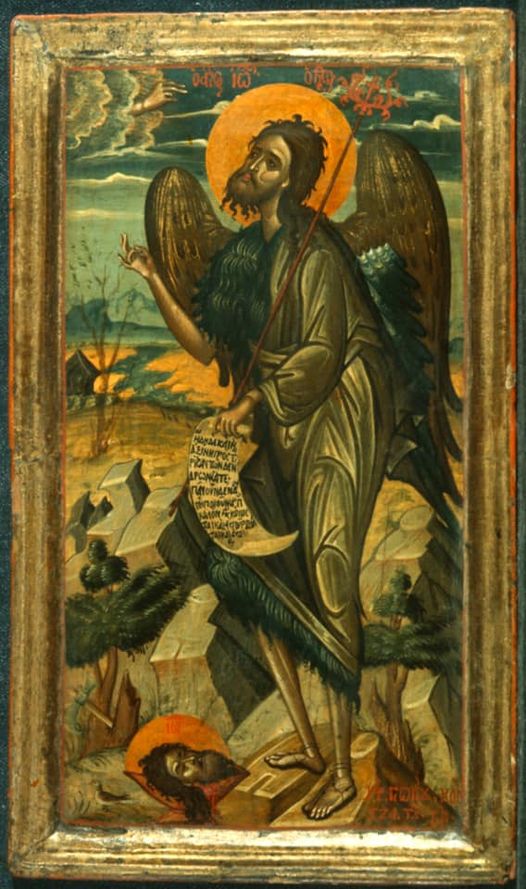
John the Baptist (date unknown) from the Sinai Icon Collection — shared through the Courtesy of the Michigan-Princeton-Alexandria Expeditions to the Monastery of St. Catherine on Mount Sinai, Egypt December 12, 2021 Lectionary Texts — Year C
Zephaniah 3:14-20
Isaiah 12:2-6
Philippians 4:4-7
Luke 3:7-18This week we are again exploring a Christian icon piece. I will be bringing many icons into the Visio Divina space. I have been and always will be a lover of history and old stuff. For a time, I seriously considered majoring in archaeology in college. We have so very much to gain in studying the art at the roots of the Christian tradition. The Monastery of Saint Catherine in the Sinai Desert of Egypt, the world’s oldest monastery spanning 17 centuries, is a treasure trove holding some of Christianity’s oldest works of art. Our icon today of John the Baptist lives there.
John the Baptist icons are also known as The Angel of the Desert. One of the first things you may have noticed about John here is that he has wings. It is important to remember that icons are not illustrations. They are rather symbolic visualizations of important Biblical truths and concepts. You could say they present Scripture in a visible rather than audible way. John is depicted with wings to signify that he is God’s appointed messenger. In the Greek texts, the word angelos is used for John which has the meaning of both angel/messenger and since angels in icons have wings to signify that they have swiftly and miraculously come directly from the presence of God, John bears this symbol also. I don’t know of other prophets being depicted with wings, so there is real importance to John’s role as a messenger being shown here.
John the Baptist icons can also be called The Forerunner. This title of course comes from the words of the messenger angel who visits John’s father, Zacharias: “he will be the Lord’s forerunner, the one who will prepare the people and make them ready for God.” In the icon we see John’s head in a chalice on the ground — the symbol signifying his own execution prior to that of Christ’s. I suspect, though I did not find it mentioned in any of my sources, the small bird looking very much like a killdeer (who run fast over the ground – quite common here in South Dakota) is also a symbol of this forerunner role. Other icons of John may show a running deer.
Looking at John himself you will note unique elements to him are the messy hair and the shaggy fur garment. He gestures a blessing with his right hand and holds a scroll that usually reads (I do not know what this icon specially says): Repent, for the Kingdom of Heaven is come near OR I saw and witnessed concerning him, “Behold the Lamb of God who takes away the sins of the world.” John is also holding a staff with a cross at the top – this is a martyr’s staff. John’s eyes are fixed on heaven the source of his message. We see the hand of God gesturing a blessing toward him.
Quite common to icons of John the Baptist as seen here is a small desert shrub or tree with an axe. This image rises out of John’s statement found in Luke 3:9.
Questions to help you explore:
What do you notice about this work?
What do you see? What do you feel?
What message is John inviting you to hear?Don’t be sad anymore about all the time you were away in exile, unable to keep the appointed feasts or worship Me in the appointed place. I will gather those who’ve shamed you, Zion. Keep watching! At the right time, I will deal with those who assaulted you. I will steady those who are lame and about to fall; I will gather those who are outcasts and oppressed. Instead of being filled with shame as they always have been, I will fill them with praise and make them famous over all the world. On that day, I will gather all of you together for one big homecoming. I will make you famous, and all the world will sing your praises. Right before your eyes, I will restore to you all that you have lost, and your lives will be full again. So says the Eternal One.
Zephaniah 3:18-20 -
Second Sunday of Advent

Divine Blessing by Michelle L Hofer – mixed media painting, 2018 December 5, 2021 Lectionary Texts — Year C
Baruch 5:1-9 or Malachi 3:1-4
Luke 1:68-79
Philippians 1:3-11
Luke 3:1-6This painting features the hand of God. Commonly found in early Christian and Byzantine icon imagery, this gesture carries the special meaning of sovereignty and blessing. The scribbled texture in the background of this piece was created by scraping and jabbing a brush handle in the wet paint. The dot pattern forming the hand is inspired by a technique used in Celtic Christian Scripture illumination where the space between forms or letters is filled with tiny red dots — a visual to indicate the living Word.
Questions to help you explore this artwork with the texts:
How is Malachi’s image of God as Refiner reflected in this piece?
What characteristic of God do you most sense in this image?
How is this image a symbol for the the message John proclaims in the wilderness?If you are overwhelmed trying to connect this image with the questions, break it down by looking at just colors, textures, what is ordered vs. disordered, movement or the energy/feeling in the art.
Feel free to share answers here in the comments. Also, remember, if you have a question, please ask, there are no dumb questions when we are exploring art! I am here to help you and guide you. Like anything, this kind of exploration becomes easier the more you engage and practice.
As Isaiah the prophet had said, a solitary voice is calling: “Go into the wilderness; prepare the road for the Eternal One’s journey. In the desert, repair and straighten every mile of our True God’s highway. Every low place will be lifted and every high mountain, every hill will be humbled; The crooked road will be straightened out and rough places ironed out smooth; Then the radiant glory of the Eternal One will be revealed. All flesh together will take it in.”
LUKE 3:4-6 -
First Sunday of Advent
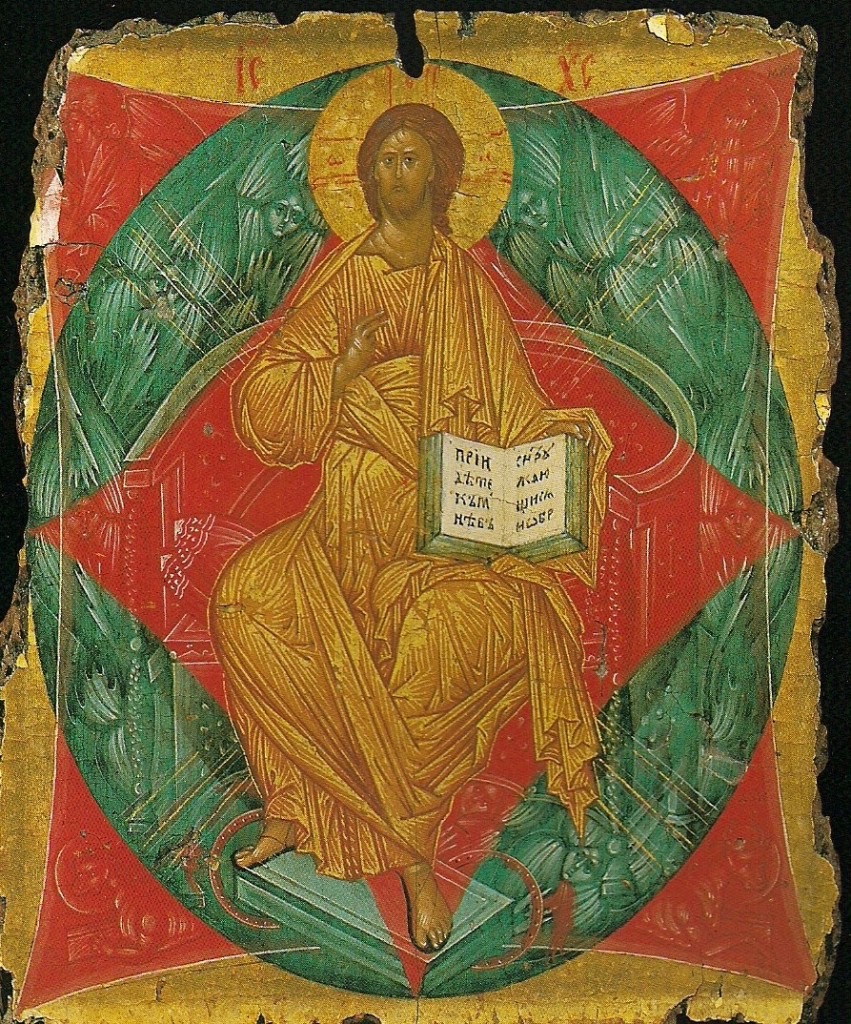
Christ in Majesty by Andrei Rublev, 1410 November 28, 2021 Lectionary Texts — Year C
Jeremiah 33:14-16
Psalm 25:1-10
I Thessalonians 3:9-13
Luke 21:25-36Today marks the beginning of a new year — the liturgical church calendar begins with the season of Advent. We step out this first Sunday in the hope of what is to come — and that ultimate hope focuses us on Christ and the time when He will come “with power and blazing glory” as He tells the disciples in the Luke 21 passage.
I present to you a Christian icon form originating in the early centuries of the faith. The church of the past would have been quite familiar with this image of Christ. Known as Christ Enthroned, Christ in Power, Christ in Glory or Christ in Majesty, we see Christ seated on a throne dressed in gold, rays of glory shining out from behind him, his feet resting on a platform supported by spinning wheels surrounded by angels (we can see their faces among a flurry of wings) and the four creatures (faintly in the red at the image corners. This is an illustration of the vision from Ezekiel 1-3 where Ezekiel sees the Son of Man in glory.
Icons are important images not only for what they illustrate. They also teach and contain important symbolism. A quick walk through this particular form shows us a red diamond shape behind Christ symbolizing earth and a blue oval representing heaven. These are a nod to Christ’s dual nature of both God and human. Then we have those four creatures long understood to represent the four Gospel writers. Here the red rectangle they “stretch” out is their presentation of Christ to the world. We see the red letters at the top of the image “IC XC” — these are the Greek abbreviation for the name “Jesus Christ”. Letters on the cross shape within Christ’s halo spell “I AM” in Greek. The book held is an open Gospel. Christ gestures a blessing with his right hand.
Rublev is considered the master of the Russian icon tradition and his version of this form here is no exception. New for me looking at this icon was the symbolism of “heaven is round/earth is square”. Early church structures such as the Hagia Sophia were constructed precisely around this symbolism — a square base with a round dome on top. I continue to be amazed at how theology is repeatedly incorporated into the things early Christians created. This really resonates with me. I find myself wanting to do the same in my work.
To ponder… What about this image is hopeful? grounding? centering?
There will be earth-shattering events —the heavens themselves will seem to be shaken with signs in the sun, in the moon, and in the stars. And across the earth the outsider nations will feel powerless and terrified in the face of a roaring flood of fear and foreboding, crashing like tidal waves upon them. “What’s happening to the world?” people will wonder. The cosmic order will be destabilized. And then, at that point, they will see the Son of Man coming in a cloud with power and blazing glory. So when the troubles begin, don’t be afraid. Look up—raise your head high, because the truth is that your liberation is fast approaching. —
LUKE 21:25-28
 Visio Divina
You must be logged in to post a comment.