-
Ordinary Time: Proper 9
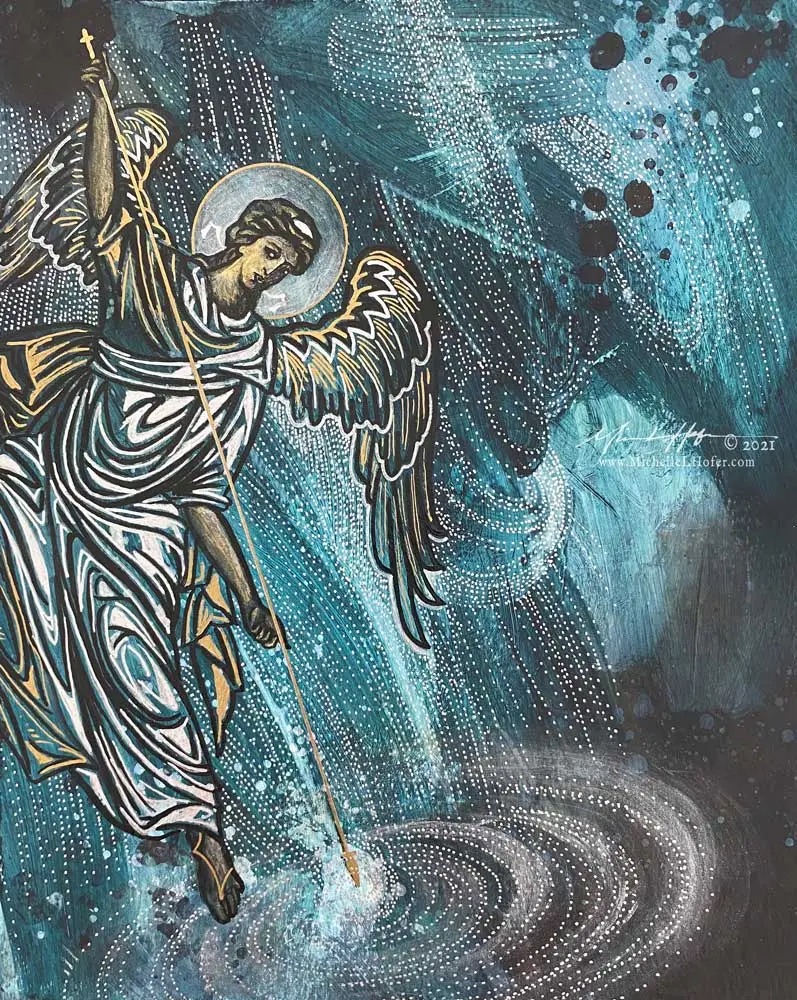
Divine Stirring by Michelle L Hofer — mixed media painting on paper, 8 x 10 inches, 2021. July 3, 2022 Lectionary Texts — Year C
2 Kings 5:1-14 and Psalm 30 • Isaiah 66:10-14 and Psalm 66:1-9 • Galatians 6:(1-6), 7-16 • Luke 10:1-11, 16-20
View LectionaryEternal One, my True God, I cried out to You for help; You mended the shattered pieces of my life. You lifted me from the grave with a mighty hand, gave me another chance, and saved me from joining those in that dreadful pit. Sing, all you who remain faithful! Pour out your hearts to the Eternal with praise and melodies; let grateful music fill the air and bless His name. — Psalm 30:2-4
The piece I have chosen this week is the painting I completed as a prayer for healing in the midst of the Covid-19 pandemic. This image of an angel stirring waters originates from the story found in John’s gospel:
In Jerusalem they came upon a pool by the sheep gate surrounded by five covered porches. In Hebrew this place is called Bethesda. Crowds of people lined the area, lying around the porches. All of these people were disabled in some way; some were blind, lame, paralyzed, or plagued by diseases[; and they were waiting for the waters to move. From time to time, a heavenly messenger would come to stir the water in the pool. Whoever reached the water first and got in after it was agitated would be healed of his or her disease]. — John 5:2-4
I found the theme of healing — both seeking it (Naaman) and administering it (the seventy sent out in pairs) in this week’s texts. I am most curious about Jesus instructions to cure the sick and say to them, “The kingdom of God has come near to you.” Some questions are arising for me around this and I present them to you to consider as you contemplate this stirring, healing angel and our lectionary texts:
Was this statement included as a part of the healing process?
Does healing bring the kingdom closer?
Have you experienced a healing that you would say also brought some sense of divine connection with it?Practicing Visio Divina:
- View the artwork
What do you see?
Note shapes – color – style – movement
What stands out for you?
What are you curious about?
What questions do you have?
Hold back any feelings – judgments – opinions - Read the accompanying scripture and look over the artwork again
What connections do you make?
Between the image and text?
What is coming to mind from your own experience?
What feelings are rising in you?
Are you uncomfortable with something?
There are no right or wrong answers - Read the scripture again and explore the artwork a third time
What do you hear?
What is God saying to you?
What do you wish to speak to God?
What blessing or prayer is rising in you?
- View the artwork
-
Ordinary Time: Proper 8

Elijah on the Fiery Chariot by Unknown Artist — 39 x 25 inches, 16th century, Tretyakov Gallery in Moscow, Russia. June 26, 2022 Lectionary Texts — Year C
2 Kings 2:1-2, 6-14
Psalm 77:1-2, 11-20
1 Kings 19:15-16, 19-21
Psalm 16
Galatians 5:1, 13-25
Luke 9:51-62
View Lectionary…and Elisha abandoned his oxen and chased after Elijah.
Elisha: Before I leave, allow me to tell my parents goodbye, and then I will journey with you.
Elijah: Go then. Tell them goodbye. What have I done to you?
Elisha returned, but not to his parents. He killed his oxen, then he used the equipment (harness, yoke, and reigns) to prepare a fire and cook all the ox meat. He offered the food to everyone, and they feasted. Elisha then joined Elijah and became his apprentice. — 1 Kings 19:20-21A Third Volunteer: I’ll come, Jesus. I’ll follow You. But just let me first run home to say good-bye to my family.
Jesus: Listen, if your hand is on the plow but your eyes are looking backward, then you’re not fit for the kingdom of God. — Luke 9:61-62The lectionary provides a beautiful way of helping us compare and contrast Scripture passages. I love this. We receive this week the story of Elisha being called by Elijah who requests to go say goodbye to his parents but then changes his mind, burns his equipment and sacrifices his team of oxen to follow Elijah. Elisha exhibits the same level commitment when the time of Elijah’s departure grows near. He refuses to leave Elijah’s side. Compare and contrast these with Jesus’ stories of excuses encouraging great commitment to following him.
The icon I have selected features the incredible event of Elijah’s departure and so wonderfully conveys Elisha’s commitment to his mentor. Elisha is literally hanging on to Elijah’s cloak as the vibrant fiery red mandorla (a circle or semi-circle shape symbolizing an opening between the realms of heaven and earth) opens to take Elijah up into heaven. When contemplated with the words of Christ from the Luke passage, this icon gives us a visual metaphor of the fervent follower Jesus desires.
I find another metaphor between the Elijah-Elisha story and the Gospel text in Elijah’s cloak. It is the object passed on from Elijah to Elisha and with it the power of Elijah is given to Elisha. This reminds me of the Spirit given to those who followed Christ upon his departure from them.
I hope you will enjoy digging into the texts and this week’s image as I have. I am adding this icon to my list of subjects I would like to creatively explore.Practicing Visio Divina:
- View the artwork
What do you see?
Note shapes – color – style – movement
What stands out for you?
What are you curious about?
What questions do you have?
Hold back any feelings – judgments – opinions - Read the accompanying scripture and look over the artwork again
What connections do you make?
Between the image and text?
What is coming to mind from your own experience?
What feelings are rising in you?
Are you uncomfortable with something?
There are no right or wrong answers - Read the scripture again and explore the artwork a third time
What do you hear?
What is God saying to you?
What do you wish to speak to God?
What blessing or prayer is rising in you?
2 Kings, Christian art, Christian Icon, cloak, committment, Elijah, Elijah on the Fiery Chariot, Elisha, fiery chariot, fiery horses, Galatians, heaven, icon art, Jesus, Lectionary, Luke, mandorla, mentor, Moscow, Ordinary Time, Proper 8, Psalms, Russia, sacrifice, Spirit, Tretyakov Gallery, visio divina, Year C - View the artwork
-
Ordinary Time: Proper 7

The Good Way: South to the Sea by Michelle L Hofer — mixed media on basswood panel, 12 x 12 inches, 2021. June 19, 2022 Lectionary Texts — Year C
I Kings 19:1-4, (5-7), 8-15a
Psalm 42 and 43
Isaiah 65:1-9
Psalm 22:19-28
Galatians 3:23-29
Luke 8:6-39
View LectionaryIn the roar of Your waterfalls, ancient depths surge, calling out to the deep. All Your waves break over me; am I drowning? Yet in the light of day, the Eternal shows me His love. When night settles in and all is dark, He keeps me company— His soothing song, a prayerful melody to the True God of my life. — Psalm 42:7-8
Last fall I created a small series of landscapes titled The Good Way. In essence, these images were a way for me to explore the the dualities of life, our experiences, our world. What I mean by this is exemplified in the texts for today:
- feeling alone and feeling God near
- words of assurance and words of warning/judgment
- crying out for help and rejection of help offered
- rejoicing in what Jesus has done and freaking out over the same
South by the Sea is a dual tone landscape. Some of it is in full color while other places are monotone done in charcoal and black ink.
You will also spot a raven if you look closely enough. We are accustomed to seeing these creatures as bad omens… something is going to happen and it ain’t gonna be good. I’ve done a lot of art centered on ravens especially Elijah’s raven — the raven bringing Elijah bread in the desert. Ravens hold a lot of personal symbolism for me. They represent Divine provision in our most vulnerable times. So while they may signal a treacherous path ahead, they also serve as a sign of encouragement.
The message I most wanted to convey with South by the Sea and the Good Way Series is this:
The good way is more often than not the path fraught with difficulty and doubt… but we are not without hope and God’s assurance.Practicing Visio Divina:
- View the artwork
What do you see?
Note shapes – color – style – movement
What stands out for you?
What are you curious about?
What questions do you have?
Hold back any feelings – judgments – opinions - Read the accompanying scripture and look over the artwork again
What connections do you make?
Between the image and text?
What is coming to mind from your own experience?
What feelings are rising in you?
Are you uncomfortable with something?
There are no right or wrong answers - Read the scripture again and explore the artwork a third time
What do you hear?
What is God saying to you?
What do you wish to speak to God?
What blessing or prayer is rising in you?
-
Trinity Sunday
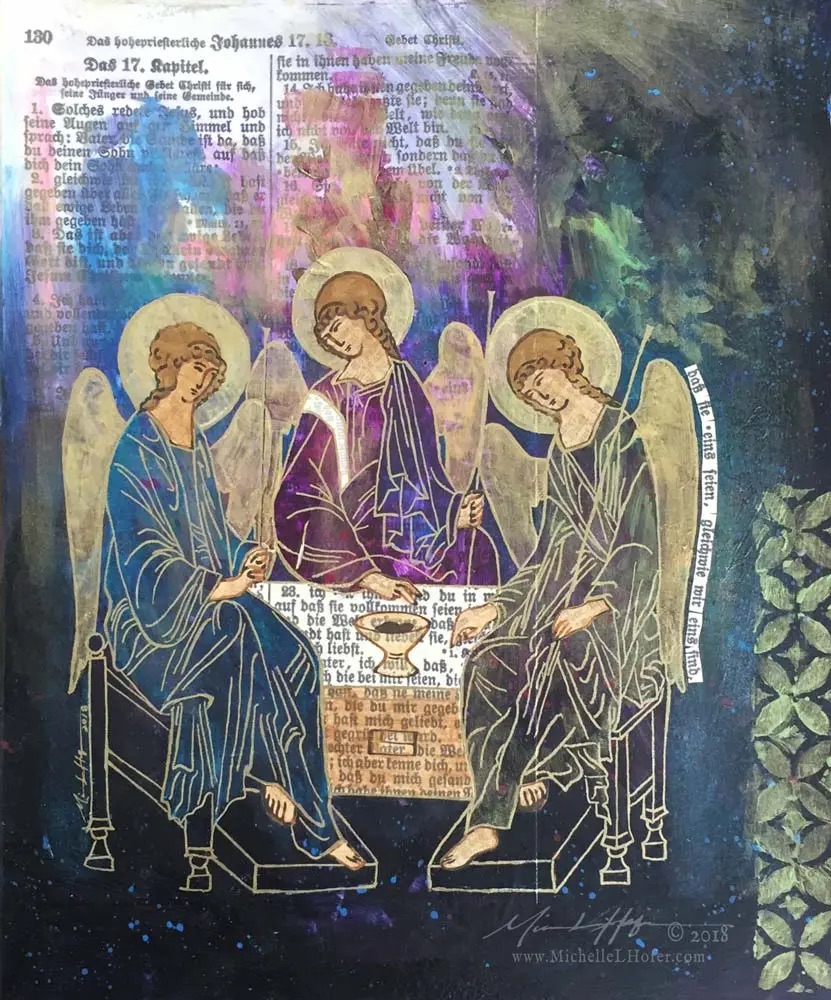
We Are One (Holy Trinity) by Michelle L Hofer — mixed media collage on mat board, 10 1/4 x 12 inches, 2018. June 12, 2022 Lectionary Texts — Year C
Proverbs 8:1-4, 22-31
Psalm 8
Romans 5:1-5
John 16:12-15
View LectionaryBack during Christmas and Epiphany of this liturgical year, I introduced two collages made from copied text from a German Luther Bible I found in the paper bin of my local recycling center. Those pieces plus this one (three in total) were my simple attempt to reunite images with the Word. This artwork combines the text of John chapter 17 with Andrei Rublev’s famous icon of Holy Trinity. It is not THE Holy Trinity, but rather a portrayal of the Hospitality of Abraham — God visiting Abraham in the form of three persons to deliver the news he and Sarah will have a son. Rublev expanded this image into a visual symbol for the triune nature of God.
The mysterious way in which these three figures are communing and interactions with each other and similarity/differences in the figures portrays the concept of one God in three persons. Each figure holds a staff in the left hand indicative of their joint authority over all things. On the table sits a single bowl of food, a sign of their oneness and equally a symbol of Christ’s sacrifice. The translation of the German text along the wing reads: …that they may be one even as we are one. — John 17:22
The figure on the left represents the Father. With the right hand, the Holy Parent gestures a sign of blessing toward the figure representing Christ at center. A band of gold across his shoulder distinguishes Christ as a ruler or king. Christ gestures towards the chalice with his right hand indicating his divine mission to become the sacrificial lamb who takes away the sins of the world. His gesture of two fingers is a reference to his dual nature – fully man and fully God. The Holy Spirit is represented by the figure who sits at left. Their hand gestures downward, perhaps to the small opening at the front of the altar table, a space indicating the customary placement of relics and the dwelling place of the saints as mentioned in the book of Revelation.
I have long treasured this quote in regards to that rectangular opening…
We must give all our attention to that open space because it is the place to which the Spirit points and where we become included in the divine circle… I come to the realization that this rectangular space speaks about the narrow road leading to the house of God. It is the road of suffering. While it’s four corners remind us that it represents the created order, including all people from the north, south, east, and west, its position in the altar signifies that there is room around the divine table only for those who are willing to become participants in the Divine sacrifice by offering their lives as a witness to the love of God. — Henri Nouwen
O Eternal, our Lord, Your majestic name is heard throughout the earth; Your magnificent glory shines far above the skies. When I gaze to the skies and meditate on Your creation — on the moon, stars, and all You have made, I can’t help but wonder why You care about mortals — sons and daughters of men — specks of dust floating about the cosmos. — Psalm 8:1,3-4
Practicing Visio Divina:
- View the artwork
What do you see?
Note shapes – color – style – movement
What stands out for you?
What are you curious about?
What questions do you have?
Hold back any feelings – judgments – opinions - Read the accompanying scripture and look over the artwork again
What connections do you make?
Between the image and text?
What is coming to mind from your own experience?
What feelings are rising in you?
Are you uncomfortable with something?
There are no right or wrong answers - Read the scripture again and explore the artwork a third time
What do you hear?
What is God saying to you?
What do you wish to speak to God?
What blessing or prayer is rising in you?
- View the artwork
-
Day of Pentecost
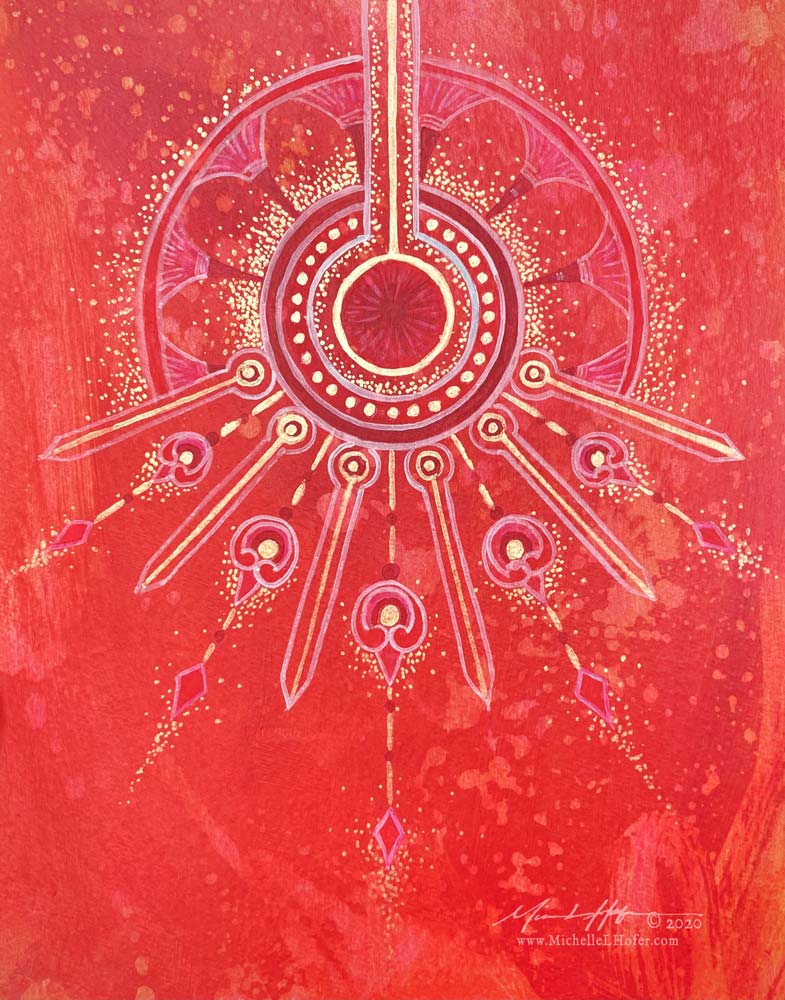
Descent of the Holy Spirit by Michelle L Hofer — mixed media painting on paper, 8 x 10 inches, 2020. June 5, 2022 Lectionary Texts — Year C
Acts 2:1-21 or Genesis 11:1-9
Psalm 104:24-34,35b
Romans 8:14-17 or Acts 2:1-21
John 14:8-17, (25-27)
View LectionaryMy own depiction of the Holy Spirit descending at Pentecost rises out of a symbol found in Christian icon art (see icon image below). At the very top of the these icons there is a semicircle (known as a mandorla) with rays extending from it. Sometimes there are flames at the end of these rays. This symbolizes the sending of the Holy Spirit to earth from God in heaven.
My expression of this visual element is decorative and playful. Set on a flaming bright neon orange-pink background, a beam descends into a central circle shape from which arrow and sword-like rays extend. The overall design is accented boldly with gold lines and energetic dot work.
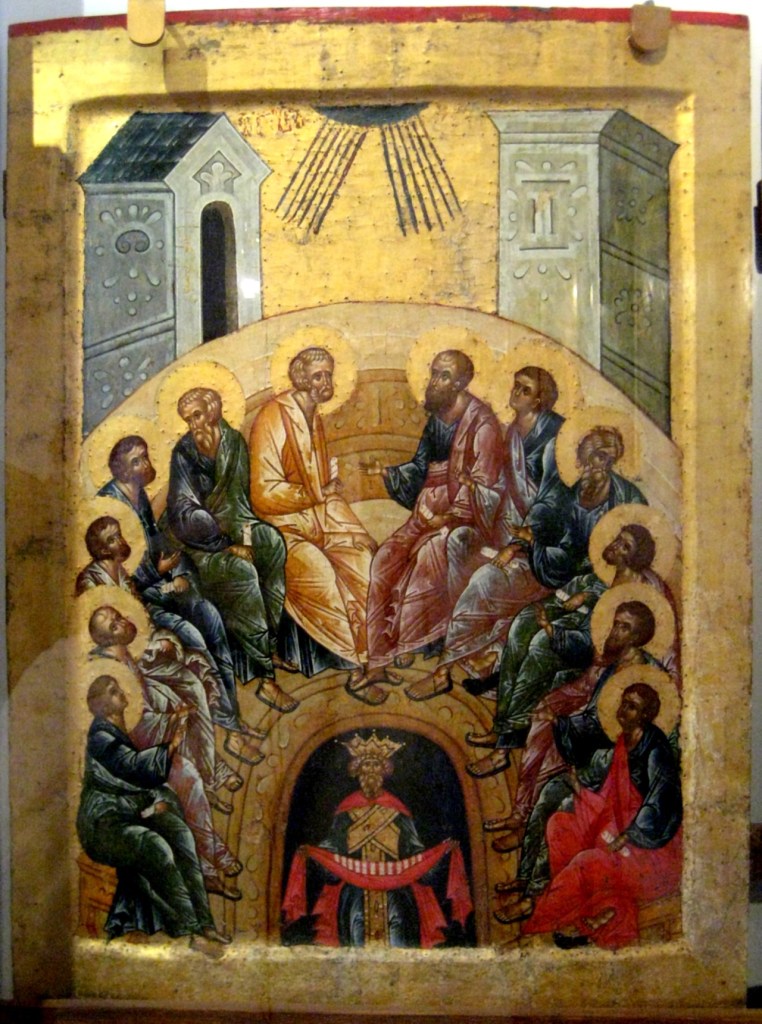
Pentecost icon, c.1497 — Monastery of St. Cyril on the White Lake, Northern Russia. You may be interested to know a bit more about the rest of the elements found in a Pentecost icon:
The twelve apostles in the Pentecost icon are harmoniously seated in a semi-circle beneath the Spirit-emitting mandorla. They are not rendered in proper perspective with those seated farther back as smaller, but rather all are equally sized and uniquely posed. This is done to emphasize unity in diversity. Each apostle holds a scroll symbolizing their contributions to the New Testament (in some icons the four gospel writers will hold a book volume rather than a scroll). At the top of the semi-circle of figures is an open seat. This is Christ’s seat, but since he has ascended it is now empty and emphasizes the need for Christ’s presence among the apostles through the Holy Spirit.
Modern versions of this icon will sometimes feature a dove to represent the Holy Spirit. This would be an incorrect addition according to the icon tradition as on Pentecost the Holy Spirit appeared as tongues of fire and the dove is only a specific form seen on the occasion of Christ’s baptism.
Lastly, at the bottom of the Pentecost icon is an aged man standing in a tomb-like space. This man is know as Kosmos and he represents the entirety of humankind. Though he wears a crown signifying his authority over creation, he is trapped in the darkness of sin. On the blanket he holds are the scrolls of Holy Scripture that will teach him and ultimately free him from darkness and death.
Jesus: I will ask the Father to send you another Helper, the Spirit of truth, who will remain constantly with you. The world does not recognize the Spirit of truth, because it does not know the Spirit and is unable to receive Him. But you do know the Spirit because He lives with you, and He will dwell in you. — John 14:16-17
Practicing Visio Divina:
- View the artwork
What do you see?
Note shapes – color – style – movement
What stands out for you?
What are you curious about?
What questions do you have?
Hold back any feelings – judgments – opinions - Read the accompanying scripture and look over the artwork again
What connections do you make?
Between the image and text?
What is coming to mind from your own experience?
What feelings are rising in you?
Are you uncomfortable with something?
There are no right or wrong answers - Read the scripture again and explore the artwork a third time
What do you hear?
What is God saying to you?
What do you wish to speak to God?
What blessing or prayer is rising in you?
- View the artwork
-
Seventh Sunday of Easter
Vision of the New Jerusalem, Donald Jackson, ©2011 The Saint John’s Bible, Saint John’s University, Collegeville, Minnesota, USA. – This link to the Abbey blog will allow you to open and explore the image in another window as I do not have permission to post it. You will be able to click on the image to enlarge. I do my best to read and honor copyright and permissions on Visio Divina.
May 29, 2022 Lectionary Texts — Year C
Acts 16:16-34
Psalm 97
Revelation 22:12-14,16-17,20-21
John 17:20-26
View LectionaryThrough this Easter season, we have traveled across the ages and the globe looking at the work of artists compelled to give visual to the glorious imagery found in John’s Revelation. Our journey began with a story of my own experience in a small Bosnian art gallery. I had an equally amazing experience tied to Donald Jackson’s Vision of the New Jerusalem.
I visited the vault at Saint John’s University set up for the preservation and protection of The Saint John’s Bible. If you are unfamiliar, The Saint John’s Bible is an illuminated hand-crafted manuscript of the entire Holy Scriptures commissioned by Saint John’s Abbey and Saint John’s University of Collegeville, Minnesota. A work of this magnitude and quality has not been undertaken for several centuries. It is a revival of a long gone artform having faded with the dawn of the printing press. Visiting the vault where this incredible volume resides was such a life-giving experience for me. Myself and the few individuals who went were able to view the exquisite workmanship as pages of the Bible where laid out before us to explore up close. The detail… the colors… the gold… so rare and precious.
Donald Jackson, a world renowned calligrapher (in fact he is calligrapher to the Queen of England) headed up this project. It had been his dream since he was a teenager to inscribe and illuminate the Bible. Though the entire work is the collaboration of numerous artists and calligraphers, Jackson himself competed both text and illumination for all of Revelation.
This Benedictine community who commissioned Donald names the practice of visio divina as an important aspect of The Saint John’s Bible:
The illuminations are not illustrations, they are spiritual meditations on a text. — Father Michael Patella
The city here is laid out like a map of sorts. We see the streets of gold, floating angel forms, the tree of life with golden fruit, a river-like background, and God enthroned. Tiny geometric shapes enter at the bottom of the image and serve to represent the saints entering the New Jerusalem. You will note a pair of crosses in the lower right hand corner. These were added during the presentation service of the completed Bible and follow a Judaic tradition whereby the one who commissioned a new scroll would place the final mark. Both the Abbot of Saint John’s Abbey and the president of Saint John’s University burnished these Benedictine crosses and signified the work’s completion in 2011.
The Anointed One: See, I am coming soon, and I will bring My reward with Me. I will pay back every person according to the deeds he has done. I am the Alpha and Omega, the First One and the Last One, the beginning and the end. Blessed are those who wash their garments. In the end, they have rightful access to the tree of life and will enter the city through its gates. — Revelation 22:12-14
Practicing Visio Divina:
- View the artwork
What do you see?
Note shapes – color – style – movement
What stands out for you?
What are you curious about?
What questions do you have?
Hold back any feelings – judgments – opinions - Read the accompanying scripture and look over the artwork again
What connections do you make?
Between the image and text?
What is coming to mind from your own experience?
What feelings are rising in you?
Are you uncomfortable with something?
There are no right or wrong answers - Read the scripture again and explore the artwork a third time
What do you hear?
What is God saying to you?
What do you wish to speak to God?
What blessing or prayer is rising in you?
Acts, Bible art, Bible illustration, calligraphy, Christian art, Donald Jackson, heaven, illuminated Bible, illumination, John, Lectionary, Psalms, Revelation, Saint John's Abbey, Saint John's University, Seventh Sunday of Easter, The New Jerusalem, The Saint John's Bible, visio divina, vision, Vision of the New Jerusalem, Year C - View the artwork
-
Ascension Day

The Ascension of Christ (one of seven) possibly by Jean III Pénicaud (French, died 1570) — painted enamel on copper – partly gilt, 2 3/4 x 2 1/4 inches, mid-16th century. Image by the Metropolitan Museum of Art. May 26, 2022 Lectionary Texts — Year C
Acts 1:1-11
Psalm 47 or Psalm 93
Ephesians 1:15-23
Luke 24:44-53
View LectionaryThe piece I have chosen for this special day is a bit of a special piece in itself. This is an enamel work, a very unique art form that arose in France during medieval times. Using materials similar to those used in stained glass, the artisan applies and heats it to create lovely detailed works. Enamelware became quite popular during the Renaissance for the design and decoration of many church related items such as reliquaries, small boxes and chests, ornamental book covers, candlesticks, and small devotional images. Several generations of the Pénicaud family ran a prolific studio in the city of Limoges, France.
The Ascension of Christ is part of a series of seven miniature images from the life of Christ based on the woodcuts of Albrecht Altdorfer and Albrecht Dürer. Each enameled piece is under three inches in size. As in Altdorfer’s Ascension, we see only Christ’s feet and the hem of his robe as he floats away from the disciples and his mother Mary who had been gathered around him. It is a most unusual depiction of the Ascension. It is not focused on Christ rising in full glory to the throne that awaits him. The composition of this scene leaves us to make sense of what is happening along with Christ’s followers.
God has placed all things beneath His feet and anointed Him as the head over all things for His church. This church is His body, the fullness of the One who fills all in all. — Ephesians 1:22-23
Practicing Visio Divina:
- View the artwork
What do you see?
Note shapes – color – style – movement
What stands out for you?
What are you curious about?
What questions do you have?
Hold back any feelings – judgments – opinions - Read the accompanying scripture and look over the artwork again
What connections do you make?
Between the image and text?
What is coming to mind from your own experience?
What feelings are rising in you?
Are you uncomfortable with something?
There are no right or wrong answers - Read the scripture again and explore the artwork a third time
What do you hear?
What is God saying to you?
What do you wish to speak to God?
What blessing or prayer is rising in you?
- View the artwork
-
Sixth Sunday of Easter
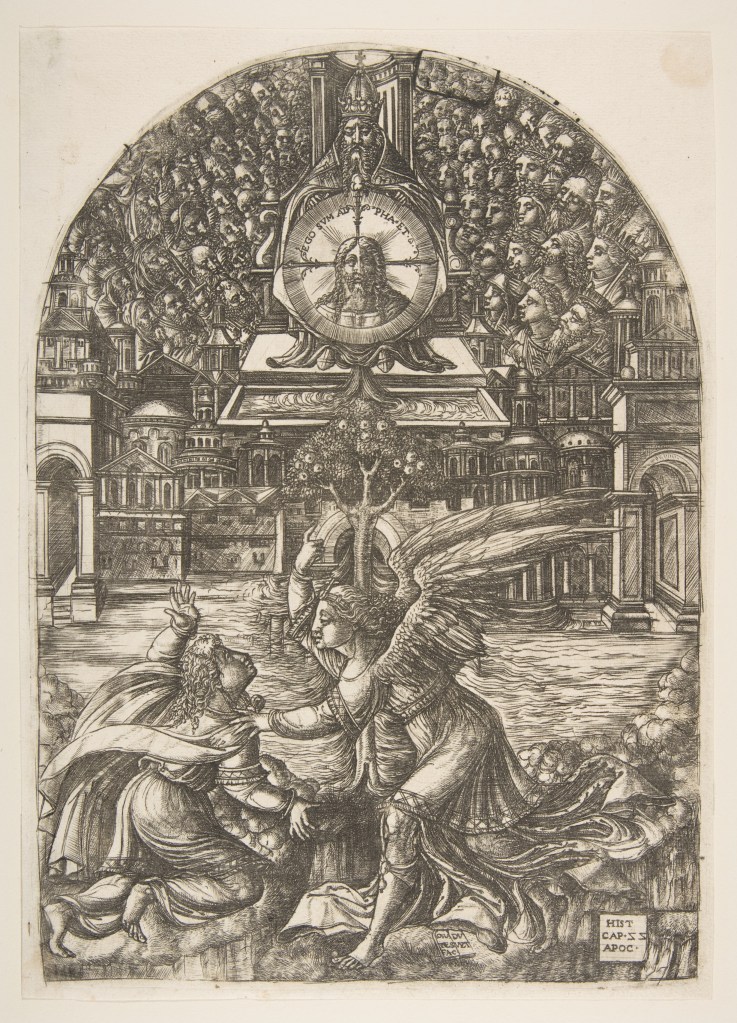
The Angel shows Saint John the Fountain of Living Water, from the Apocalypse by Jean Duvet (1485–after 1561) — engraving, 12 1/16 x 8 5/8 inches, no date. May 22, 2022 Lectionary Texts — Year C
Acts 16:9-15
Psalm 67
Revelation 21:10,22 – 22:5
John 14:23-29 or John 5:1-9
View LectionaryI am learning that for many serious European artists from the Renaissance and forward, it was a crowning achievement to complete a set of works depicting the Book of Revelation. This is true of the French engraver, Jean Duvet who produced 23 Apocalypse engravings sometime around 1855. In the opening image, Duvet portrays Revelation author John as himself, now an old man who tiredly rests his head on his hand and points to the completed book on the table in front of him. An inscription on this plate reads: The Fates are pressing, already sight fails, the mind remains victorious, and the great work is completed.
Duvet’s engraving corresponding to the Revelation passage from today’s lectionary reading depicts God on the throne atop the buildings of the New Jerusalem. God, depicted here as an older man, holds a large disk bearing the Lamb/Christ’s image. Saints and elders occupy the space surrounding the throne. We see the river emerge from under God’s garments, flow into a large rectangular pool and then out through an arch below the city filling an even larger area from which the tree of life grows up. John and the angel appear in the foreground frozen in an moment of urgency and excitement. Garments and hair billow as if there is a strong wind. While Duvet’s style clearly reflects Renaissance influence, there is a pleasing symmetry along with a skewed perspective to entire composition. This is more in keeping with Christian icon art which purposely flattens a scene to indicate a reality beyond the familiar earthly realm.
Practicing Visio Divina:
- View the artwork
What do you see?
Note shapes – color – style – movement
What stands out for you?
What are you curious about?
What questions do you have?
Hold back any feelings – judgments – opinions - Read the accompanying scripture and look over the artwork again
What connections do you make?
Between the image and text?
What is coming to mind from your own experience?
What feelings are rising in you?
Are you uncomfortable with something?
There are no right or wrong answers - Read the scripture again and explore the artwork a third time
What do you hear?
What is God saying to you?
What do you wish to speak to God?
What blessing or prayer is rising in you?
Jesus: Anyone who loves Me will listen to My voice and obey. The Father will love him, and We will draw close to him and make a dwelling place within him. My peace is the legacy I leave to you. I don’t give gifts like those of this world. Do not let your heart be troubled or fearful. — John 14:23,27
- View the artwork
-
Fifth Sunday of Easter
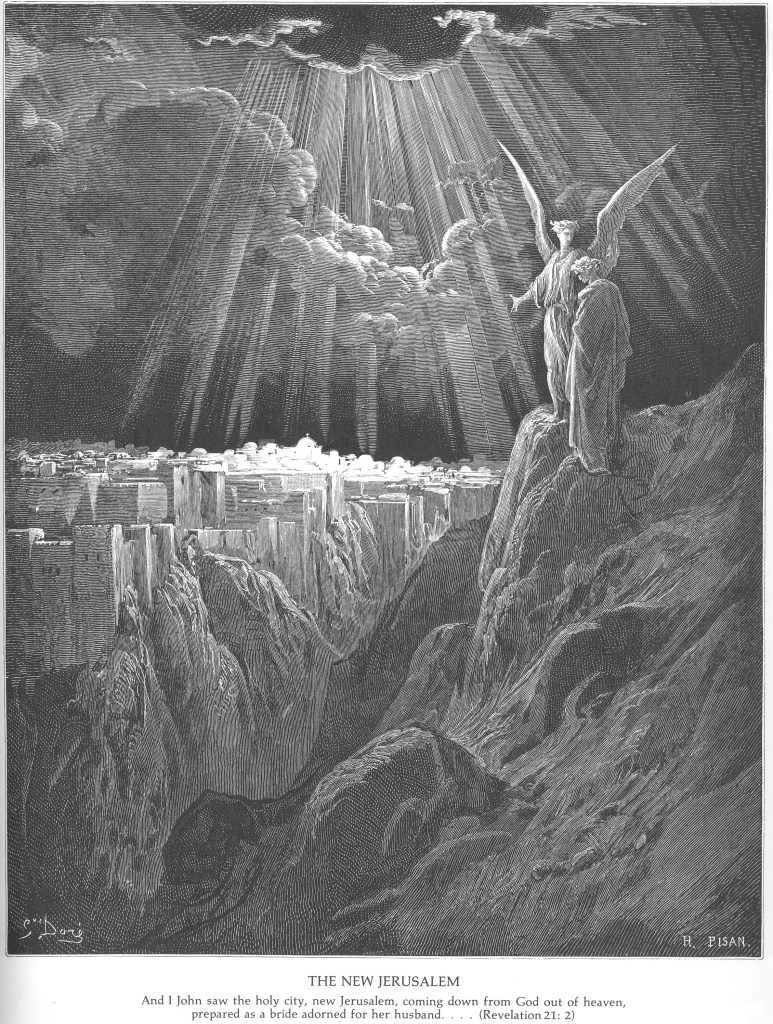
The New Jerusalem by Gustave Doré, woodcut engraving completed by H. Pisan, originally published in France, 1865. May 15, 2022 Lectionary Texts — Year C
Acts 11:1-18
Psalm 148
Revelation 21:1-6
John 13:31-35
View LectionaryYears ago, I organized a display of Bibles for Lent and Easter. The largest Bible in the collection was brought by a woman and this particular Bible had been in her family many, many years. It was a beautiful volume containing over 200 illustrations by the French artist, Gustave Doré. That’s how I first learned of this artist. Although he died at age 51, Doré had been extremely prolific. He was proficient in watercolor, oil painting and wood engraving. Doré’s art career began when he was hired to draw cartoons for a French newspaper at age 15.
The final illustration for Doré’s Bible series is this scene… standing high on a rocky ledge, John and his angel guide overlook a massive city. Light streaming down from above through billowy clouds brilliantly illuminates the buildings at the heart of the city. A cross can be seen atop the dome at center.
You can find the entire body of Bible illustrations in high resolution by Gustave Doré here >. These were wonderfully compiled by Felix Just, S.J., Ph.D.
Practicing Visio Divina:
- View the artwork
What do you see?
Note shapes – color – style – movement
What stands out for you?
What are you curious about?
What questions do you have?
Hold back any feelings – judgments – opinions - Read the accompanying scripture and look over the artwork again
What connections do you make?
Between the image and text?
What is coming to mind from your own experience?
What feelings are rising in you?
Are you uncomfortable with something?
There are no right or wrong answers - Read the scripture again and explore the artwork a third time
What do you hear?
What is God saying to you?
What do you wish to speak to God?
What blessing or prayer is rising in you?
And I heard a great voice, coming from the throne.
A Voice: See, the home of God is with His people. He will live among them; They will be His people, And God Himself will be with them. The prophecies are fulfilled: He will wipe away every tear from their eyes. Death will be no more; Mourning no more, crying no more, pain no more, For the first things have gone away. And the One who sat on the throne announced to His creation,
The One: See, I am making all things new. (turning to me) Write what you hear and see , for these words are faithful and true. — Revelation 21:3-5 - View the artwork
-
Fourth Sunday of Easter
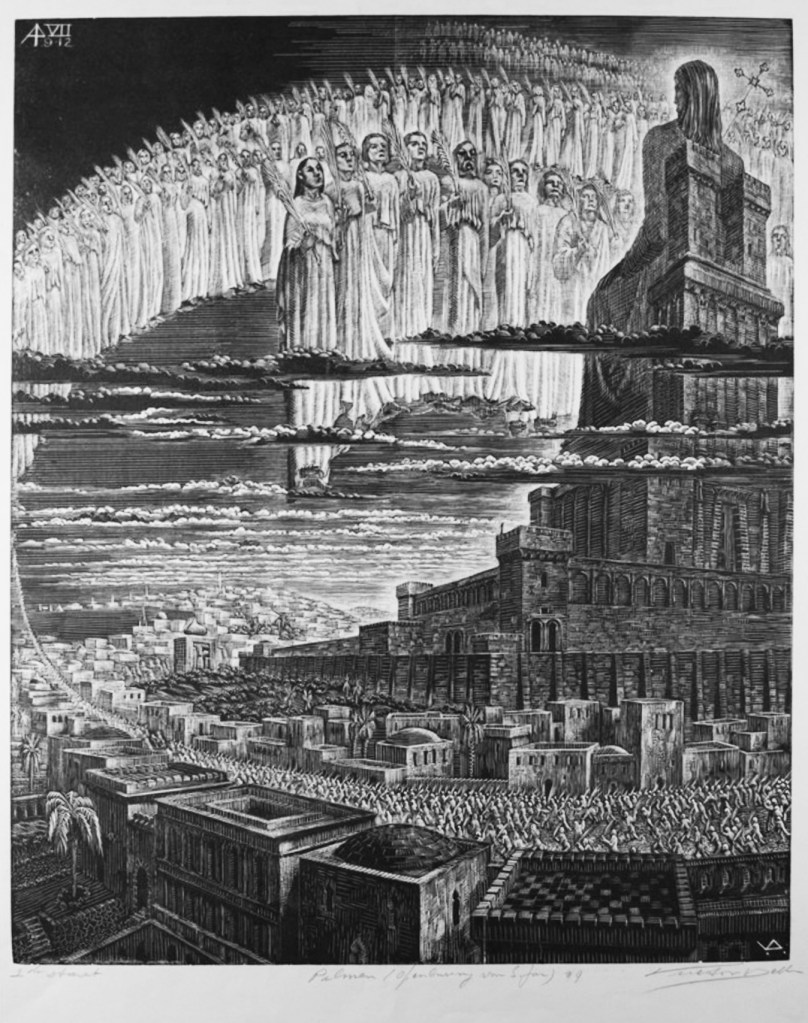
Palms by Victor Delhez — copper plate engraving, 13 x 15.7 inches, after 1956
Link to websiteMay 8, 2022 Lectionary Texts — Year C
Acts 9:36-43
Psalm 23
Revelation 7:9-17
John 10:22-30
View LectionaryThe scene is impressive… Set in the New Jerusalem, a massive crowd of white-robed palm bearers makes its way down a street and straight into the sky. United in a song of unending praise, the crowd appears before the Lamb seated on the throne. From our vantage point, we see Christ sitting above the clouds with his back towards us. The throne is atop a massive temple-like structure.
This marvelous envisioning of the Revelation text comes to us from the South American artist, Victor Delhez, a skilled engraver who served many years as a professor at the Academy of Fine Arts at the National University of Cuyo in Argentina. Inspired by his friendships with individuals among the indigenous Quechua peoples, Delhez created over 100 Gospel illustrations set in the Bolivian landscape. A Buenos Aires publisher printed an exquisitely bound Spanish Gospel volume featuring 90 of the Delhez’s images in 1944. Sometime after 1956, Delhez began working on an Apocalypse series for the Book of Revelation. Palms is one of 31 plates in that collection. If you have some spare time, I would highly recommend you view the complete set of engravings.
Practicing Visio Divina:
- View the artwork
What do you see?
Note shapes – color – style – movement
What stands out for you?
What are you curious about?
What questions do you have?
Hold back any feelings – judgments – opinions - Read the accompanying scripture and look over the artwork again
What connections do you make?
Between the image and text?
What is coming to mind from your own experience?
What feelings are rising in you?
Are you uncomfortable with something?
There are no right or wrong answers - Read the scripture again and explore the artwork a third time
What do you hear?
What is God saying to you?
What do you wish to speak to God?
What blessing or prayer is rising in you?
Jesus: I have told you, and you do not believe. The works I am doing in My Father’s name tell the truth about Me. You do not listen; you lack faith because you are not My sheep. My sheep respond as they hear My voice; I know them intimately, and they follow Me. I give them a life that is unceasing, and death will not have the last word. Nothing or no one can steal them from My hand. My Father has given the flock to Me, and He is superior to all beings and things. No one is powerful enough to snatch the flock from My Father’s hand. The Father and I are one. — John 10:25-30
- View the artwork

 Visio Divina
You must be logged in to post a comment.