-
Ordinary Time: Proper 19
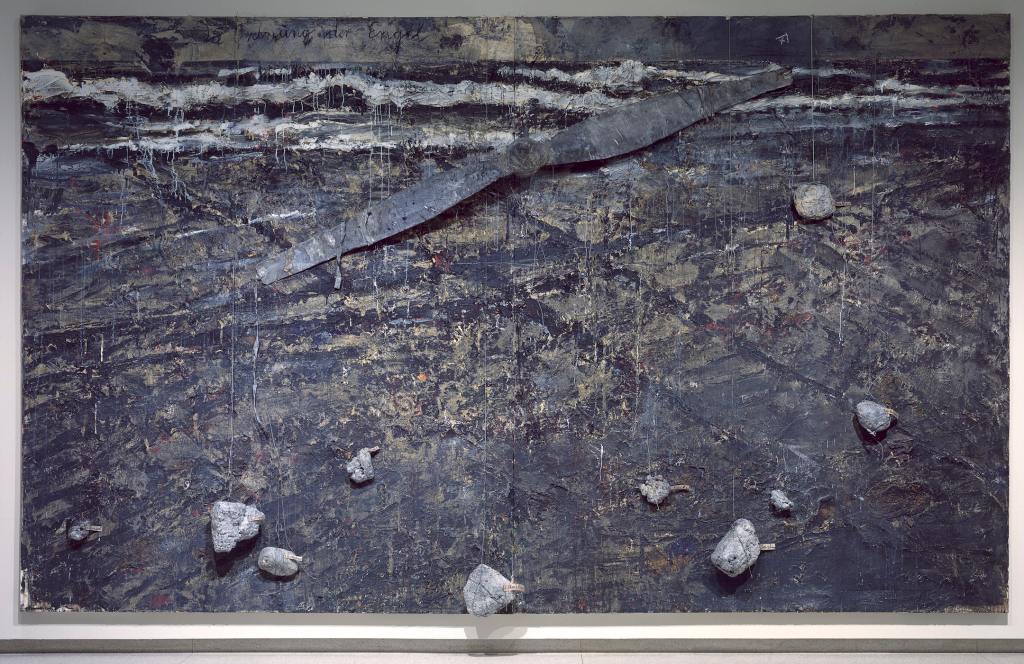
Die Ordnung der Engel (The Hierarchy of Angels) by Anselm Kiefer — Oil, emulsion, shellac, acrylic, chalk, lead propeller, curdled lead, steel cables, band-iron, and cardboard on canvas, 133-1/2 x 220-7/8 x 22-3/4 inches unframed, 1985-1987. Photo by Walker Art Center. September 11, 2022 Lectionary Texts — Year C
Jeremiah 4:11-12, 22-28 and Psalm 14 • Exodus 32:7-14 and Psalm 51:1-10 • 1 Timothy 1:12-17 • Luke 15:1-10
View LectionaryImage description: A massive canvas (over 11 x 18 feet in size) portrays a dark and brooding landscape. A grey-blue cloudy sky appears in a thin strip at the very top of the piece below which a equal strip of ocean with foamy waves meets a flat beach. The muddy looking beach is marked with ruts or tracks moving in perpendicular directions. The paint has been applied heavily and thickly with much of it also running or dripping downward. A large three-dimensional airplane propeller of two blades is attached at the shore line. It tilts slightly with the right blade higher. Both blades are bent so the ends touch the canvas. Suspended by wire cables from the top of the canvas are nine curdled lead “stones” of various sizes. These are hung at various lengths mostly near the bottom of the artwork. Each stone is labeled with a small, hand-written paper tag representing the orders of angels: angels, archangels, principalities, powers, virtues, dominions, thrones, cherubim, and seraphim.
I looked at the earth and saw that it was again formless and empty; I looked at the heavens and saw no light. I looked around and saw no hint of life. The people were gone. The birds had fled the sky.
Eternal One: The whole land will lie in ruin, but I will not completely destroy it. Because of this devastation, the earth will mourn and the skies will darken — for I have spoken. Once I have decided, I will not change My mind. I will not turn back from this. — Jeremiah 4:23,25,27,28Jesus: Can’t you understand? There is joy in the presence of all God’s messengers over even one sinner who changes his way of life. — Luke 15:10
My art selection this week is a favorite piece of mine; and because it resides in Minneapolis, I have stood in front of it many times over the years. My first exposure to it was during my college days. I remember watching my art professor survey it with excited curiosity. Such a piece is a massive undertaking just in terms of it’s size. Most of us don’t even have the studio space to complete something that is this tall and wide. Not many of us have seen first hand the devastation of a war zone, but standing before a piece like Keifer’s can be a powerfully similar experience. Then there is the curiosity of the suspended “stones” representing angels. It is most perplexing that they should be depicted with weighty items that cannot “fly”. My thoughts go to the burden which war, desolation and evil place both on God and the heavenly beings.
Practicing Visio Divina:
- View the artwork
What do you see?
Note shapes – color – style – movement
What stands out for you?
What are you curious about?
What questions do you have?
Hold back any feelings – judgments – opinions - Read the accompanying scripture and look over the artwork again
What connections do you make?
Between the image and text?
What is coming to mind from your own experience?
What feelings are rising in you?
Are you uncomfortable with something?
There are no right or wrong answers - Read the scripture again and explore the artwork a third time
What do you hear?
What is God saying to you?
What do you wish to speak to God?
What blessing or prayer is rising in you?

- View the artwork
-
Ordinary Time: Proper 18
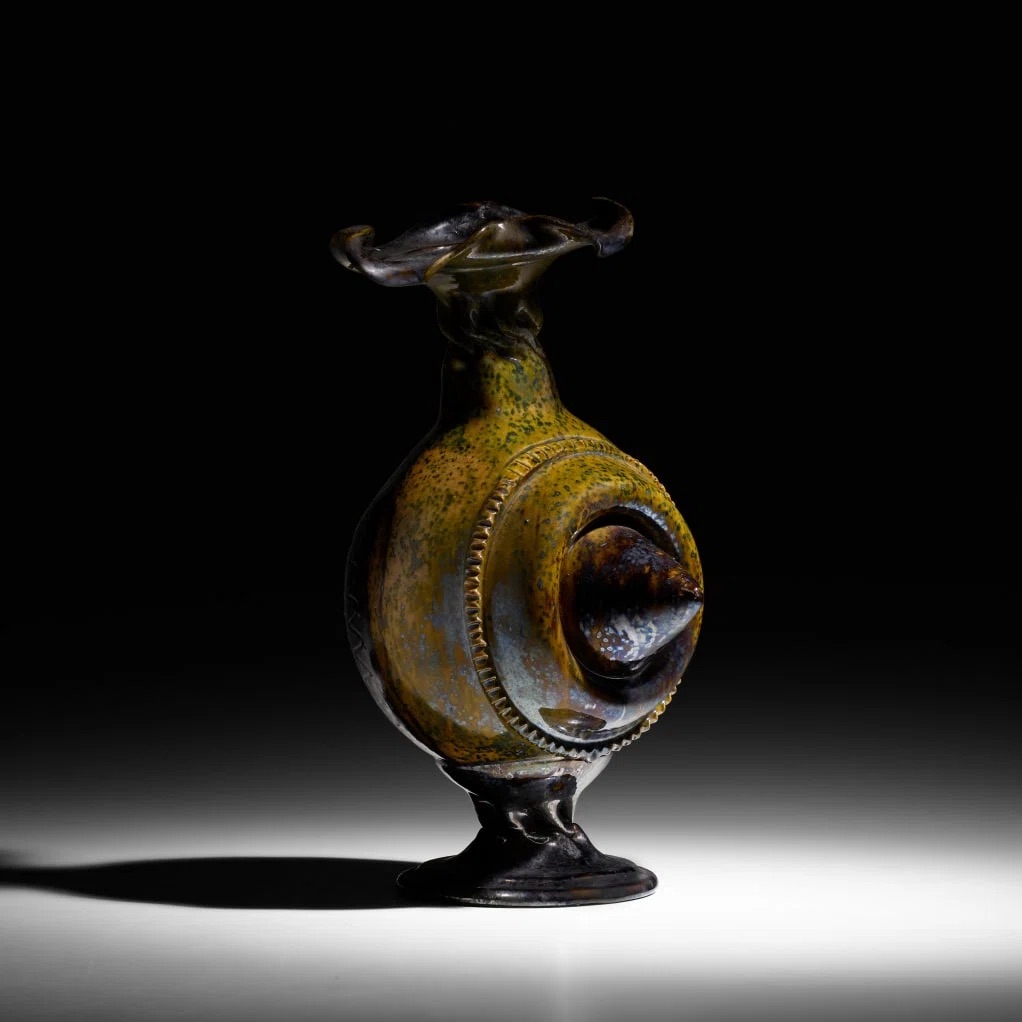
Vessel by George E. Ohr — glazed ceramic pottery, produced some time between 1895-1905. Photo by Rago Arts and Auction Center. September 4, 2022 Lectionary Texts — Year C
Jeremiah 18:1-11 and Psalm 139:1-6, 13-18 • Deuteronomy 30:15-20 and Psalm 1 • Philemon 1:1-21 • Luke 14:25-33
View Lectionary
Image description: A footed ceramic clay vessel that leans slightly. The foot of the object appears to have been manually twisted as does the neck. The spherical belly of the vase features a cone shaped protrusion a slender ring of zigzag detailing. The top of the pot was perhaps twisted and then flattened into a wide shape with curled sides and a tiny opening. The glaze is a streaked warm brown on the body with green speckles while the top, neck, the cone protrusion and foot are a deeper dark brown. The entire vessel has a shimmery streaked lustre-glaze effect.The word of the Eternal came to Jeremiah.
Eternal One: Go down to the potter’s shop in the city, and wait for My word.
So I went down to the potter’s shop and found him making something on his wheel. And as I watched, the clay vessel in his hands became flawed and unusable. So the potter started again with the same clay. He crushed and squeezed and shaped it into another vessel that was to his liking. In that moment, I heard again God’s word for His rebellious people.
Eternal One: O people of Israel, can I not do the same to you as this potter has done? You are like clay in My hands—I will mold you as I see fit. — Jeremiah 18:1-6Ever since an antiques dealer found himself in an auto shop down in Biloxi, Mississippi staring at a wall of boxes at the back of the shop in the early 1970’s, the world has been waking up to the pottery of George E. Ohr, also know as “the mad potter of Biloxi.” The auto shop was owned by George’s sons, who had stashed their father’s some 10,000 “mud babies” (the term George gave his unique creations) in a mass of boxes and crates. When offered to take a look at “some of dad’s pottery”, the antiques dealer was captivated by the beauty of the pieces. He spent years negotiating with the Ohr family to buy the entire collection and eventually a deal was made. Taking the finds back to New York, the dealer began selling pieces. Artists like Andy Warhol and Jasper Johns were among the first to snatch up these odd, imperfect, creative, brilliantly colored, yet skillful vessels.
Young Ohr fell in love with the potters wheel. He made a living cranking out common water pitchers and ceramic chimney flues, but in his spare time, Ohr experimented with the red clay he himself dug out of the river bank. He enjoyed creating incredibly delicate vessels and bowls with ornate handles or experimented with squishing and twisting the things he had spun on his wheel. Ohr considered each an every piece special. He placed outrageously high prices on his unusual creations saying they were “worth their weight in gold.” Very few were sold during his lifetime. Today, you can visit the special Smithsonian affiliated museum in Biloxi, Mississippi designed by architect Frank Gehry that solely houses Ohr’s pottery. He is hailed as a master potter for his unusual designs and secret techniques. Ohr is now considered an American artist of significance.
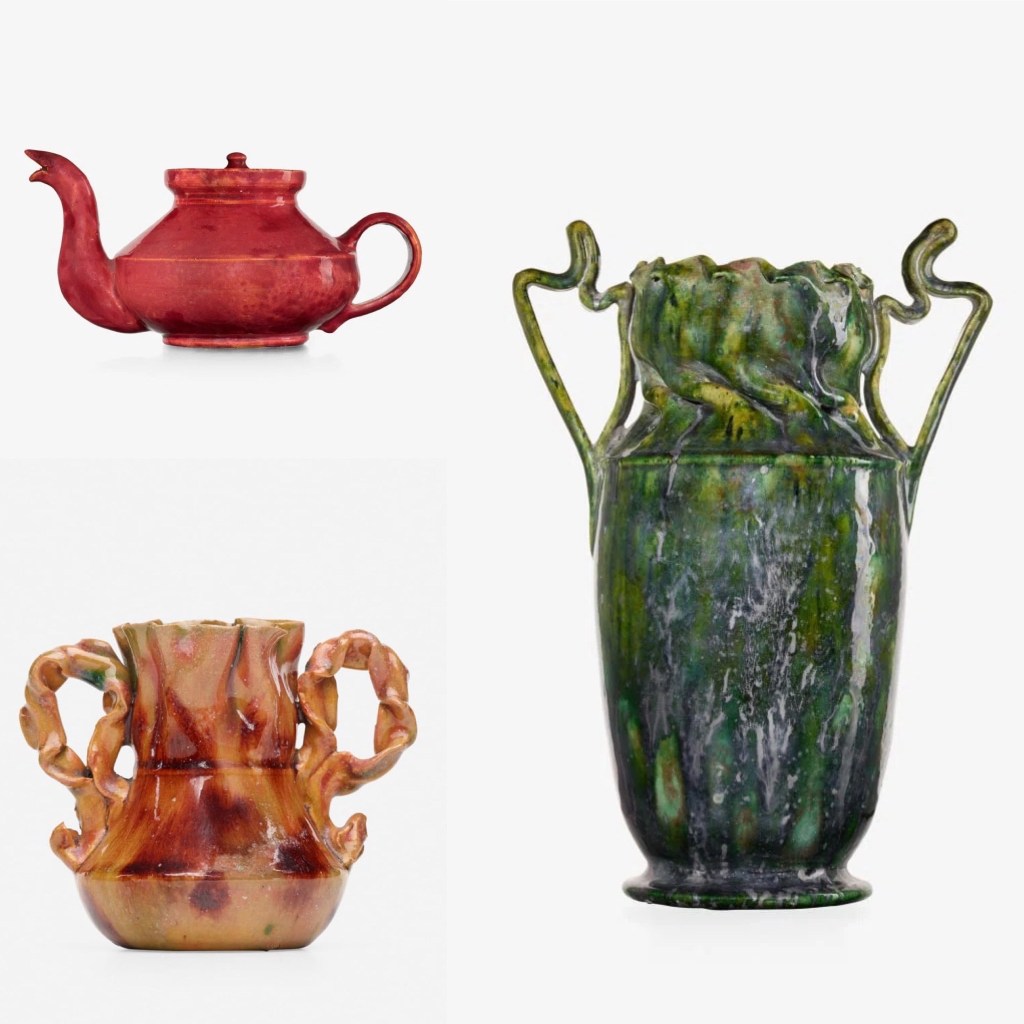
“God made no two souls alike, and I’ll make no two pots alike.” — George E. Ohr. Practicing Visio Divina:
- View the artwork
What do you see?
Note shapes – color – style – movement
What stands out for you?
What are you curious about?
What questions do you have?
Hold back any feelings – judgments – opinions - Read the accompanying scripture and look over the artwork again
What connections do you make?
Between the image and text?
What is coming to mind from your own experience?
What feelings are rising in you?
Are you uncomfortable with something?
There are no right or wrong answers - Read the scripture again and explore the artwork a third time
What do you hear?
What is God saying to you?
What do you wish to speak to God?
What blessing or prayer is rising in you?

- View the artwork
-
Ordinary Time: Proper 17
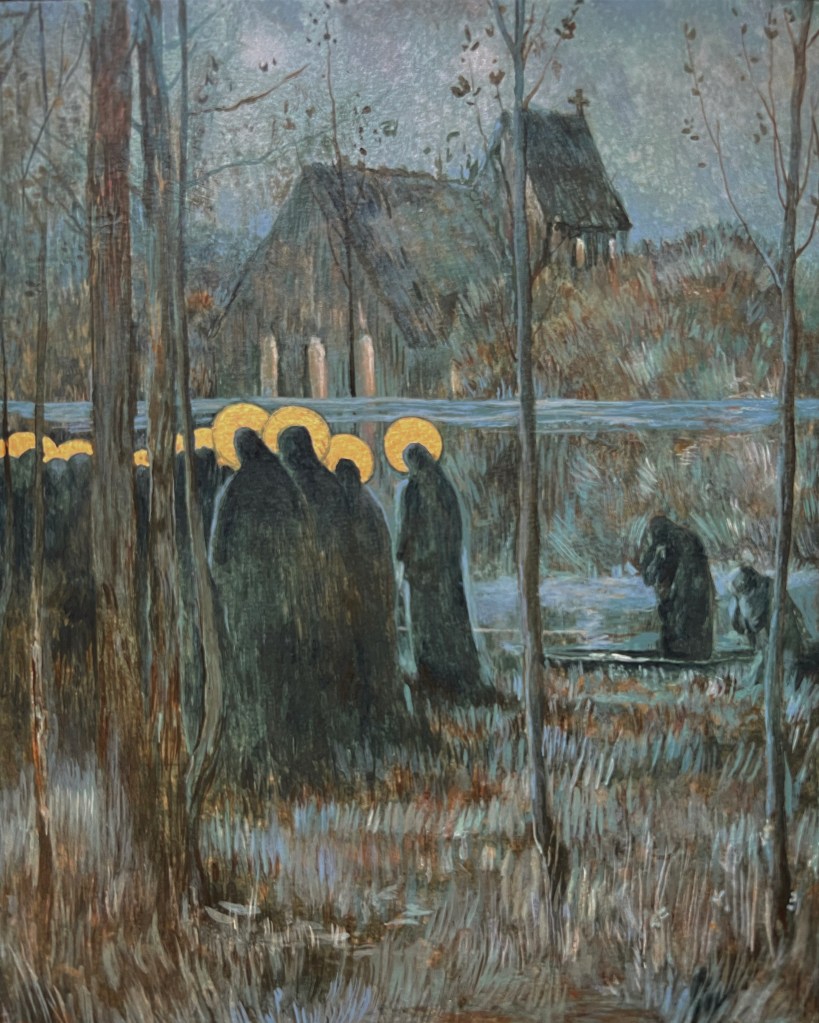
Procession of Souls (after Louis Welden Hawkins, 1893) by Michelle L Hofer — acrylic painting with gold leaf on paper, 8 x 10 inches, 2022. August 28, 2022 Lectionary Texts — Year C
Jeremiah 2:4-13 and Psalm 81:1, 10-16 • Sirach 10:12-18 or Proverbs 25:6-7 and Psalm 112 • Hebrews 13:1-8, 15-16 • Luke 14:1, 7-14
Image description: The scene features indistinct figures along a river bank across from a simple church building surrounded by large and thick shrubbery. The muted blues, greens and brown tones would indicate the time of day to be either dusk or dawn. A soft golden light glows from the church windows on the opposite shore. Two figures emerge from a small boat onto this side of the river while a group of figures draped in cloaks and bearing golden halos is present on the shore at left. Tall grass and young trees with sparse foliage fill the foreground.
“I am the Eternal, your True God. I liberated you from slavery, led you out from the land of Egypt. If you open your mouth wide, I will fill it. But My own people did not hear My voice! Israel refused to obey Me. So I freed them to follow their hard hearts, to do what they thought was best. If only My people would hear My voice and Israel would follow My direction! Then I would not hesitate to humble their enemies and defeat their opposition Myself. Those who hate the Eternal will cower in His presence, pretending to submit; they secretly loathe Him, yet their doom is forever. But you—I will feed you the best wheat and satisfy you with honey out of the rock.” — Psalm 81:10,13-16
This piece was commissioned this summer by my daughter who found the original to be an intriguing work of art. I wasn’t able to find much to explain the artist’s intentions beyond it depicting a sculpture (of the figures possibly) which the artist admired. There is much to ruminate on and many questions come to mind with this mysterious scene. The Scripture passage I have selected and included brought this piece to mind this week. How does the scene depicted here align with the words of the Psalmist?
Practicing Visio Divina:
- View the artwork
What do you see?
Note shapes – color – style – movement
What stands out for you?
What are you curious about?
What questions do you have?
Hold back any feelings – judgments – opinions - Read the accompanying scripture and look over the artwork again
What connections do you make?
Between the image and text?
What is coming to mind from your own experience?
What feelings are rising in you?
Are you uncomfortable with something?
There are no right or wrong answers - Read the scripture again and explore the artwork a third time
What do you hear?
What is God saying to you?
What do you wish to speak to God?
What blessing or prayer is rising in you?

- View the artwork
-
Ordinary Time: Proper 16

Yosemite Firefall by Dave Koch, 2021. Photographed on the Nikon D850 at 220mm, ISO 100 f/11 at ½ second as explained in Dave’s post on PetaPixel. August 21, 2022 Lectionary Texts — Year C
Jeremiah 1:4-10 and Psalm 71:1-6 • Isaiah 58:9b-14 and Psalm 103:1-8 • Hebrews 12:18-29 • Luke 13:10-17
View LectionaryImage description: Over a sheer mountain rock face in Yosemite National Park in California flows Horsetail Falls eerily lit by the setting sun. The sky’s golden orange glow gives the falls the appearance of it being on fire as if it were hot lava pouring down the mountain.
Be my rock of refuge where I can always hide. You have given the order to keep me safe; You are —my rock and my fortress. I have leaned upon You since I came into this world; You took me from my mother’s body, so I will ever praise You. For You are my hope, Eternal One; You, Lord, have been my confidence since I was young. — Psalm 71:3,5-6
You have not come to the place that can be touched — with blazing fire, darkness, gloom, and a windstorm — You have come to Jesus, the mediator of a new covenant, and to His sprinkled blood, which speaks a greater word than the blood of Abel. Therefore, let us all be thankful that we are a part of an unshakable Kingdom and offer to God worship that pleases Him and reflects the awe and reverence we have toward Him, for He is like a fierce fire that consumes everything. — Hebrews 12:18,24,28-29
It is only recently that I learned of the phenomenon of Horsetail Falls in Yosemite becoming Firefall for a few brief days in February and October when the sun is at just the right position to create this stunning effect. Every year, crowds of photographers and observers gather to witness this glorious sight. I have always considered such things of enormous natural beauty to be God’s way of giving us also glimpses of Themselves to us. I am naturally stirred to a state of awe and praise.
Practicing Visio Divina:
- View the artwork
What do you see?
Note shapes – color – style – movement
What stands out for you?
What are you curious about?
What questions do you have?
Hold back any feelings – judgments – opinions - Read the accompanying scripture and look over the artwork again
What connections do you make?
Between the image and text?
What is coming to mind from your own experience?
What feelings are rising in you?
Are you uncomfortable with something?
There are no right or wrong answers - Read the scripture again and explore the artwork a third time
What do you hear?
What is God saying to you?
What do you wish to speak to God?
What blessing or prayer is rising in you?

- View the artwork
-
Ordinary Time: Proper 15
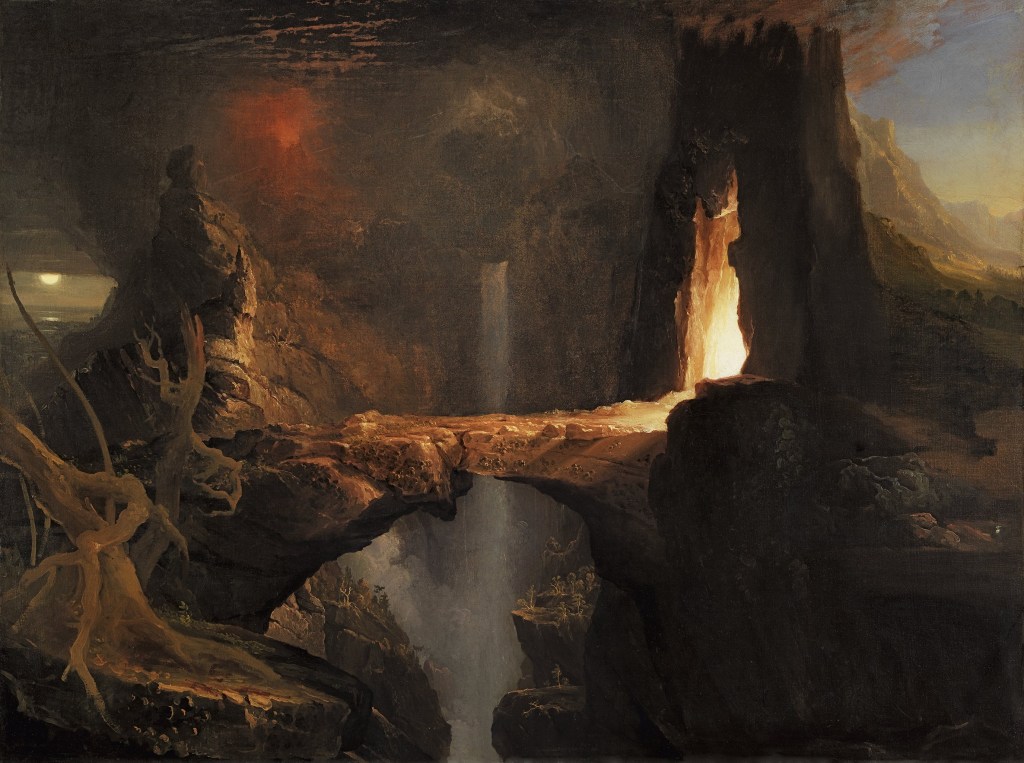
Expulsion. Moon and Firelight by Thomas Cole, ca. 1828 —
Oil on canvas, 91.4 x 122 cm, Museo Nacional Thyssen-Bornemisza, Madrid.August 14, 2022 Lectionary Texts — Year C
Isaiah 5:1-7 and Psalm 80:1-2, 8-19 • Jeremiah 23:23-29 and Psalm 82 • Hebrews 11:29-12:2 • Luke 12:49-56
View LectionaryImage description: A rich and detailed fantasy landscape is dominated by a natural stone bridge spanning the center of the painting. To the right of the bridge is a large cave opening on a tower of rock from which a bright light (possibly from a raging fire inside) is glowing. Behind the rock tower, in the upper right corner of the painting is a glimpse of an idyllic mountain and valley landscape with a warm dawn or dusk sky. At the paintings center is a dark and foreboding storm/smoke and ash-filled sky (from a volcano erupting far off in the distance) above a tall and slim waterfall plunging into a deep and rock-faced cavern below the stone bridge. The horizontal bridge and the waterfall behind form a cross. The left portion of the painting includes jagged rock peaks. In the distance, more ash hovers above a full moon above the sea. On a rock cliff in the lower left sits a large mangled dead tree. Blood stains are visible near the edge of the flat surface of the cliff.
You took us a grapevine dug from Egypt; You forced out the nations and transplanted it. Why have You pulled down the wall so that everyone who wanders by can pick its? O God, Commander of armies, come back. Gaze down from heaven and see, keep watch over this vine. Your enemies have chopped it down and burned it with fire; may they be destroyed by the sight of Your rebuke. Let Your hand rest on the one at Your right hand, the child of man whom You have raised for Yourself. Then we will not turn away from You. Bring us back to life! And we will call out for You! — Psalm 80:8,12,14,16-18
Jesus: My mission is to send a purging fire on the earth! In fact, I can hardly wait to see the smoke rising. Do you think I’ve come with a nice little message of peace? No way. Believe Me, My message will divide. I have a kind of baptism to go through, and I can’t relax until My mission is accomplished! — Luke 12:49-51
Thomas Cole is honored as being America’s first landscape artist, and this was how he was taught to me in my college studies. What I am discovering about Cole (and so many of the artists this Visio Divina venture has me perusing), is he allowed his work to express his own spiritual journey and faith ponderings. Cole took his love of landscape and fused it with spiritual meaning as Expulsion. Moon and Firelight presents. Here, Cole is presenting a fantasy landscape around the theme of Adam and Eve’s fall into sin and their expulsion from the garden. The painting documents the movement from the pristine and perfect beauty of Eden on the right to the harsh reality of the world at left into which sin now is present. The blood seen on the rocky cliff is likely a nod to the murder of Abel by his brother Cain.
In addition to this biblical reference, Cole is also working out a personal concern in this painting. Cole was fearful of what would become of the beauty of the American wilderness as he watched the nation’s rapid industrialization. Expulsion’s transition from Paradise to Destruction speaks to this apprehension.
I found the dead twisted tree in the painting to serve as a nice metaphor for the vine spoken of in the texts today. I also enjoyed pondering this painting along with the words of Jesus in the Luke passage to be enriching. What connections between this image and the texts are you able to make?
Practicing Visio Divina:
- View the artwork
What do you see?
Note shapes – color – style – movement
What stands out for you?
What are you curious about?
What questions do you have?
Hold back any feelings – judgments – opinions - Read the accompanying scripture and look over the artwork again
What connections do you make?
Between the image and text?
What is coming to mind from your own experience?
What feelings are rising in you?
Are you uncomfortable with something?
There are no right or wrong answers - Read the scripture again and explore the artwork a third time
What do you hear?
What is God saying to you?
What do you wish to speak to God?
What blessing or prayer is rising in you?
- View the artwork
-
Ordinary Time: Proper 14
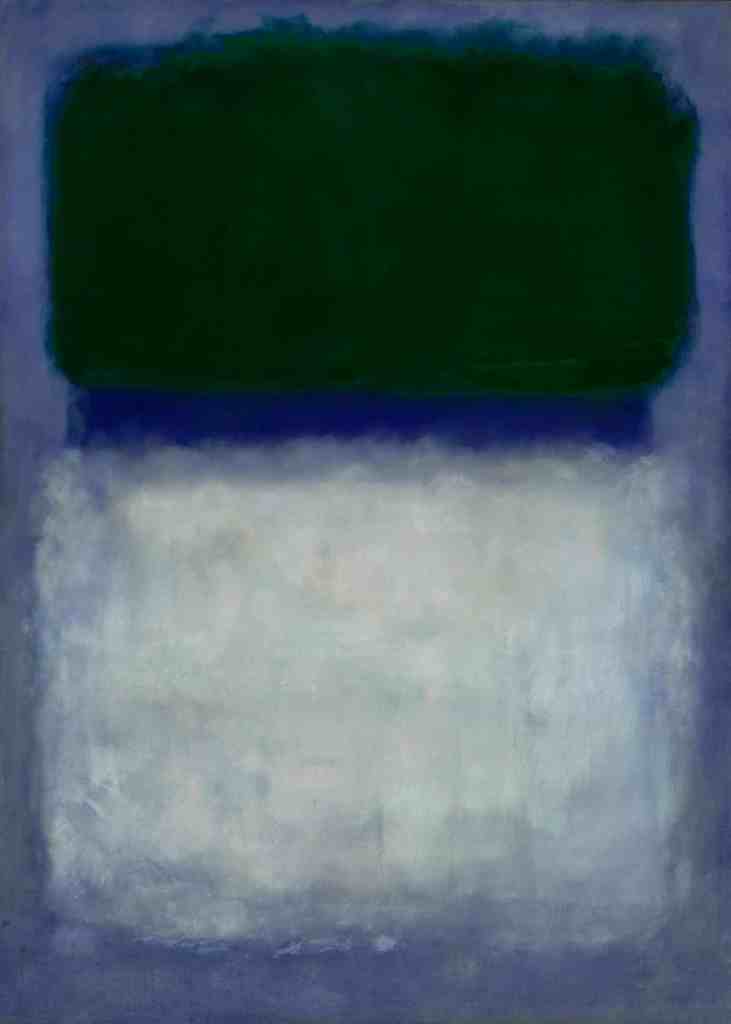
Green on Blue (Earth-Green and White) by Mark Rothko — oil on canvas, 1956, Arizona Museum of Art. August 7, 2022 Lectionary Texts — Year C
Isaiah 1:1, 10-20 and Psalm 50:1-8, 22-23 • Genesis 15:1-6 and Psalm 33:12-22 • Hebrews 11:1-3, 8-16 • Luke 12:32-40
View LectionaryImage description: Over a dusty blue background float two large fuzzy edged rectangles of color: a white area on the lower half of the canvas and a slightly smaller deep green area at the top. Between these is a brilliant and dark sapphire blue band of color.
Faith is the assurance of things you have hoped for, the absolute conviction that there are realities you’ve never seen. It was by faith that our forebears were approved. Through faith we understand that the universe was created by the word of God; everything we now see was fashioned from that which is invisible. — Hebrews 11:1-3
This is a Rothko painting. Mark Rothko was a definitive artist in an art movement know as abstract expressionism. Though highly criticized at the time for their seemingly unskilled, lazy approach to making art, Rothko and other artists chose to cover canvases in splashes, drips, pours and swashes of paint.
Rothko explained his color field paintings to be a spiritual and meditative practice. A completed piece like Green on Blue was a very slow and time consuming endeavor involving the application of many layers of thin paint being built up on the canvas. Working in a slow manner such as this allows the artist to contemplate. This is remarkably similar to the way in which iconographers create Christian icon art. Paint is applied to areas of the image in thin layers lending time for the mind to meditate while the hands are busy with this work.For a number of years now I have adopted a similar personal practice of layering paint to create abstract expressions. For me, this became a way of praying during a difficult time when I found other forms of spiritual practices to overwhelming. It is soothing to simply allow myself to express to God my thoughts or feelings through the colors I chose to work with.

Images of color abstraction paintings by Michelle L Hofer — acrylic on paper, 2018-2022. It is the “unknowing” quality of faith present in the lectionary texts this week which inspired my art choice this week. We can’t possibly know or see or even understand at times what is unfolding in our lives, our surroundings, our world. It is natural to respond in fear, but God calls us just as he calls Abraham to live by faith rather than fear. I find in a Rothko color field painting the space to explore what it means to willingly step into the unknown present and future in faith. What do you see?
Practicing Visio Divina:
- View the artwork
What do you see?
Note shapes – color – style – movement
What stands out for you?
What are you curious about?
What questions do you have?
Hold back any feelings – judgments – opinions - Read the accompanying scripture and look over the artwork again
What connections do you make?
Between the image and text?
What is coming to mind from your own experience?
What feelings are rising in you?
Are you uncomfortable with something?
There are no right or wrong answers - Read the scripture again and explore the artwork a third time
What do you hear?
What is God saying to you?
What do you wish to speak to God?
What blessing or prayer is rising in you?
- View the artwork
-
Ordinary Time: Proper 13
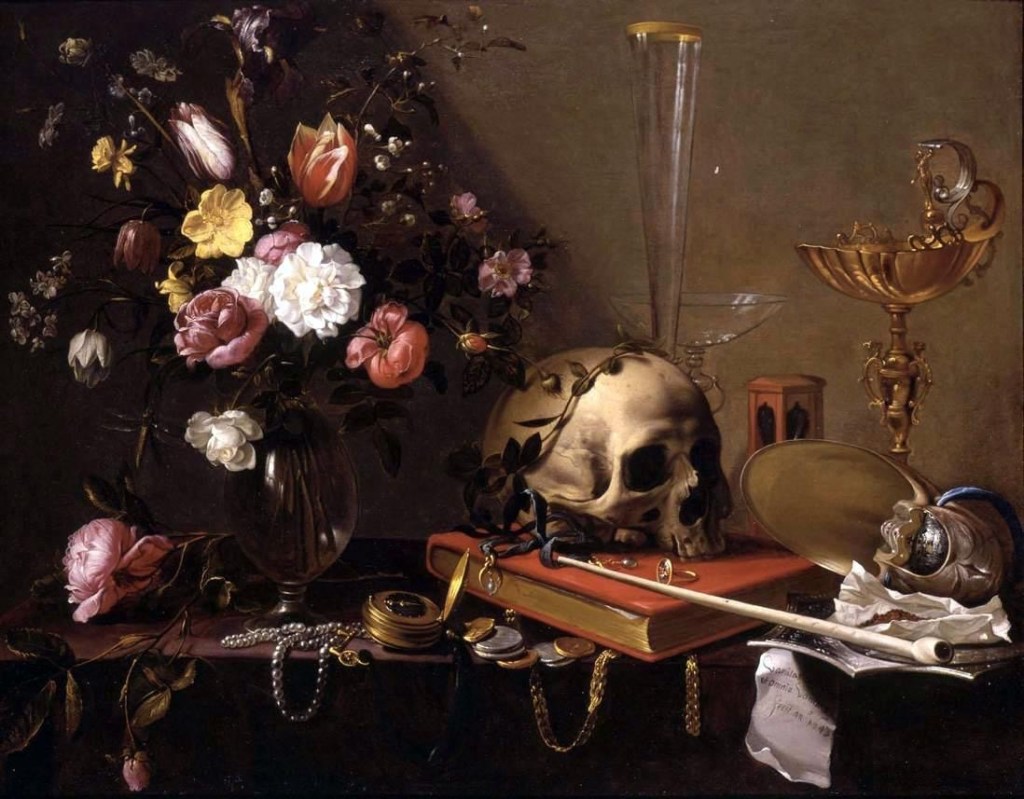
Vanitas – Still Life with Bouquet and Skull by Adriaen van Utrecht — oil on canvas, 26.3 x 33.8 inches, circa 1642. July 31, 2022 Lectionary Texts — Year C
Hosea 11:1-11 and Psalm 107:1-9, 43 • Ecclesiastes 1:2, 12-14; 2:18-23 and Psalm 49:1-12 • Colossians 3:1-11 • Luke 12:13-21
View LectionaryImage description: Rendered in exquisite realism, this vanitas has a warm dark setting. At left in dark shadow sits a floral bouquet of pink and white roses, yellow daffodils, multi-color tulips, irises and sprays of small flowers. Some of the tulips are wilted and drooping. A limp pink rose with dry, curled leaves slumps over the edge of the table. At center sits a vine draped skull atop a dusty red book along with a pearl earring, gold signet ring and a gold and pearl pendant strung on black velvet. Behind this grouping stand a tall slender glass vase with gold rim, a shorter pedestal glass bowl and an small wood-housed hour-glass. An ornate golden pedestal bowl occupies the right side of the painting. Below it is a large spiral shell and a small silver tray with a pile of smoking tobacco in paper. A long white pipe lays on the tray and across the book. A note scribbled on paper hangs over the table edge under the silver tray. Scattered at the front of the table between the floral vase and book is a gray string of pearls, a gold pocket watch, gold and silver coins, and a thick gold chain.
Teacher: Life is fleeting, like a passing mist. It is like trying to catch hold of a breath; All vanishes like a vapor; everything is a great vanity. I have witnessed all that is done under the sun, and indeed, all is fleeting, like trying to embrace the wind. — Ecclesiastes 1:2,14
Then I’ll be able to say to myself, ‘I have it made! I can relax and take it easy for years! So I’ll just sit back, eat, drink, and have a good time!’”
Then God interrupted the man’s conversation with himself. “Excuse Me, Mr. Brilliant, but your time has come. Tonight you will die. Now who will enjoy everything you’ve earned and saved?”
This is how it will be for people who accumulate huge assets for themselves but have no assets in relation to God. — Luke 12:19-21The texts for this week, especially the passage from Ecclesiastes, has long been the inspiration for a very specific genre of art known as vanitas. The vanitas (Latin for vanity) was made popular by the Dutch masters of the 16th and 17th centuries. The example here by Adriaen van Utrecht is a fine example.
A vanitas still-life contains the following symbolic objects pertaining to the brevity and precariousness of life along with the futility of its vain pursuits:- an hourglass, clock or watch
- withering flowers/vegetation or rotting fruit
- extinguished candles
- coins, jewels, glass or pottery – the trappings of wealth
- books, eyewear – the pursuit of knowledge
- wine, tobacco, musical instruments – earthly pleasures
- a skull
These still-lifes were very much meant to encourage spiritual meditation on one’s earthly life and pursuits and the consequences of any such vanities. The lectionary texts today do the same.
Practicing Visio Divina:
- View the artwork
What do you see?
Note shapes – color – style – movement
What stands out for you?
What are you curious about?
What questions do you have?
Hold back any feelings – judgments – opinions - Read the accompanying scripture and look over the artwork again
What connections do you make?
Between the image and text?
What is coming to mind from your own experience?
What feelings are rising in you?
Are you uncomfortable with something?
There are no right or wrong answers - Read the scripture again and explore the artwork a third time
What do you hear?
What is God saying to you?
What do you wish to speak to God?
What blessing or prayer is rising in you?
-
Ordinary Time: Proper 12

Divine Help (Psalm 63:7-8) by Michelle L Hofer — mixed media painting on paper, 8 x 10 inches, 2018. July 24, 2022 Lectionary Texts — Year C
Hosea 1:2-10 and Psalm 85 • Genesis 18:20-32 and Psalm 138 • Colossians 2:6-15, (16-19) • Luke 11:1-13
View LectionaryImage Description: On a background of bright metallic copper brushed and splattered atop deep teal blue appears a wing lined in bright white and dark blue in the upper portion of the painting. Beneath the wing is a hand gently reaching down — it’s shape subtly created with golden dot work.
Whenever I walk into trouble, You are there to bring me out. You hold out Your hand to protect me against the wrath of my enemies, and hold me safely in Your right hand. The Eternal will finish what He started in me. Your faithful love, O Eternal One, lasts forever; do not give up on what Your hands have made. — Psalm 138:7-8
Practicing Visio Divina:
- View the artwork
What do you see?
Note shapes – color – style – movement
What stands out for you?
What are you curious about?
What questions do you have?
Hold back any feelings – judgments – opinions - Read the accompanying scripture and look over the artwork again
What connections do you make?
Between the image and text?
What is coming to mind from your own experience?
What feelings are rising in you?
Are you uncomfortable with something?
There are no right or wrong answers - Read the scripture again and explore the artwork a third time
What do you hear?
What is God saying to you?
What do you wish to speak to God?
What blessing or prayer is rising in you?
- View the artwork
-
Ordinary Time: Proper 11

Madonna of the Mango Grove by Frank Wesley – Egg tempera, www.frankwesleyart.com (The image is found at this blog article which also gives information on the artist who is of Indian descent.) July 17, 2022 Lectionary Texts — Year C
Amos 8:1-12 and Psalm 52 • Genesis 18:1-10a and Psalm 15 • Colossians 1:15-28 • Luke 10:38-42
View LectionaryHe is the image of the invisible God, the firstborn of all creation; For in him all the fullness of God was pleased to dwell, the mystery that has been hidden throughout the ages and generations but has now been revealed to his saints. To them God chose to make known how great among the Gentiles are the riches of the glory of this mystery, which is Christ in you, the hope of glory. — Colossians 1:15,19,26-27
Image description: A beautifully dressed and adorned Mary holds the infant Christ while standing under two mango trees in a garden setting. The negative space under the trees is filled with a vibrant orange color. A large gold halo surrounds Mary’s head. The baby appears to be looking over Mary’s shoulder at a white bird perched in the the tree at left. The tree at right bears fruit on the half above Mary while the rest of the tree appears to be only in bloom. Several uniquely colored/textured oval shaped shrubs occupy the garden space below the blooming half of the right-hand tree. A group of birds sits in the grass in front of the shrubs. The overall coloration of the piece is warm and vibrant and the style reflects the artist’s Indian heritage.
What a delight to have discovered the works of Frank Wesley in my search for an art piece for today. It is good to find those artists who can expand and help us explore visuals beyond those of Western art and culture. It is so valuable for artists of other cultures and their work to bring out different aspects of an image, scene, concept or gift the viewer with a completely different feeling and understanding of the Divine. Frank Wesley’s work does this. His visual approach brings a tenderness and femininity as well as a colorful joy to this Madonna and Child image.
I made connections with Madonna of the Mango Grove with these Scripture mentions:- a basket of summer fruit — Amos 8:1,2
- “But my life is abundant — like a lush olive tree cared for at the house of the one True God.” — Psalm 52:8
- “your wife Sarah shall have a son.” — Genesis 18:10
- “Eternal One, who is invited to stay in Your dwelling?” — Psalm 15:1
Practicing Visio Divina:
- View the artwork
What do you see?
Note shapes – color – style – movement
What stands out for you?
What are you curious about?
What questions do you have?
Hold back any feelings – judgments – opinions - Read the accompanying scripture and look over the artwork again
What connections do you make?
Between the image and text?
What is coming to mind from your own experience?
What feelings are rising in you?
Are you uncomfortable with something?
There are no right or wrong answers - Read the scripture again and explore the artwork a third time
What do you hear?
What is God saying to you?
What do you wish to speak to God?
What blessing or prayer is rising in you?
-
Ordinary Time: Proper 10

The Good Samaritan by Michelle L Hofer — mixed media ink drawing with Swarovski crystal on hardboard, 2012. July 10, 2022 Lectionary Texts — Year C
Amos 7:7-17 and Psalm 82 • Deuteronomy 30:9-14 and Psalm 25:1-10 • Colossians 1:1-14 • Luke 10:25-37
View LectionaryThis is what he showed me: the Lord was standing beside a wall built with a plumb line, with a plumb line in his hand. And the Lord said to me, “Amos, what do you see?”
And I said, “A plumb line.”
Then the Lord said, “See, I am setting a plumb line in the midst of my people Israel; I will never again pass them by…” — Amos 7:7-8Image description: Jesus, dressed in a long flowing robe and sandals, is seen leaning over a gaunt man who is lying on the ground and wearing only a short tunic around his waist. The man rests his head on a rock and has multiple bandages on his arms and legs. He looks up at Jesus who is holding his hand and pouring balm (accented by Swarovski crystals) from a pitcher into an open wound on the man’s arm. A blooming flower is seen in the background.
Commission work for me as an artist has always been a real challenge. Years ago, my local hospital foundation asked if I would create a piece of art around the theme of healing. I chose the Christian icon of the Good Samaritan where Jesus is placed in the role of finding, helping, and healing the person who had been robbed and beaten at the side of the road. While I was pleased with my completed art piece, it did not resonate with the audience attending the annual hospital gala where it was being auctioned. The foundation director bid and won the piece at a price well under what I was hoping it would bring.
Later, the director told me how she herself didn’t connect with the style of the piece (the forms and style of icons are often lost on Protestant and Anabaptist Christians who are unfamiliar with them). I got the impression she bid on my art because no one else would. I was disappointed. I felt as if my art piece was a bit like the man laying by the side of the road with everyone awkwardly walking past.
One of the messages for me in this image and the story of the Good Samaritan is this: learn to love what appears unlovable. I often think this is an important concept in viewing art, especially when that art is not something we automatically find pleasing. Embracing the awkwardness or discomfort rising in us has the power to grow and stretch and even bless.
It’s been years since I have viewed this particular art piece in my portfolio. I have enjoyed reconnecting with it, and I am still pleased with the finished piece. Meditating on it once again has allowed me to remember and hold with compassion the experience of creating something that did not suit its audience.
Practicing Visio Divina:
- View the artwork
What do you see?
Note shapes – color – style – movement
What stands out for you?
What are you curious about?
What questions do you have?
Hold back any feelings – judgments – opinions - Read the accompanying scripture and look over the artwork again
What connections do you make?
Between the image and text?
What is coming to mind from your own experience?
What feelings are rising in you?
Are you uncomfortable with something?
There are no right or wrong answers - Read the scripture again and explore the artwork a third time
What do you hear?
What is God saying to you?
What do you wish to speak to God?
What blessing or prayer is rising in you?
Amos, art auction, awkwardness, Christian art, Christian Icon, Colossians, commission art, Deuteronomy, discomfort, healing, icon art, Jesus Christ, Lectionary, love the unlovable, Luke, Michelle L Hofer, Ordinary Time, plumb line, Proper 10, Psalms, Swarovski crystal, The Good Samaritan, visio divina, Year C - View the artwork

 Visio Divina
You must be logged in to post a comment.