-
Christ the King Sunday
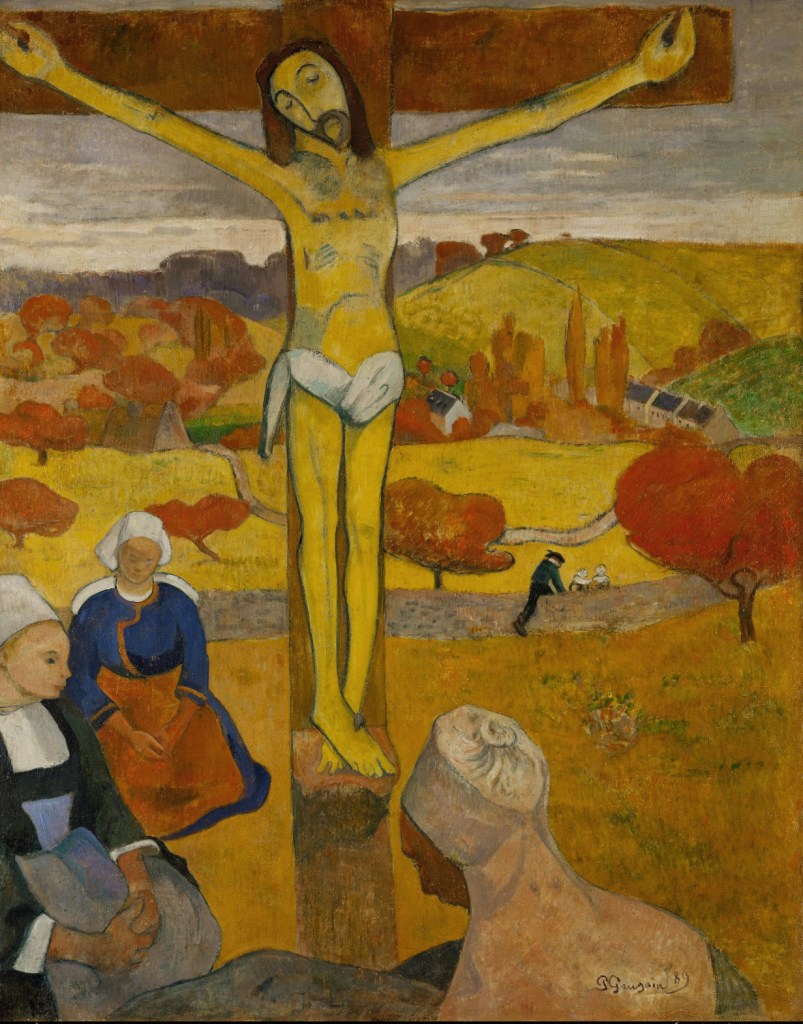
Le Christ jaune (The Yellow Christ) by Paul Gauguin — oil on canvas, 36 x 29 inches approximately, 1889. In the collection of the Albright-Knox Art Gallery, Buffalo, New York. Ordinary Time: Proper 29 — November 13, 2022 Lectionary Texts — Year C
Jeremiah 23:1-6 and Luke 1:68-79 • Jeremiah 23:1-6 and Psalm 46 • Colossians 1:11-20 • Luke 23:33-43Image description: Slightly off-center to the left, the crucified Christ hangs on a heavy beamed wooden cross. The top cross-beam nearly touches the top edge of the canvas. Christ has been depicted with yellowish skin, long thin and straight limbs and rounded face that ends in a very pointy chin. The expression of the face is gentle and peaceful with eyes closed. Gauguin based his Christ on the 17th-century wood sculpture crucifix found in the chapel at Trémalo, Pont-Aven, France which was painted a yellowish hue. The setting for the painting is 19th-century northern France — a hilly landscape with golden fields, several buildings, a winding road, rust-orange trees and a gray dusky sky (possibly sunrise or sunset). Three prayerful women sit around the base of the cross. They wear the traditional dress of the Breton ethnic peoples of this particular region of France. The closest woman has her back to us with her head bowed and her face in profile. A stone fence crosses the background in the distance. There, a male figure in dark clothing crosses to join two figures wearing the traditional women’s head-coverings.
Because of the tender mercy of our God, by which the rising sun will come to us from heaven to shine on those who sit in darkness and in the shadow of death, to guide our feet into the path of peace. — Luke 1:78-79
For God in all his fullness was pleased to live in Christ, and through him God reconciled everything to himself. He made peace with everything in heaven and on earth by means of Christ’s blood on the cross. — Colossians 1:19-20
It is said that Gauguin’s inspiration for this painting was his observance of the faith of the Breton peoples. These peasant believers made a deep spiritual connection during the season of harvest in Autumn between the cycle of birth, life, death and rebirth of the collected crops and the parallel cycle in the Christian life. Gauguin says he choose yellow for Christ to convey his feelings about the devotion and isolation of the Bretons.
Gauguin was part of the Symbolist art movement which explored escape from the weariness of modern society. Dreams and visions were oft chosen subjects rendered in vibrant color, bold forms and unexpected compositions — all of which we see in this work.
Christ the King Sunday marks the end of the liturgical year. For many regions of the world this is the autumn season of harvest and I find this painting to be a wonderful bridge given the beliefs of the Bretons (who rose out of the Celtic tradition with its deep appreciation for nature and life cycles) as we end this year to begin again in the next. We are about to be ushered into the season of Advent and the time of waiting for new birth. It was Christ himself who used the illustration when he said, “The time has come for the Son of Man to be glorified. I tell you the truth: unless a grain of wheat is planted in the ground and dies, it remains a solitary seed. But when it is planted, it produces in death a great harvest.”
Practicing Visio Divina:
- View the artwork
What do you see?
Note shapes – color – style – movement
What stands out for you?
What are you curious about?
What questions do you have?
Hold back any feelings – judgments – opinions - Read the accompanying scripture and look over the artwork again
What connections do you make?
Between the image and text?
What is coming to mind from your own experience?
What feelings are rising in you?
Are you uncomfortable with something?
There are no right or wrong answers - Read the scripture again and explore the artwork a third time
What do you hear?
What is God saying to you?
What do you wish to speak to God?
What blessing or prayer is rising in you?

- View the artwork
-
Ordinary Time: Proper 28
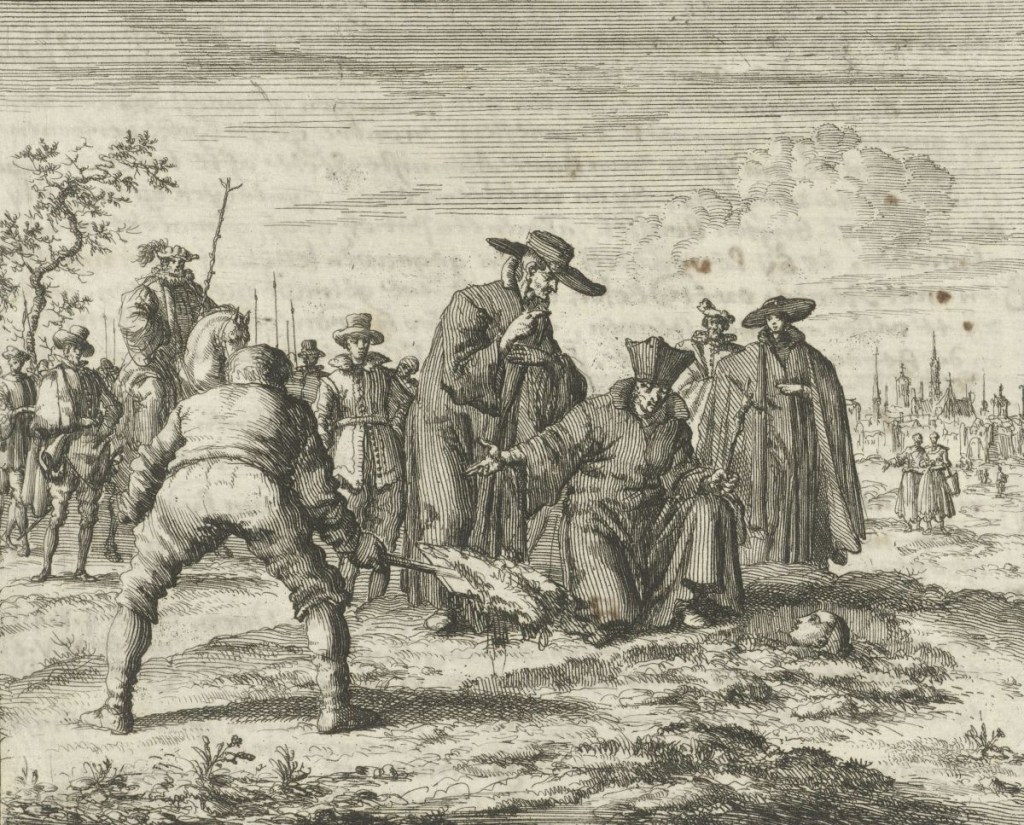
Burial alive of Anneke van den Hove, Brussels, 1597. Engraving by Jan Luiken in Martyrs Mirror, v. 2, p. 793 of Dutch edition. Source: Rijksmuseum. November 13, 2022 Lectionary Texts — Year C
Isaiah 65:17-25 and Isaiah 12 • Malachi 4:1-2a and Psalm 98 • 2 Thessalonians 3:6-13 • Luke 21:5-19
…they will capture you and persecute you. They’ll send you to synagogues for trial and to prisons for punishment; you’ll stand before kings and government officials for the sake of My name. This will be your opportunity—your opportunity to tell your story. Make up your mind in advance not to plan your strategy for answering their questions, for when the time comes, I will give you the words to say— wise words — which none of your adversaries will be able to answer or argue against. Your own parents, brothers, relatives, and friends will turn on you and turn you in. Some of you will be killed, and all of you will be hated by everyone for the sake of My name. But whatever happens, not a single hair of your heads will be harmed. By enduring all of these things, you will find not loss but gain — not death but authentic life. — Luke 21:12-18
The largest volume on my bookshelves is Martyrs Mirror, a compilation of stories of Christians and Anabaptists who suffered martyrdom from Christianity’s beginning through the Protestant Reformation. The book contains plate illustrations for a select number of these accounts.
Anneke van den Hove was arrested for belonging to the Anabaptist Christians of Brussels, Belgium and imprisoned for close to 3 years. When she was offered another 6 months to deeply consider recanting her beliefs, she refused saying they should do what seemed good to them. In 1597, Anneke was dragged outside the city of Brussels and put into a pit that had just been dug. As the dirt was being thrown in on top of her, she was asked whether she would recant. “No.” Anneke answered. The priests continued to threaten that not only would she suffer death by being buried alive, she would also endure the eternal pain of hell.
“[Anneke] answered that she had peace in her conscience, being well assured that she died saved, and had to expect the eternal, imperishable life, full of joy and gladness in heaven with God and all His saints… Hence they at last threw much additional earth and sods upon her face and whole body, and stamped with their feet upon it, in order that she should die the sooner. This was the end of this pious heroine of Jesus Christ, who gave her body to the earth, that her soul might obtain heaven…” — Martyrs Mirror, p. 1093
Practicing Visio Divina:
- View the artwork
What do you see?
Note shapes – color – style – movement
What stands out for you?
What are you curious about?
What questions do you have?
Hold back any feelings – judgments – opinions - Read the accompanying scripture and look over the artwork again
What connections do you make?
Between the image and text?
What is coming to mind from your own experience?
What feelings are rising in you?
Are you uncomfortable with something?
There are no right or wrong answers - Read the scripture again and explore the artwork a third time
What do you hear?
What is God saying to you?
What do you wish to speak to God?
What blessing or prayer is rising in you?

- View the artwork
-
Ordinary Time: Proper 27

A Storm in the Rocky Mountains, Mt. Rosalie by Albert Bierstadt — Oil on canvas, 83 in × 142.25 in, 1866. Acquired by the Brooklyn Museum in 1976. November 6, 2022 Lectionary Texts — Year C
Haggai 1:15b-2:9 and Psalm 145:1-5, 17-21 or Psalm 98 • Job 19:23-27a and Psalm 17:1-9 • 2 Thessalonians 2:1-5, 13-17 • Luke 20:27-38Image description: A grand landscape painted on a canvas that is approximately 7 x 12 feet in size, a group of Indigenous peoples hunt deer in the foreground while an encampment of teepees is located at a distance along a stream. In the lower right is a clear pool fed by a small waterfall. Beyond is a glassy lake reflecting the dark and ominous approaching storm clouds above. The mountains towering on either side of the lake are dramatically bathed in sun and shadow. The light accentuates a waterfall flowing down the mountain at right. Through the clouds above the storm is a grand snow capped peak which the artist has named Rosalie after the woman he would later marry.
Now may our Lord Jesus (the Anointed One Himself) and God our Father (who has loved us, comforted us eternally, and given us a good hope by His grace) bring comfort to your hearts and strengthen your wills to accomplish every good work and word. — 2 Thessalonians 2:16-17
I will lift my praise above everything to You, my God and King! I will continually bless Your name forever and always. My praise will never cease — I will praise You every day; I will lift up Your name forever. The Eternal is great and deserves endless praise; His greatness knows no limit, recognizes no boundary. No one can measure or comprehend His magnificence. One generation after another will celebrate Your great works; they will pass on the story of Your powerful acts to their children. Your majesty and glorious splendor have captivated me; I will meditate on Your wonders, sing songs of Your worth. — Psalm 145:1-5The subject of a Bierstadt landscape is not the scene he has so skillfully rendered, but rather the wave of awe washing over you when standing in the presence of something utterly beautiful. This is my observation.
Bierstadt was among those American artists who traveled west to explore and document the natural beauty of the continent. He often included the Indigenous people he met in his paintings, a detail that was widely criticized. And while he did experience some acclaim during his lifetime, Bierstadt’s work fell out of favor for many decades for being too dramatic, too romanticized. One could say Bierstadt painted landscape “delusions of grandeur”.
So how might this aspect of his work hold spiritual meaning and significance?
Practicing Visio Divina:
- View the artwork
What do you see?
Note shapes – color – style – movement
What stands out for you?
What are you curious about?
What questions do you have?
Hold back any feelings – judgments – opinions - Read the accompanying scripture and look over the artwork again
What connections do you make?
Between the image and text?
What is coming to mind from your own experience?
What feelings are rising in you?
Are you uncomfortable with something?
There are no right or wrong answers - Read the scripture again and explore the artwork a third time
What do you hear?
What is God saying to you?
What do you wish to speak to God?
What blessing or prayer is rising in you?

- View the artwork
-
Ordinary Time: Proper 26
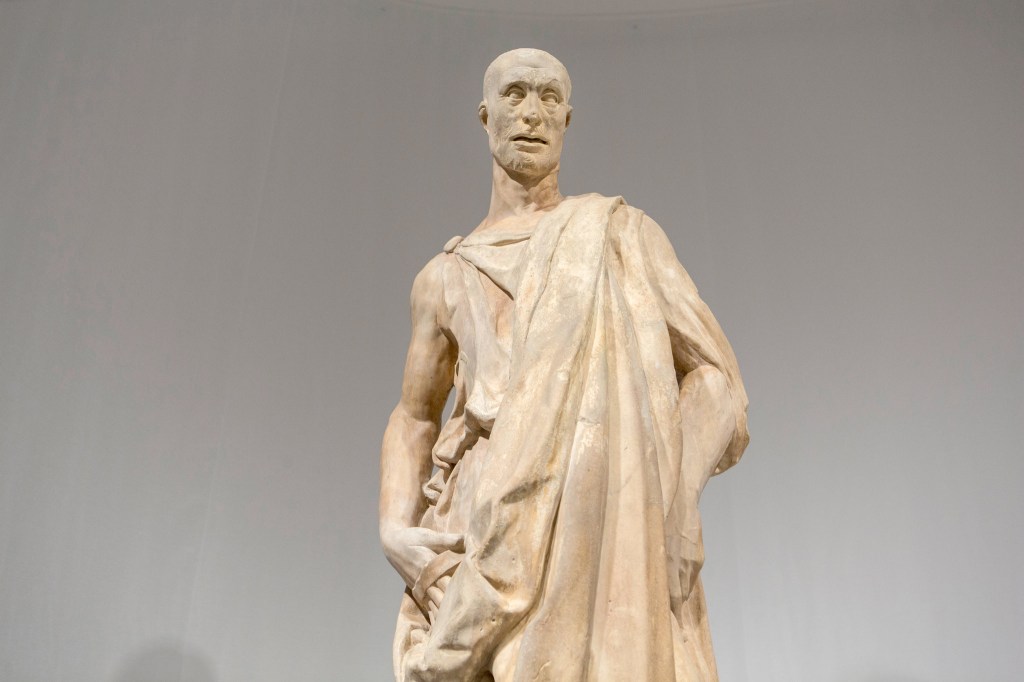
The Prophet (Habakkuk) by Donatello (Donato di Niccolò di Betto Bardi). — Marble sculpture originally for the Cathedral in Florence, Italy, 76.7 inches, 1435-36. Photo by Emon Hassan for The New York Times. October 30, 2022 Lectionary Texts — Year C
Habakkuk 1:1-4; 2:1-4 and Psalm 119:137-144 • Isaiah 1:10-18 and Psalm 32:1-7 • 2 Thessalonians 1:1-4, 11-12 • Luke 19:1-10
View LectionaryImage description: Standing with a look of exasperation, the prophet Habakkuk stares with a large open mouth as if he is about to speak. Dressed in a toga-like garment with one arm and shoulder exposed, we glimpse a thin yet slightly muscular man. One hand is casually tucked under the strap of a scroll while the other dangles limply in the folds of his robe.
This is the vision with which the prophet Habakkuk was burdened. “How long must I cry, O Eternal One, and get no answer from You? Even when I yell to You, ‘Violence is all around!’ You do nothing to save those in distress.” — Habakkuk 1:1-2
Trouble and distress have overtaken me, but Your commandments bring me great joy. — Psalm 119:143
So, of course, we’ve proudly bragged about you within circles of God’s people at other churches near and far because, even in the grip of much persecution and affliction, you’ve stood firm in your faith and have persevered. All this is why we are constantly praying for you, so God will make you worthy of the great calling you have received from Him and will give you the power to accomplish every good intention and work of faith. — 2 Thessalonians 1:4,11The texts this week remind us that a life of faith is not a life of joy and prosperity. No… we are more likely to witness and even experience ourselves injustice, violence and afflictions. We are called to persevere and to hold on to hope. This will prove challenging, if not impossible.
I am so thankful then when Scripture provides the exact words that reflect my own feelings and thoughts of confusion, trouble and anguish. Habakkuk, though a lesser known prophet, is one such example. The sculpture I have chosen today is a critical work of art which provides us a wonderful visual expression of Habakkuk’s wrestling with discomfort… dis-ease… distress.
It is definitely the most well-known piece of art to depict Habakkuk, and it is also the capstone work for Italian Renaissance artist, Donatello. Completed at the very end of his stellar career, Donatello was said to be surprised by the depth of expression in The Prophet’s face. He repeatedly told the sculpture to speak as he worked. The Prophet is popularly known as Lo Zuccone which translates to “pumpkin head” or “bald head”. A distinguishing feature of The Prophet is the roughness with which Donatello carved the head and face choosing not to polish it to a silky smooth finish.
Practicing Visio Divina:
- View the artwork
What do you see?
Note shapes – color – style – movement
What stands out for you?
What are you curious about?
What questions do you have?
Hold back any feelings – judgments – opinions - Read the accompanying scripture and look over the artwork again
What connections do you make?
Between the image and text?
What is coming to mind from your own experience?
What feelings are rising in you?
Are you uncomfortable with something?
There are no right or wrong answers - Read the scripture again and explore the artwork a third time
What do you hear?
What is God saying to you?
What do you wish to speak to God?
What blessing or prayer is rising in you?

- View the artwork
-
Ordinary Time: Proper 25
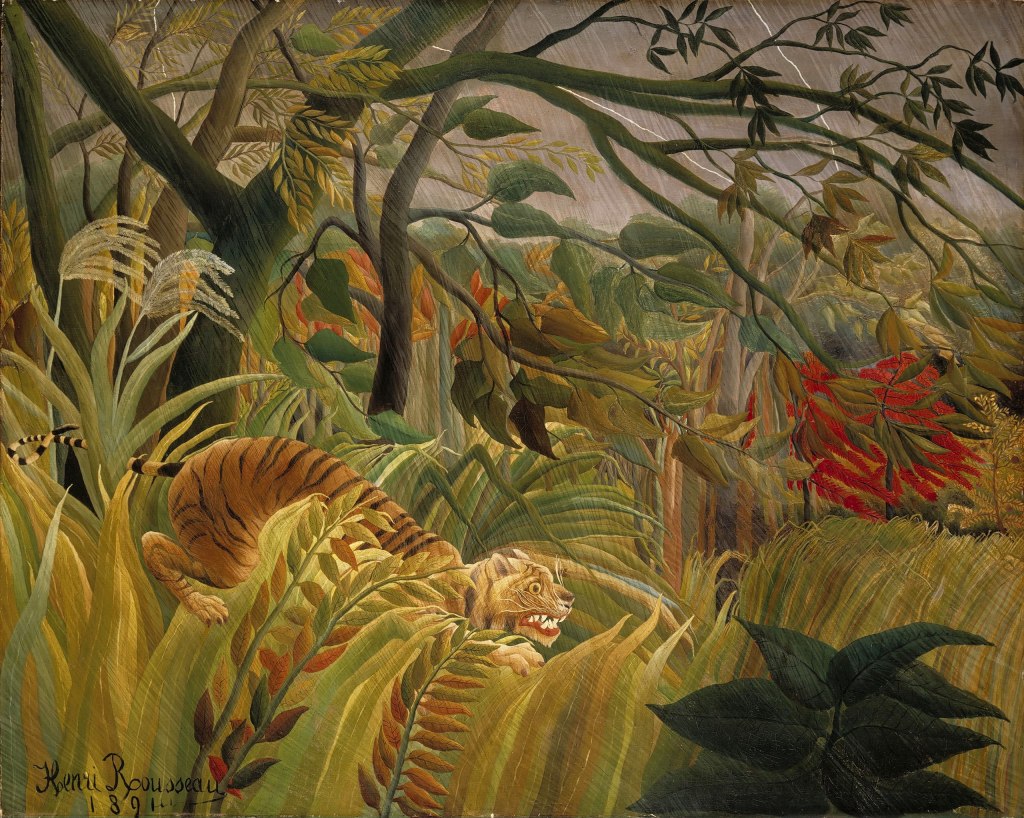
Surprised! By Henri Rousseau — oil on canvas, 129.8 x 161.9 cm, 1891. Image courtesy of The National Gallery London. October 23, 2022 Lectionary Texts — Year C
Joel 2:23-32 and Psalm 65 • Sirach 35:12-17 or Jeremiah 14:7-10, 19-22 and Psalm 84:1-7 • 2 Timothy 4:6-8, 16-18 • Luke 18:9-14
View LectionaryImage description: The scene is a jungle filled with a variety of trees, grasses and other tropical plants in rich yellow and green tones with the occasional pop of rust and orange. At right a flaming red bush peeks out of the background. At center is a crouched snarling tiger, wide-eyed, showing all its teeth and with a slender tail slinking back through a tall clump of pampas grass. Lightning bolts are also visible in the dark grey sky behind the trees. The entire piece is streaked with an effect to mimic driving rain.
You leave us breathless when Your awesome works answer us by putting everything right. God of our liberation — You are the hope of all creation, from the far corners of the earth to distant life-giving oceans. — Psalm 65:5
Do not fear, O land. You have been revived. Celebrate and rejoice, for the Eternal One has done great things! Do not fear, you wild beasts: You will eat again, for the desert pastures are green again! And so will we: the trees bear their fruit; the fig trees and the vines produce their bounty once again. People of Zion, shout with joy and happiness in the Eternal, your God; The drought is over; He has sent the early autumn rain as a sign of His faithfulness. He has poured down heavy rain, autumn and spring, as before. — Joel 2: 21-23
[The Lord] stood by me, strengthened me, and backed the truth I proclaimed with power so it may be heard by all the non-Jews. He rescued me, pried open the lion’s jaw, and snatched me from its teeth. And I know the Lord will continue to rescue me from every trip, trap, snare, and pitfall of evil and carry me safely to His heavenly kingdom. May He be glorified throughout eternity. Amen. — 2 Timothy 4:17-18I love that Rousseau titled this piece, Surprised! It’s exactly what I experienced recently walking into a room at the National Gallery in London and seeing this painting. Its been a favorite of mine for a long time. Rousseau was not a trained artist. One of the first artists in more recent history to be widely appreciated and acclaimed as an amateur, Rousseau is known today as the pioneer of naïve art. His work was laughed at, some thought him a fool. And yet, as Felix Vallaton, a young artist and writer observed upon seeing Surprised! exhibited for the first time in Paris: “His tiger… ought not to be missed: it is the alpha and omega of painting…not everyone laughs, and some who do are quickly brought up short. There is always some thing beautiful about seeing a faith, any faith, so pitilessly expressed.”
As to connections we can make between this painting and some of the lectionary passages… First, I like how the title, Surprised! captures both an experience of perhaps meeting a tiger in the jungle, but also the experience of being struck with the beauty of the creation (as in the Psalms passage) or a magnificent artistic expression (as Vallaton wrote). I most enjoyed reading the Joel passage plus a few extra verses (21-22) while contemplating this image – a beautiful expression of the earth being restored and refreshed. Then there is Paul giving us a wonderful visual of how God has rescued him.
Practicing Visio Divina:
- View the artwork
What do you see?
Note shapes – color – style – movement
What stands out for you?
What are you curious about?
What questions do you have?
Hold back any feelings – judgments – opinions - Read the accompanying scripture and look over the artwork again
What connections do you make?
Between the image and text?
What is coming to mind from your own experience?
What feelings are rising in you?
Are you uncomfortable with something?
There are no right or wrong answers - Read the scripture again and explore the artwork a third time
What do you hear?
What is God saying to you?
What do you wish to speak to God?
What blessing or prayer is rising in you?

- View the artwork
-
Ordinary Time: Proper 24
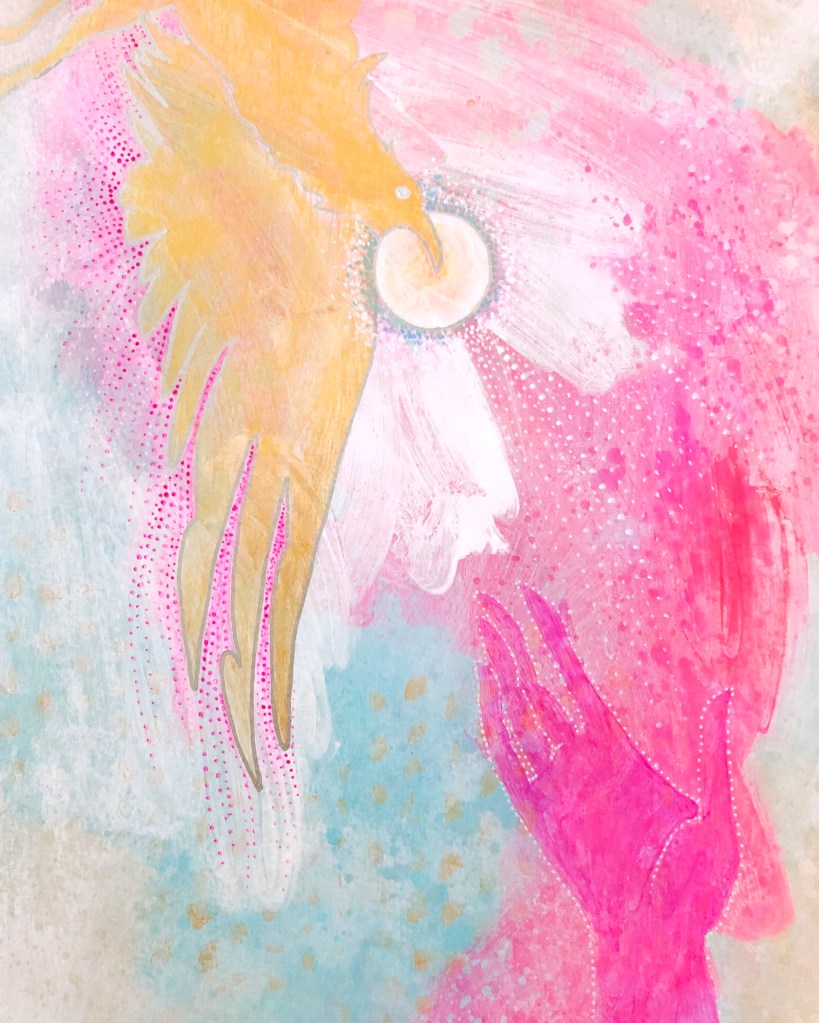
At Days End (Elijah’s Raven) by Michelle L Hofer — mixed media painting on paper, 8 x 10 inches, 2019. October 16, 2022 Lectionary Texts — Year C
Jeremiah 31:27-34 and Psalm 119:97-104 • Genesis 32:22-31 and Psalm 121 • 2 Timothy 3:14-4:5 • Luke 18:1-8Image description: A colorful depiction of a raven bringing Elijah bread in the desert (I Kings 17: 6) Bursting from the upper left corner, a golden raven form descends carrying a disk of sustenance in it’s beak. From the bottom Elijah’s hot pink open hand reaches up to receive the delivery. The image background is energetically filled with an abstract splattering and smearing of soft gold, sky blue and shades of bright pink. Pink dot work flows from under the raven’s wing while the bread disk emits blue and white dots some of which spray down onto the open hand. The raven is outlined in metallic silver and the hand is traced with white dots.
Your words are sweet to my taste! Yes, they are sweeter than honey in my mouth! — Psalm 119:103
If he can be moved to act justly, won’t God bring justice for His chosen people when they cry to Him day and night? Will He be slow to bring them justice? — Luke 18:7This week’s texts encompass themes such as: God’s restoration and a deepening of relationship (Jeremiah), the sweet tasting wisdom of God’s teachings and truths (Psalms and 2 Timothy), and persistence in asking God for justice or help (Luke).
The images I choose to work with begin as illustrations. This piece illustrates Elijah raising his hand to receive bread from the raven whom God sends to provide him food in the desert. I love this story for the ways it teaches us about God and the relationship potential available to us. But what I most enjoy about working with an image (and especially continuing to work with the same subject, even the same exact composition), is the way in which an image becomes symbol of truths and wisdom beyond even the original story.
Explored with the texts today: we view a snippet of what that intimate relationship can be, bread represents the wisdom of God’s teachings and a raised hand encourages us to bold in our asking of God.
Practicing Visio Divina:
- View the artwork
What do you see?
Note shapes – color – style – movement
What stands out for you?
What are you curious about?
What questions do you have?
Hold back any feelings – judgments – opinions - Read the accompanying scripture and look over the artwork again
What connections do you make?
Between the image and text?
What is coming to mind from your own experience?
What feelings are rising in you?
Are you uncomfortable with something?
There are no right or wrong answers - Read the scripture again and explore the artwork a third time
What do you hear?
What is God saying to you?
What do you wish to speak to God?
What blessing or prayer is rising in you?

- View the artwork
-
Ordinary Time: Proper 23
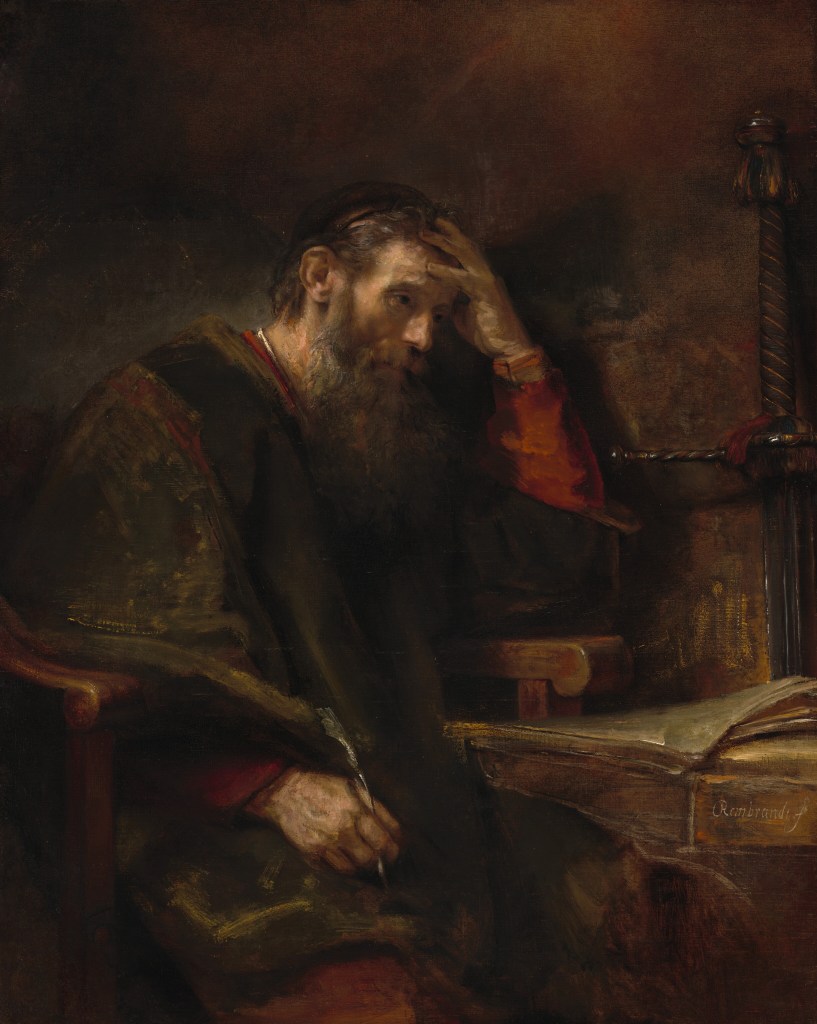
The Apostle Paul by Rembrandt van Rijn — oil on canvas, 51 3/4 x 41 1/8 inches, 1657. Photo by the National Gallery of Art. October 9, 2022 Lectionary Texts — Year C
Jeremiah 29:1, 4-7 and Psalm 66:1-12 • 2 Kings 5:1-3, 7-15c and Psalm 111 • 2 Timothy 2:8-15 • Luke 17:11-19
View LectionaryImage description: Seated in a wooden chair at a small writing desk, Paul holds his writing quill in his right hand resting on his leg. He appears deep in a somewhat anguished thought/prayer. His forehead rests in his left hand as his elbow is propped up on the arm of the chair. A pile of parchments sits on the table in front of him while a large twisted iron sword stands against the wall.
Remember Jesus the Anointed, raised from the dead, descended from David’s royal line. This is the crux of my good news! This is why I suffer and why I am bound and chained like a lawbreaker. But God’s word is not in chains! That’s why I endure everything for the sake of God’s chosen: so that they might experience salvation with lasting, eternal glory through Jesus the Anointed, our Liberating King. — 2 Timothy 2:8-10
For You have put us to the test, O God; You have refined us as silver is refined. You trapped us with a snare; You have laid upon our backs a heavy burden. You allowed us to be conquered and let our enemies run over us. We journeyed through dangers, through fire and flood, but You led us finally to a safe place, a land rich and abundant. — Psalm 66:10-12
Rembrandt painted numerous portraits of Saint Paul, the New Testament’s major contributor and a person of great interest and fascination to the artist. The sword in this painting is a multi-faceted symbol representing Paul’s early days as a persecutor of the church, his own beheading and martyrdom as well as his teaching on the armor of God which includes wielding the “sword of the Spirit” which is the Word.
Practicing Visio Divina:
- View the artwork
What do you see?
Note shapes – color – style – movement
What stands out for you?
What are you curious about?
What questions do you have?
Hold back any feelings – judgments – opinions - Read the accompanying scripture and look over the artwork again
What connections do you make?
Between the image and text?
What is coming to mind from your own experience?
What feelings are rising in you?
Are you uncomfortable with something?
There are no right or wrong answers - Read the scripture again and explore the artwork a third time
What do you hear?
What is God saying to you?
What do you wish to speak to God?
What blessing or prayer is rising in you?

- View the artwork
-
Ordinary Time: Proper 22
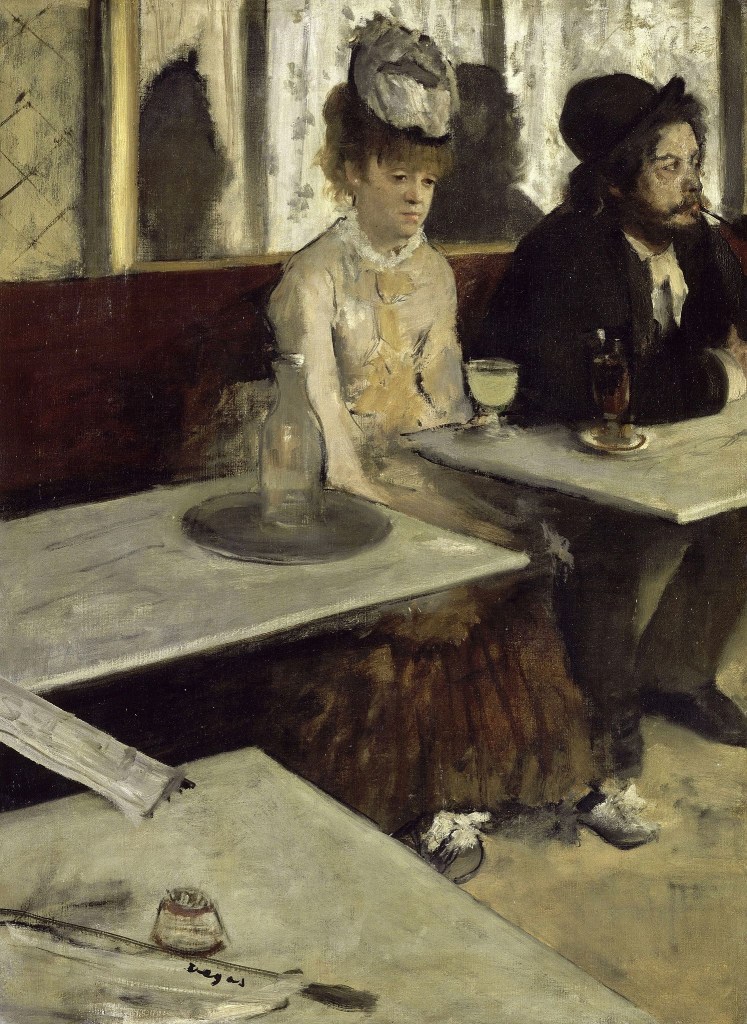
L’Absinthe by Edgar Degas — oil on canvas, 36.2 x 26.8 inches, 1875-76. October 2, 2022 Lectionary Texts — Year C
Lamentations 1:1-6 and Lamentations 3:19-26 or Psalm 137 • Habakkuk 1:1-4; 2:1-4 and Psalm 37:1-9 • 2 Timothy 1:1-14 • Luke 17:5-10
View LectionaryImage description: A woman and man sit side-by-side at a café table on a cushioned bench against a mirrored wall. Two drinks sit on the table — a full glass of absinthe in front of the woman and a dark drink in a taller glass near the man’s elbow. The man, resting his crossed arms on the table and looking away from the woman seated beside him, wears a hat and smokes a pipe. The woman, dressed fashionably including a stylish hat, appears catatonic as she sits staring at the floor with arms hanging limply beside her slumped body . On the table beside the couple is a drink carafe on a tray. Other café tables occupy the foreground of the artwork.
Aaghh! Lonely is this city that once bustled with life; cheer is empty; like a widow, she is abandoned and oh, so lonely. She who was a princess, great among the nations, has lost everything and been forced to serve as a slave. Bawling, she weeps without constraint every night, cries herself to sleep, bitter tears streaming down her cheeks. Her former friends ignore her; there is no one there to share her sorrow; companions contend and have betrayed her; friends have been unfaithful and turned against her as enemies. — Lamentations 1:1-2
Have courage, for the Eternal is all that I will need. My soul boasts, “Hope in God; just wait.” It is good. The Eternal One is good to those who expect Him, to those who seek Him wholeheartedly. It is good to wait quietly for the Eternal to make things right again. — Lamentations 3:24-26
Even as this painting by Degas portrays the emotions of despair and despondency quite well, it was a real shocker to viewers at the time. The image was found to be quite offensive in the public’s eye. Critics called it demoralizing, ugly and disgusting — the portrait of a whore. Others saw it as a warning against drinking, revelry, etc.
I sought this art piece out as a visual to contemplate with the personification of both Judah and Jerusalem as a woman in Scriptures such as the passage from Lamentations. I was drawn to the instruction to “wait quietly for the Eternal to make things right again” also from Lamentations. What does waiting quietly look like? My own experience is that waiting can at times be hopeful and positive and at other times it is a distressing or discouraging place. Degas’ painting has captured a very real moment — one we may wish to resist, but nonetheless one we have all felt.
Practicing Visio Divina:
- View the artwork
What do you see?
Note shapes – color – style – movement
What stands out for you?
What are you curious about?
What questions do you have?
Hold back any feelings – judgments – opinions - Read the accompanying scripture and look over the artwork again
What connections do you make?
Between the image and text?
What is coming to mind from your own experience?
What feelings are rising in you?
Are you uncomfortable with something?
There are no right or wrong answers - Read the scripture again and explore the artwork a third time
What do you hear?
What is God saying to you?
What do you wish to speak to God?
What blessing or prayer is rising in you?

- View the artwork
-
Ordinary Time: Proper 21

Lazarus in Abraham’s Bosom by Derek Clarke — oil on canvas, H 240 x W 122 cm, 1998-1999. Photo courtesy of (c) Scottish Catholic Archives; Supplied by The Public Catalogue Foundation, September 25, 2022 Lectionary Texts — Year C
Jeremiah 32:1-3a, 6-15 and Psalm 91:1-6, 14-16 • Amos 6:1a, 4-7 and Psalm 146 • 1 Timothy 6:6-19 • Luke 16:19-31
View LectionaryImage description: At the top of the artwork a golden portal has opened from heaven revealing Abraham holding the small gray figure of Lazarus in one hand and an open testament in the other. Abraham’s garment is vibrantly patterned in orange and gold with a star studded sky tunic. The city of Jerusalem and surrounding hills provides a background. People throughout the city have noticed the glorious event happening in the sky — many raise their hands in praise. On the right edge we see a rich ruler seated on his throne. He looks straight ahead rather than upward like everyone else. Near the lower left corner is Lazarus’ mat — a pack of dogs lurks nearby. Brilliant blue flames emerging from the bottom of the artwork buoy the rich man as if he floats on them. He is dressed in purple with his hands extending his plea heavenward.
[The rich man] shouted out, “Father Abraham! Please show me mercy! Would you send that beggar Lazarus to dip his fingertip in water and cool my tongue? These flames are hot, and I’m in agony!” But Abraham said, “Son, you seem to be forgetting something: your life was full to overflowing with comforts and pleasures, and the life of Lazarus was just as full with suffering and pain. So now is his time of comfort, and now is your time of agony. — Luke 16:24,25
He who takes refuge in the shelter of the Most High will be safe in the shadow of the Almighty. You will not dread the terrors that haunt the night or enemy arrows that fly in the day or the plagues that lurk in darkness or the disasters that wreak havoc at noon. — Psalm 91:1,5,6
Practicing Visio Divina:
- View the artwork
What do you see?
Note shapes – color – style – movement
What stands out for you?
What are you curious about?
What questions do you have?
Hold back any feelings – judgments – opinions - Read the accompanying scripture and look over the artwork again
What connections do you make?
Between the image and text?
What is coming to mind from your own experience?
What feelings are rising in you?
Are you uncomfortable with something?
There are no right or wrong answers - Read the scripture again and explore the artwork a third time
What do you hear?
What is God saying to you?
What do you wish to speak to God?
What blessing or prayer is rising in you?

- View the artwork
-
Ordinary Time: Proper 20

Big Fish and the Perils of the Fishery by Mark Wagner — American currency collage, 5 1/2 x 4 feet. Photo by Mark Wagner, Inc. September 18, 2022 Lectionary Texts — Year C
Jeremiah 8:18-9:1 and Psalm 79:1-9 • Amos 8:4-7 and Psalm 113 • 1 Timothy 2:1-7 • Luke 16:1-13
View LectionaryImage description: Below a sky featuring a full radiant sunburst, a large whale form plunges straight up out of the ocean. A small row boat full of men (identical George Washingtons) has been jostled by the whale such that some of the men are being thrown from the boat. One man stands at the back of the boat about to hurl a large spear at the beast. A large sailing vessel can be seen in the distance. From the dark waters below a large open hand reaches towards the men in the small boat. The ocean waves are recognizably American one-dollar bills.
Do not hold the sins of our ancestors against us, but send Your compassion to meet us quickly, God. We are in deep despair. Help us, O God who saves us, to the honor and glory of Your name. Pull us up, deliver us, and forgive our sins, for Your name’s sake. — Psalm 79:8-9
If you’re faithful in small-scale matters, you’ll be faithful with far bigger responsibilities. If you’re crooked in small responsibilities, you’ll be no different in bigger things. If you can’t even handle a small thing like money, who’s going to entrust you with spiritual riches that really matter? If you don’t manage well someone else’s assets that are entrusted to you, who’s going to give over to you important spiritual and personal relationships to manage? Imagine you’re a servant and you have two masters giving you orders. What are you going to do when they have conflicting demands? You can’t serve both, so you’ll either hate the first and love the second, or you’ll faithfully serve the first and despise the second. One master is God and the other is money. You can’t serve them both. — Luke 16:10-13
Isn’t cutting up (destroying) money illegal? Well, yes, technically, and yet that hasn’t stopped Mark Wagner from doing just that. He’s become quite a sought after artist with shows and collectors wanting more of what he creates from American currency. I find Mark’s work to be a good match for contemplating the Gospel passage this week.
Practicing Visio Divina:
- View the artwork
What do you see?
Note shapes – color – style – movement
What stands out for you?
What are you curious about?
What questions do you have?
Hold back any feelings – judgments – opinions - Read the accompanying scripture and look over the artwork again
What connections do you make?
Between the image and text?
What is coming to mind from your own experience?
What feelings are rising in you?
Are you uncomfortable with something?
There are no right or wrong answers - Read the scripture again and explore the artwork a third time
What do you hear?
What is God saying to you?
What do you wish to speak to God?
What blessing or prayer is rising in you?

- View the artwork
 Visio Divina
You must be logged in to post a comment.