-
Third Sunday After Epiphany
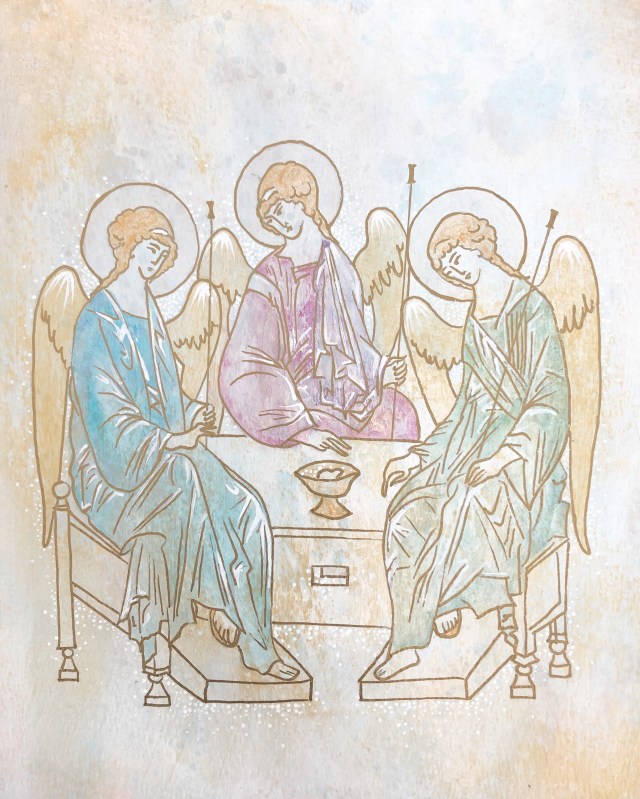
The Eternal One by Michelle L Hofer — mixed media painting on paper, 8 x 10 inches, 2019. Third Sunday After Epiphany — Year A Lectionary Texts
Isaiah 9:1-4 • Psalm 27:1, 4-9 • 1 Corinthians 1:10-18 • Matthew 4:12-23Image description: A bright pastel and gold iteration of Andrei Rublev’s well-known Hospitality of Abraham (Holy Trinity).* This icon-style image is an illustration from the story of God’s appearance to Abraham in the form of three beings (Genesis 18) delivering the news he and Sarah will have a son. Rublev expanded this image into a visual symbol for the triune nature of God. In the image, we see three haloed and winged figures holding long staffs and wearing different colored robes seated at a table. On the table rests a single pedestal-footed bowl of food (a nod to the oneness of the three while equally symbolic of Christ’s offering of his body and blood). We see platforms under the feet of the two figures sitting on either side of the table. The beings turn their faces to one another. Holding their staffs (a symbol of power and authority) in their left hands, each figure makes a gesture with their right hand. At the center of the table’s frontside is a small rectangular opening.
But there will be no gloom for those who were in anguish… The people who walked in darkness have seen a great light; those who lived in a land of deep darkness – on them light has shined. — Isaiah 9:1-2
The LORD is my light and my salvation; whom shall I fear? The LORD is the stronghold of my life; of whom shall I be afraid? One thing I asked of the LORD; this I seek: to live in the house of the LORD all the days of my life, to behold the beauty of the LORD, and to inquire in his temple. For he will hide me in his shelter in the day of trouble; he will conceal me under the cover of his tent; he will set me high on a rock. — Psalm 27:1,4-5
Now I appeal to you, brothers and sisters, by the name of our Lord Jesus Christ, that all of you be in agreement and that there be no divisions among you but that you be knit together in the same mind and the same purpose. — I Corinthians 1:10
From that time Jesus began to proclaim, “Repent, for the kingdom of heaven has come near.” — Matthew 4:17
The way in which these three figures are interacting with each other and the similarities/differences in the figures holds the invitation to enter a space of mystery and divine curiosity. Author Henri Nouwen described the evident communion here as a “circle of love”. How would you describe the facial expressions of the figures?
The figure on the left represents the Father-Mother. With the right hand, the Holy Parent gestures a sign of blessing toward the figure representing Christ at center. A band of gold across his shoulder distinguishes Christ as a ruler or king. Christ gestures towards the chalice with his right hand indicating his divine mission to become the sacrificial lamb who takes away the sins of the world. His gesture of two fingers is a reference to his dual nature – fully man and fully God. The Holy Spirit is represented by the figure who sits at left. Their hand gestures downward, perhaps to the small opening at the front of the altar table, a space indicating the customary placement of relics and the dwelling place of the saints as mentioned in the book of Revelation.
I have long treasured this quote in regards to that rectangular opening…
We must give all our attention to that open space because it is the place to which the Spirit points and where we become included in the divine circle… I come to the realization that this rectangular space speaks about the narrow road leading to the house of God. It is the road of suffering. While it’s four corners remind us that it represents the created order, including all people from the north, south, east, and west, its position in the altar signifies that there is room around the divine table only for those who are willing to become participants in the Divine sacrifice by offering their lives as a witness to the love of God. — Henri Nouwen*Andrei Rublev was a Russian monk who devoted his life to the painting of icons and frescoes in and around Moscow, Russia. He painted the Hospitality of Abraham in 1411 in memory of Saint Sergius, the founder of Russia’s Monastery of the Holy Trinity. Saint Sergius had a wonderful vision that all Russia should be united around the Name of God. In this unity of faith and love, the Russian people would conquer “the devouring hatred of the world by the contemplation of the Holy Trinity.”
Practicing Visio Divina:
- View the artwork
What do you see?
Note shapes – color – style – movement
What stands out for you?
What are you curious about?
What questions do you have?
Hold back any feelings – judgments – opinions - Read the accompanying scripture and look over the artwork again
What connections do you make?
Between the image and text?
What is coming to mind from your own experience?
What feelings are rising in you?
Are you uncomfortable with something?
There are no right or wrong answers - Read the scripture again and explore the artwork a third time
What do you hear?
What is God saying to you?
What do you wish to speak to God?

- View the artwork
-
Second Sunday After Epiphany

Agnus Dei apse mosaic in the Euphrasian Basilica, Poreč, Croatia — 6th-century, artisan(s) unknown. Second Sunday After Epiphany — Year A Lectionary Texts
Isaiah 49:1-7 • Psalm 40:1-11 • 1 Corinthians 1:1-9 • John 1:29-42Image description: Found at the top front center of the arched apse above the altar appears a white lamb on a green domed surface within a decorative round mandorla. A large round gold halo containing a cross surrounds the lamb’s head. The background is an aquamarine blue with six large white 8-pointed stars set on dark blue disks — three on each side of the lamb. To the right and left of the lamb are the names of two of the twelve female martyrs also depicted down the sides of the arch.
I am continuously thanking my God for you when I think about the grace God has offered you in Jesus the Anointed. In this grace, God is enriching every aspect of your lives by gifting you with the right words to say and everything you need to know. In this way, your life story confirms the life story of the Anointed One, so you are not ill-equipped or slighted on any necessary gifts as you patiently anticipate the day when our Lord Jesus, the Anointed One, is revealed. Until that final day, He will preserve you; and on that day, He will consider you faultless. Count on this: God is faithful and in His faithfulness called you out into an intimate relationship with His Son, our Lord Jesus the Anointed. — 1 Corinthians 1:4-9
…John sees Jesus coming toward him. In eager astonishment, he shouts out:
John the Baptist: Look! This man is more than He seems! He is the Lamb sent from God, the sacrifice to erase the sins of the world! He is the One I have been saying will come after me, who existed long before me and is much greater than I am. — John 1:29-30The image of the Lamb of God is one of the oldest in Christianity. It continues to be a powerful symbol for Christ. Given the history and the grand number of works portraying Jesus in this form, it took me a while to select just which lamb to share with you today. I landed on this mosaic from a very old Byzantine cathedral in Croatia for a couple of reasons.
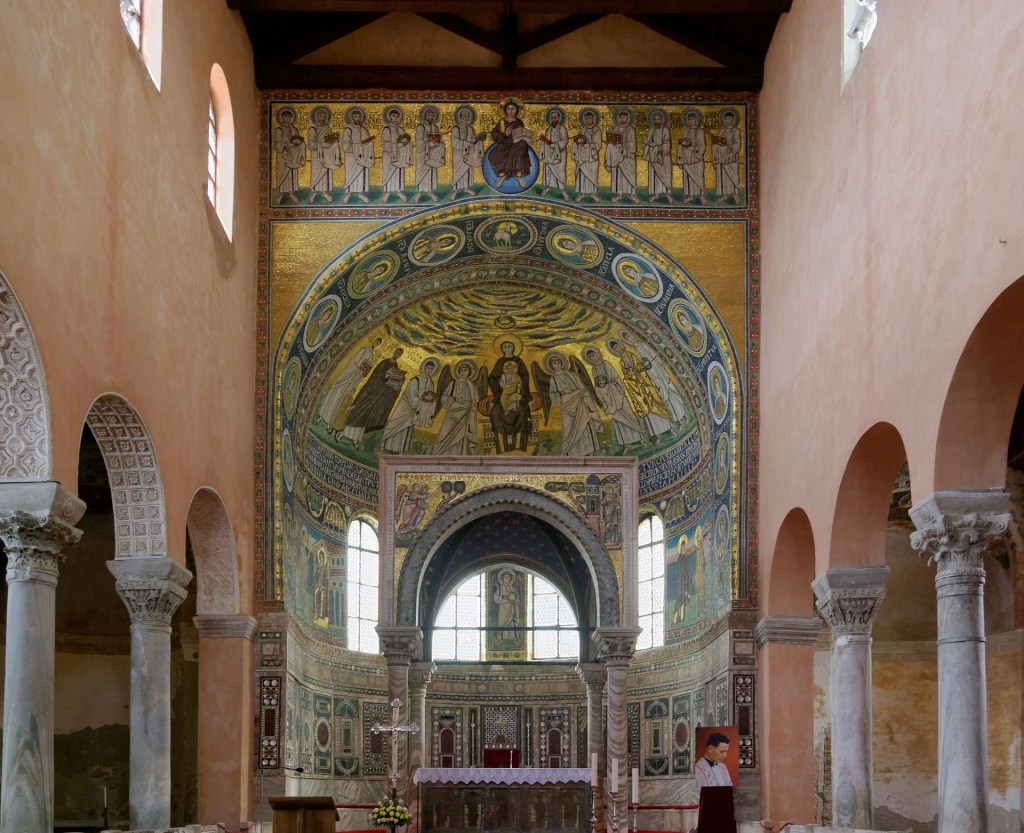
Interior of Euphrasian Basilica, Poreč, Croatia — 6th-century In my research this week I discovered that in 698AD a church council voted that Jesus should only be portrayed in his human form and not in symbolic imagery such as the Lamb of God. An interesting theological judgment call that doesn’t appear to have stuck. History shows us Lamb of God depictions continued to prevail. This symbol became so popular over the centuries we find it on coins and flags and coats of arms, in cathedral interior and exterior decoration, in beautiful stained glass and mosaics. You may have seen the popular rendering of a lamb with its hoof wrapped around a large cross or a flag with a large red cross set on white (the standard of Christianity).
Just recently a very expensive project to restore the Ghent Altarpiece of St. Bavo’s cathedral in Belgium painted by Hubert and Jan Van Eyck was completed. The result was shocking. In the restoration it was discovered someone had painted over the face on the lamb — seems the very human looking features and direct gaze on the Eycks’ Lamb of God were too much. I find the newly restored face baring a resemblance to the Croatian mosaic Lamb.
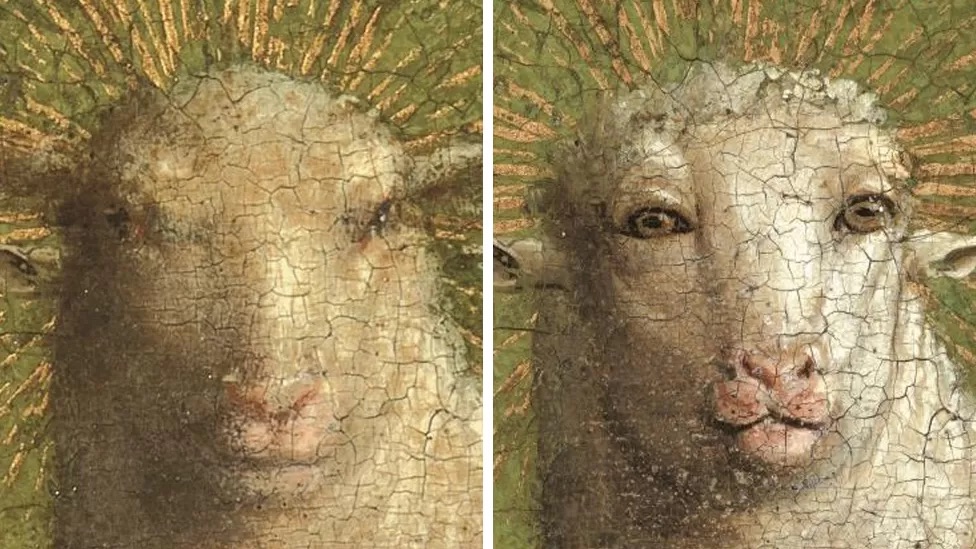
Detail of the Adoration of the Mystic Lamb panel from the Ghent Altarpiece by Hubert and Jan Van Eyck (left – pre-restoration and right – post-restoration image) — oil on wood, 1432. Photo by Royal Institute for Cultural Heritage. I am quite in favor of the decision in the Euphrasian Basilica to flank the lamb with the portraits of twelve martyred women. This is a rare find. Jesus as the Lamb of God is not surrounded by male disciples, prophets, apostles, writers, etc. I find this to be a connection point especially with the text from Paul to the Corinthians this week. Here in the opening of a letter that was read to men and woman alike comes a welcome encouragement. It strikes me as especially emboldening for those who would face persecution and death including those woman beautifully presented alongside the Lamb himself.

Apse mosaics in the Euphrasian Basilica, Poreč, Croatia — 6th-century, artisan(s) unknown. Practicing Visio Divina:
- View the artwork
What do you see?
Note shapes – color – style – movement
What stands out for you?
What are you curious about?
What questions do you have?
Hold back any feelings – judgments – opinions - Read the accompanying scripture and look over the artwork again
What connections do you make?
Between the image and text?
What is coming to mind from your own experience?
What feelings are rising in you?
Are you uncomfortable with something?
There are no right or wrong answers - Read the scripture again and explore the artwork a third time
What do you hear?
What is God saying to you?
What do you wish to speak to God?
What blessing or prayer is rising in you?
 1 Corinthians, 6th century, Agnus Dei, apse mosaics, Byzantine mosaic art, Christian art, Croatia, Euphrasian Basilica, Ghent Altarpiece, Gospel of John, Hurbert Van Eyck, Isaiah, Jan Van Eyck, Jesus Christ, John, Lamb of God, Lectionary, mandorla, Poreč, Psalms, Second Sunday After Epiphany, St. Bavo’s cathedral in Belgium, visio divina, Year A
 - View the artwork
-
Baptism of the Lord
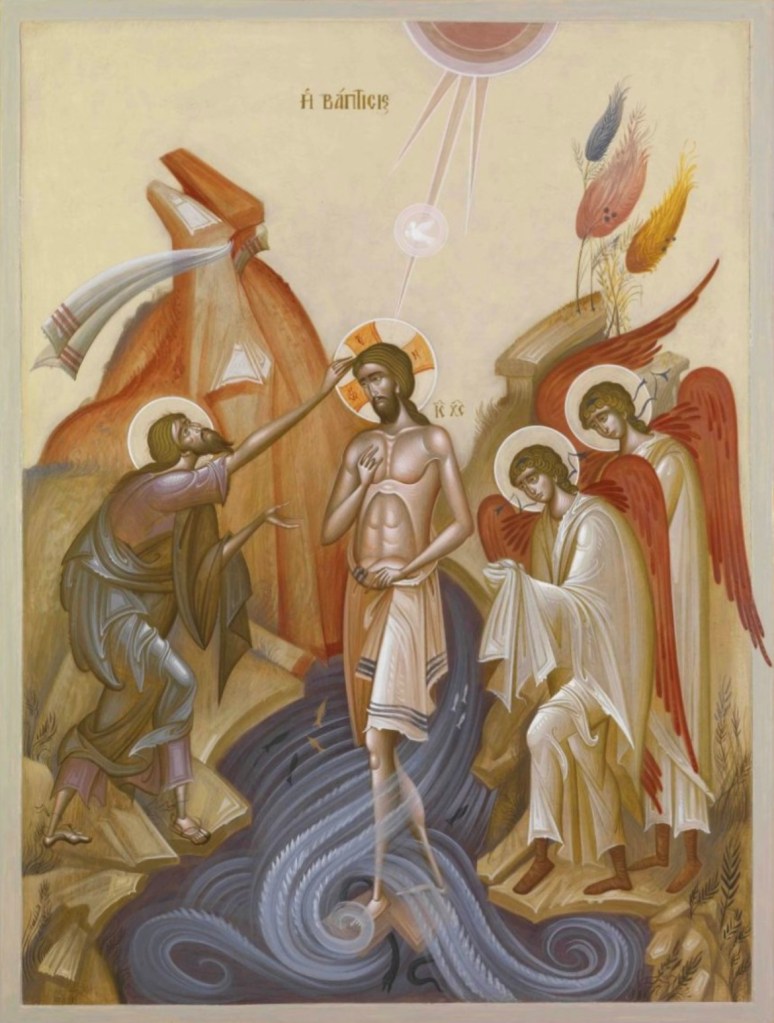
Baptism of Christ by George Kordis (Greek, born 1956) — egg tempera on wood, 75 x 55 cm. First Sunday After Epiphany — Year A Lectionary Texts
Isaiah 42:1-9 • Psalm 29 • Acts 10:34-43 • Matthew 3:13-17Image description: A traditionally painted icon with modern characteristics, Jesus stands in the Jordan River. With his left hand he clutches the cloth draped about his waist and with the right hand Jesus gestures a blessing towards himself. John the Baptist is seen crouching on the left bank of the river. With his outstretched right arm, John touches the top of Christ’s head. John’s gaze is directed upward toward the half-circle mandorla (opening of heaven) at the top of the image. John holds his left hand in an open gesture of receiving. The dove of the Spirit descends along one of the rays extending from the mandorla. Two angels stand with heads bowed and covered hands (an ancient practice of covering dirty calloused hands when approaching royalty) on the right riverbank. Colorful desert shrubbery accents the hilltop behind the angels. A garment wraps around the hill behind John flaps in the wind. In the waters of the Jordan are two schools of fish. Below Jesus’ feet are the gates of hell and a dark serpent being crushed beneath them.
Eternal One: I am the Eternal One. By righteousness I have called you. I will take you by the hand and keep you safe. You are given as a covenant between Me and the people: a light for the nations, a shining beacon to the world. You will open blind eyes so they will see again. You will lead prisoners, blinking, out from caverns of captivity, from cells pitch black with despair. — Isaiah 42:6-7
The voice of the Eternal echoes over the great waters; God’s magnificence roars like thunder. The Eternal’s presence hovers over all the waters. His voice explodes in great power over the earth. His voice is both regal and grand. — Psalm 29:3-4
You already know that God sent a message to the people of Israel; it was a message of peace, peace through Jesus the Anointed—who is King of all people. You know this message spread through Judea, beginning in Galilee where John called people to be ritually cleansed through baptism. You know God identified Jesus as the uniquely chosen One by pouring out the Holy Spirit on Him, by empowering Him. You know Jesus went through the land doing good for all and healing all who were suffering under the oppression of the evil one, for God was with Him. — Acts 10:36-38
And then, the One of whom John spoke — the all-powerful Jesus—came to the Jordan from Galilee to be washed by John. At first, John demurred.
John: I need to be cleansed by You. Why do You come to me?
Jesus: It will be right, true, and faithful to God’s chosen path for you to cleanse Me with your hands in the Jordan River.
John agreed, and he ritually cleansed Jesus, dousing Him in the waters of the Jordan. Jesus emerged from His baptism; and at that moment heaven was opened, and Jesus saw the Spirit of God descending like a dove and coming upon Him, alighting on His very body.
Voice from Heaven: This is My Son, whom I love; this is the Apple of My eye; with Him I am well pleased. — Matthew 3:13-17Today we look at an icon of Jesus’ baptism by John in the Jordan River. There are many icons of this scene to be found online. In my search for one, I landed on this modern icon from the hand of George Kordis. One difference in this icon caught my attention. It is the posture and position of John in relation to Christ. In most icons of the baptism John stands above Jesus, sometimes even leaning over him with a hand on Jesus’ head. Who George presents is a John crouching, he does not stand taller than Christ, and the extreme stretching of his arm to touch Jesus’ head so wonderfully embodies John’s humility in Jesus coming to him: “I am not worthy to untie his sandals.”
Another detail I marvel at in this icon are the garment billowing in the wind — an indicator of the Spirit’s presence? the thundering, shaking of God’s voice? There is much to explore and meditate on here in the landscape and the waters.
Practicing Visio Divina:
- View the artwork
What do you see?
Note shapes – color – style – movement
What stands out for you?
What are you curious about?
What questions do you have?
Hold back any feelings – judgments – opinions - Read the accompanying scripture and look over the artwork again
What connections do you make?
Between the image and text?
What is coming to mind from your own experience?
What feelings are rising in you?
Are you uncomfortable with something?
There are no right or wrong answers - Read the scripture again and explore the artwork a third time
What do you hear?
What is God saying to you?
What do you wish to speak to God?
What blessing or prayer is rising in you?

- View the artwork
-
Epiphany of the Lord
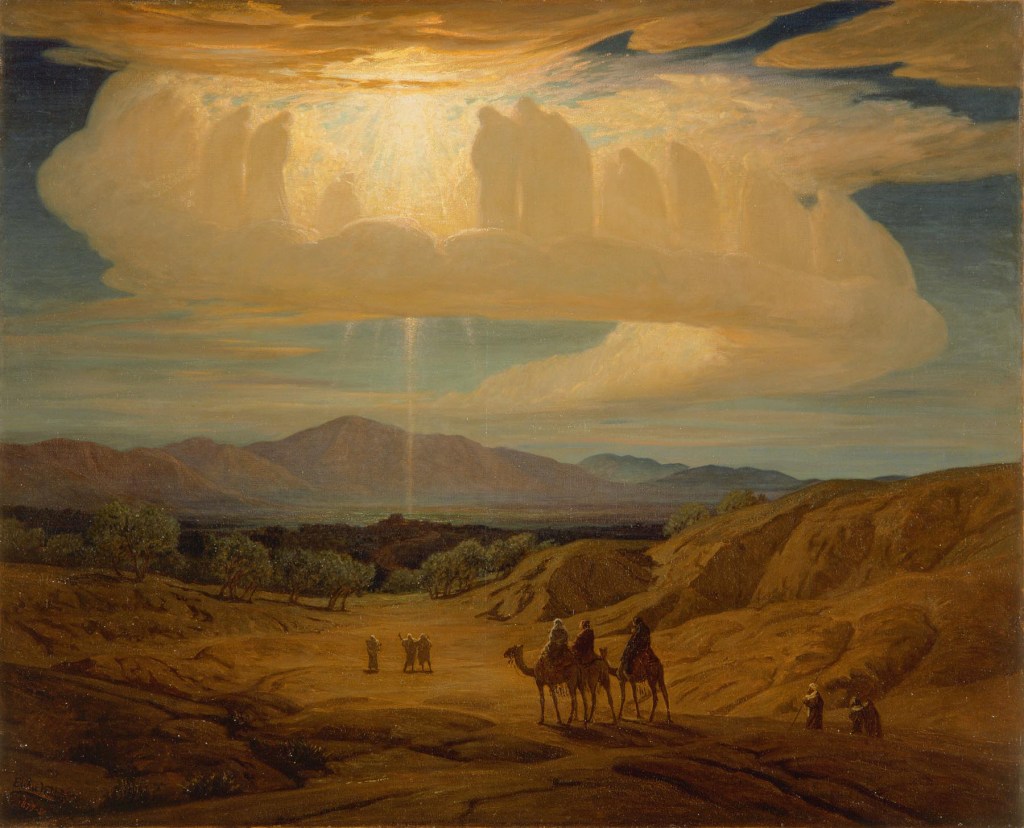
Star of Bethlehem by Elihu Vedder — oil on canvas, approximately 36 x 45 inches, 1879-80. Image by Milwaukee Art Museum. Epiphany of the Lord — Year A Lectionary Texts
Isaiah 60:1-6 • Psalm 72:1-7, 10-14 • Ephesians 3:1-12 • Matthew 2:1-12Image description: A realistic depiction of a vast landscape and sky. The foreground is desert, but in the distance are olive trees and a lush valley at the foot of a mountain range. The village of Bethlehem sits atop a darkened hill just beyond the grove of trees. From a break in the clouds near the upper edge of the paintings shines the light of the star in expanding rays. The center ray ends at Bethlehem on the hill. The wise men (riding camels) and two small groups of travelers gaze at the bright star a few have their arms raised toward the sky in gestures of amazement. Just below the star burst is a second bank of clouds upon which the forms of heavenly figures can be seen. These appear to be looking down at Bethlehem below.
See truly; look carefully—darkness blankets the earth; people all over are cloaked in darkness. But God will rise and shine on you; the Eternal’s bright glory will shine on you, a light for all to see. Nations north and south, peoples east and west, will be drawn to your light, will find purpose and direction by your light. In the radiance of your rising, you will enlighten the leaders of nations. — Isaiah 60:2-3
May good and honest people flourish for as long as he reigns, and may peace fill the land until the moon no longer rises. Let the kings of Tarshish and the island kings shower him with gifts and the kings of Sheba and Seba bring him presents as well. — Psalm 72:7,10
I am privileged to enlighten all of Adam’s descendants to the mystery concealed from previous ages by God, the Creator of all, through Jesus the Anointed. Here’s His objective: through the church, He intends now to make known His infinite and boundless wisdom to all rulers and authorities in heavenly realms. This has been His plan from the beginning, one that He has now accomplished through the Anointed One, Jesus our Lord. — Ephesians 3:9-10
The wise men left Herod’s chambers and went on their way. The star they had first seen in the East reappeared—a miracle that, of course, overjoyed and enraptured the wise men. The star led them to the house where Jesus lay. — Matthew 2:9-10
I have selected verses from each of the Lectionary texts to include with this image for it so wonderfully embodies a vision for each of these passages. It was such a delight to stumble upon this piece of art so perfect for Epiphany. It was also wonderful to discover a new American painter and one who indulged in illustrating that which is beyond our human site. Elihu Vedder (1836-1923) studied and received solid training in painting both stateside and abroad in Italy. His work is a fusion between the earthly realm and the realm of the spiritual (imagination, dreams, fantasy) as we see here in Star of Bethlehem. Vedder himself explains his artistic tendencies:
I have read much… and have thought much, and so it comes that I take short flights or wade out into the sea of mystery which surrounds us, but soon getting beyond my depth, return, I must confess with a sense of relief, to the solid ground of common sense; and yet it delights me to tamper and potter with the unknowable, and I have a strong tendency to see in things more than meets the eye … There is another thing – the ease with which I can conjure up visions. — Elihu Vedder
As I sat this week reading over the lectionary texts for both Epiphany and the Baptism of the Lord I experienced a moment of overwhelm. A joy surged through me as I marveled over the two art pieces I had selected for these occasions and just how wonderfully they brought the Scriptures alive for me. There were some tears at that moment. As a child, this was something denied me. The church I grew up in held the belief that all artistic expressions relating to Scripture, Christ, God were idolatry. Our sanctuary displayed no cross and our Sunday school material no illustrations. To have been led here by the nudging of the Spirit to this juncture is such an immense blessing to me. I recognize the healing it is for me to actively seek out every week the work of faithful artists — those from around the world who have given vision to all that God has revealed to us. These thoughts are my own small epiphany this week.
I am honored if you are reading this and are participating in this journey — thank you and thanks be to God.
Practicing Visio Divina:
- View the artwork
What do you see?
Note shapes – color – style – movement
What stands out for you?
What are you curious about?
What questions do you have?
Hold back any feelings – judgments – opinions - Read the accompanying scripture and look over the artwork again
What connections do you make?
Between the image and text?
What is coming to mind from your own experience?
What feelings are rising in you?
Are you uncomfortable with something?
There are no right or wrong answers - Read the scripture again and explore the artwork a third time
What do you hear?
What is God saying to you?
What do you wish to speak to God?
What blessing or prayer is rising in you?

- View the artwork
-
First Sunday After Christmas
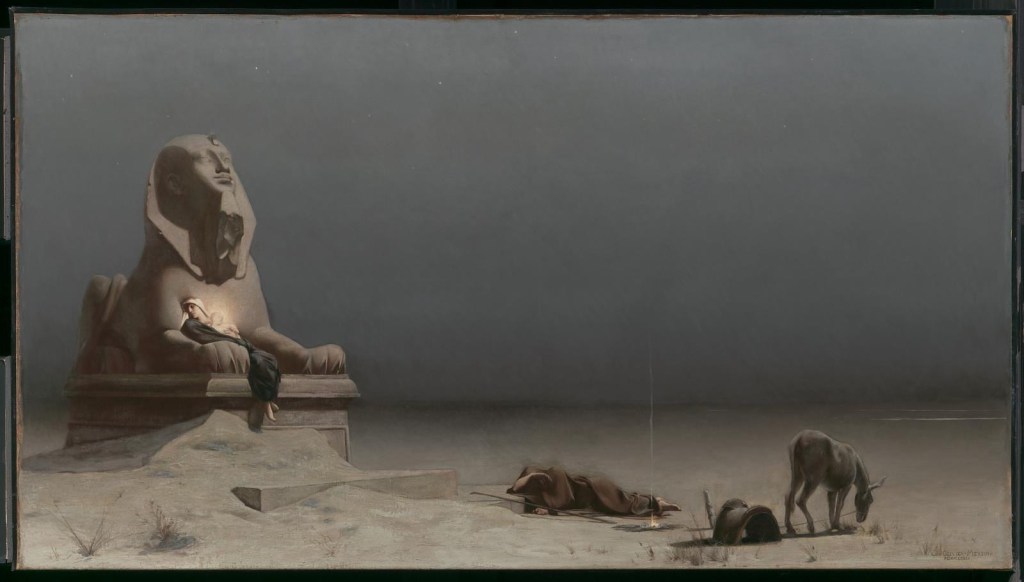
Rest on the Flight into Egypt by Luc Olivier Merson — oil on canvas, 28 1/4 x 50 1/2 inches, 1879. January 1, 2022 Lectionary Texts — Year A
Isaiah 63:7-9 • Psalm 148 • Hebrews 2:10-18 • Matthew 2:13-23Image description: The realistic scene is a vast desert landscape, perhaps along the sea judging from what look like two waves hitting a shore off in the distance. It is night, though all is quite well lit. Exhausted from travel, Joseph lies sleeping on the sand next to a small campfire which emits a single thin stream of smoke. A tethered donkey next to him forages a patch of grass in the sand. A saddle sits by the stake. Not far away, Mary and a brightly illuminated baby Jesus peacefully slumber in the nook of a large Egyptian sphinx statue. The sphinx gazes up into the dark sky where a few stars can be seen.
So let me remind you of the Eternal’s enduring love, and why we should praise Him. Let me tell you again how the Eternal gives and gives and gives. All God’s wonders and goodness are done for Israel’s benefit according to His great mercy and compassion.
Eternal One: Surely, these are My people, and they will be true to Me. My children will not try to deceive Me.
And indeed, God became their Savior. And when they suffered, God suffered too; and the messenger of His presence acted to save them. Out of enduring love, compassion, and concern, God Himself rescued them. Through all those years long ago, God picked them up and carried them through. — Isaiah 63:7-9After the wise men left, a messenger of the Lord appeared to Joseph in a dream.
Messenger of the Lord (to Joseph): Get up, take the child and His mother, and head to Egypt. Stay there until I tell you it is safe to leave. For Herod understands that Jesus threatens him and all he stands for. He is planning to search for the child and kill Him. But you will be safe in Egypt.
So Joseph got up in the middle of the night; he bundled up Mary and Jesus, and they left for Egypt. — Matthew 2:13-14Romantic as it is, artist Luc Olivier Merson provides for us a welcome variation on the classic Western depiction of Joseph leading the donkey carrying Mary and Jesus on their late night trip from Israel to Egypt. Merson was intrigued enough with this subject that he painted four different versions of it (two more are featured below) — each differing in the lighting.
The Isaiah passage references God’s rescue and even the assistance of a messenger. I like Merson’s painting in that it provides us a realistic-ish vision of such a rescue. We have a practice of turning the stories around Jesus birth into adorable vignettes — Rest on the Flight into Egypt pushes back. Merson presents a family in exhaustion. The way Joseph’s arm rests across his head hints at the stress of the ordeal: fleeing at night, extensive travel and nothing prearranged for their arrival in Egypt. I remember traveling with my children when they were small — even with much preparation the journey was challenging.
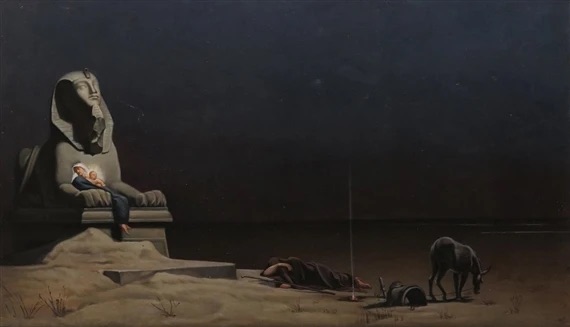
Rest on the Flight into Egypt by Luc Olivier Merson 
Rest on the Flight into Egypt by Luc Olivier Merson, 1879. Practicing Visio Divina:
- View the artwork
What do you see?
Note shapes – color – style – movement
What stands out for you?
What are you curious about?
What questions do you have?
Hold back any feelings – judgments – opinions - Read the accompanying scripture and look over the artwork again
What connections do you make?
Between the image and text?
What is coming to mind from your own experience?
What feelings are rising in you?
Are you uncomfortable with something?
There are no right or wrong answers - Read the scripture again and explore the artwork a third time
What do you hear?
What is God saying to you?
What do you wish to speak to God?
What blessing or prayer is rising in you?

- View the artwork
-
Christmas
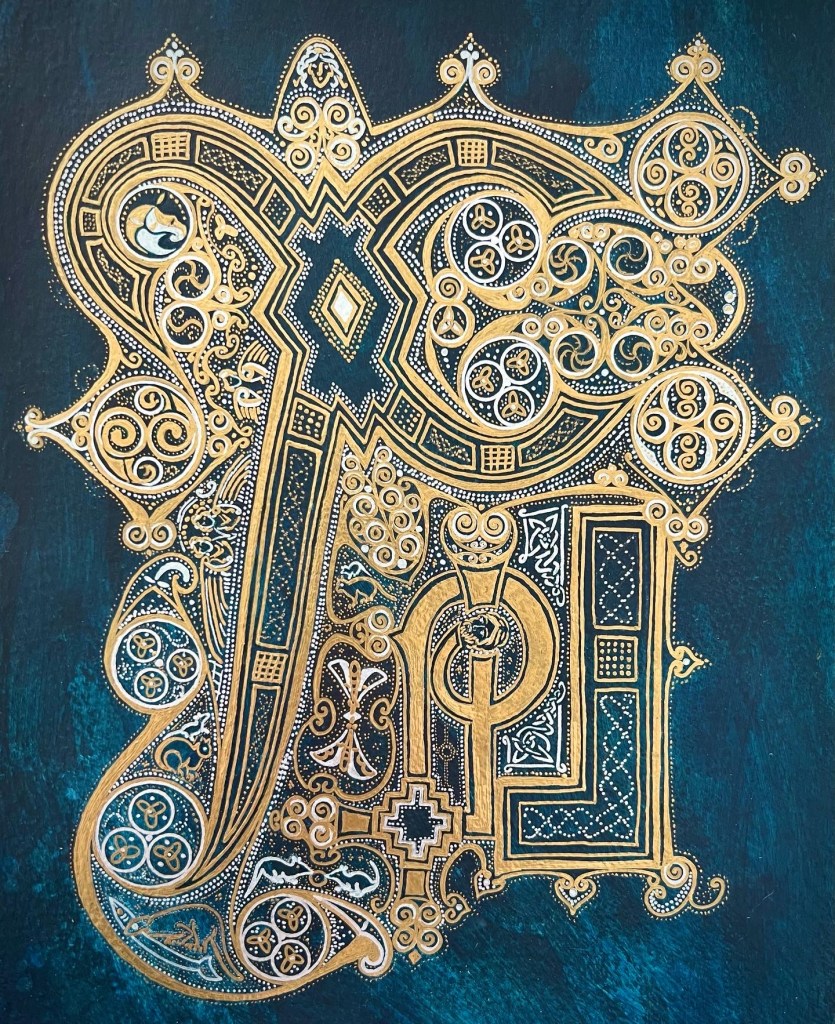
The Chi Rho (after The Book of Kells) by Michelle L Hofer — mixed media painting on paper mounted on hardboard, 8 x 10 inches, 2022. December 24/25, 2022 Lectionary Texts — Year A
Isaiah 52:7-10 • Psalm 98 • Hebrews 1:1-4, (5-12) • John 1:1-14Image description: A decorative presentation of the Greek letters X P I spelling Christi or Christ. A variation on the design found in the Chi Rho Page from the illuminated Celtic Gospels, The Book of Kells. Space around and between the letters is filled with spiral designs, Celtic knot work, angels, moths, an otter with a fish, several cats and mice playing together and the face of Christ. A diamond symbol for Christ is the focal point of the piece and appears at the cross-section of the X. The design has been rendered in mostly metallic gold and some silver on a deep blue background.
This is the One who—imprinted with God’s image, shimmering with His glory—sustains all that exists through the power of His word. He was seated at the right hand of God once He Himself had made the offering that purified us from all our sins. This Son of God is elevated as far above the heavenly messengers as His holy name is elevated above theirs. — Hebrews 1:3-4
In the beginning was the Word, and the Word was with God, and the Word was God. He was with God in the beginning. Through him all things were made; without him nothing was made that has been made. In him was life, and that life was the light of all mankind. The light shines in the darkness, and the darkness has not overcome it. — John 1:1-5
In a college library in Ireland sits one of the most valuable and impressive books in the world. It dates back to around the year 800, but so much is unknown about this rare jewel including who made it and where. There is no question however as to the why. The book, known as The Book of Kells, is a work of art.
Christian communities in the Middle Ages, especially those in the Celtic world, had a place known as the Scriptorium. Here, books and manuscripts were both kept and copied by monks (tediously by hand, of course). The newly converted Celtic Christian scribes started to get super fancy in their copying task turning the work into worship creating elaborate page designs and illustrations. This is known as illumination. No book was more attentively and creatively rendered among the Celts like a volume of the Gospels. The Book of Kells is the finest existing example of an illuminated Gospel.There is one page in The Book of Kells that stands out as an artistic masterpiece. It is called the Chi Rho (pronounced KEE – row) page. It is a highly decorative monogram for Christ whose name is spelled ΧΡΙΣΤΟΣ in Greek. The X is Greek letter Chi and the P is letter Rho. The page is filled with unbelievable woven knotwork and spirals. All this intricacy is found on a parchment page approximately 13 by 9.5 inches in size.
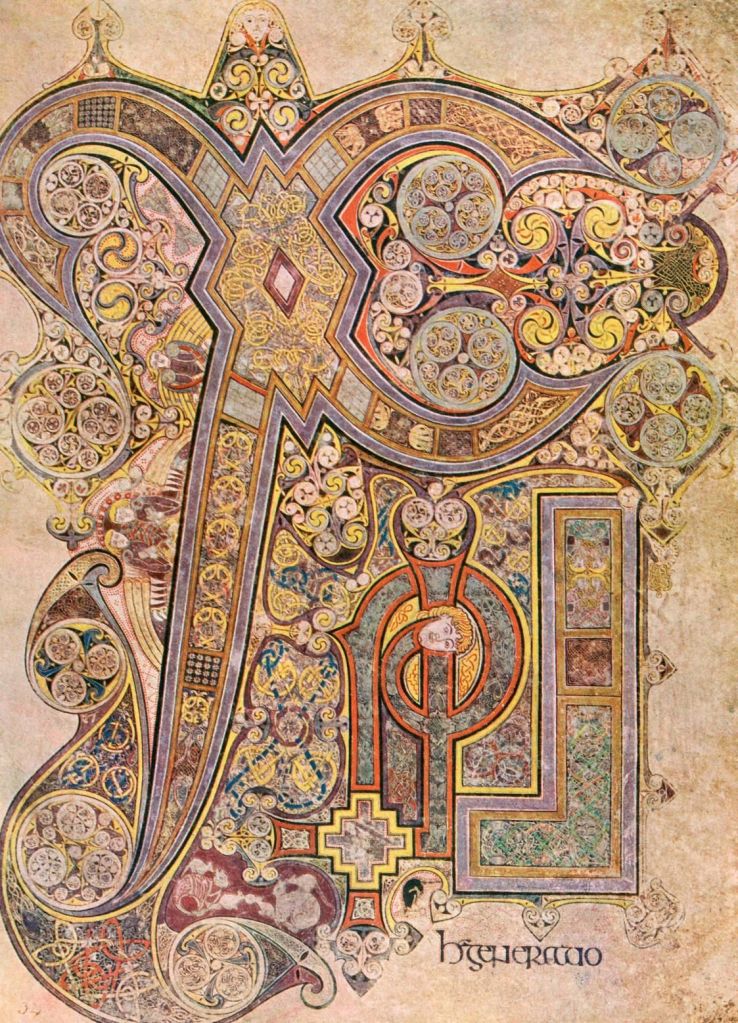
Folio034r — The Chi Rho Monogram, The Book of Kells. It is this wonderful design that I have attempted to recreate. Working on a slightly smaller scale and with larger pen tips, I was not able to replicate all of the detail found in the original. I was challenged to create my own disbursement of the spirals and creatures within the spaces around the letters. The whole piece lends itself to meditation easily as there is much to explore and discover.
Practicing Visio Divina:
- View the artwork
What do you see?
Note shapes – color – style – movement
What stands out for you?
What are you curious about?
What questions do you have?
Hold back any feelings – judgments – opinions - Read the accompanying scripture and look over the artwork again
What connections do you make?
Between the image and text?
What is coming to mind from your own experience?
What feelings are rising in you?
Are you uncomfortable with something?
There are no right or wrong answers - Read the scripture again and explore the artwork a third time
What do you hear?
What is God saying to you?
What do you wish to speak to God?
What blessing or prayer is rising in you?

- View the artwork
-
Fourth Sunday of Advent
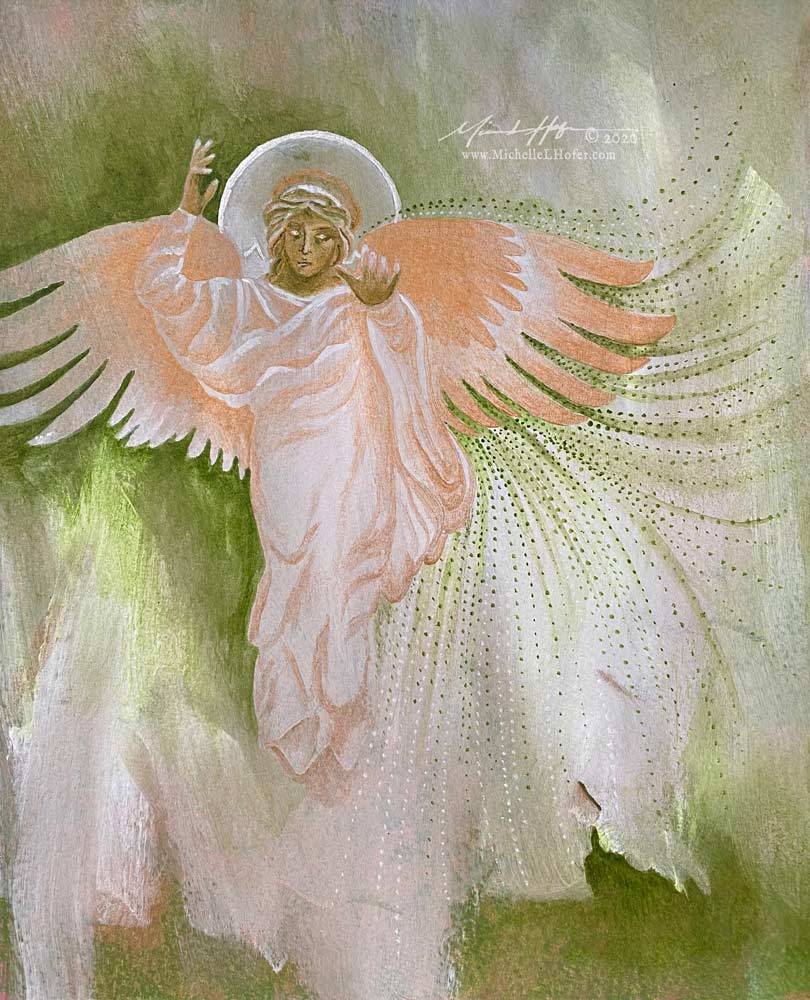
Messenger of Truth by Michelle L Hofer — mixed media painting on paper, 8 x 10 inches, 2020 Fourth Sunday of Advent — December 18, 2022 Lectionary Texts — Year A
Isaiah 7:10-16 • Psalm 80:1-7, 17-19 • Romans 1:1-7 • Matthew 1:18-25Image description: A messenger angel floats mid air in tones of spring green, copper, white and silver. Eyes glow from a stern looking feminine face. Dressed in a flowing robe that hides the feet and a silver halo, the angel holds its left hand upward its fingers extended as if it is receiving something from above. With right arm extended the angel points directly at the viewer conveying that which is being received. Shorter dense wings unfurl behind the angel. The left wing of the messenger is surrounded by green while the right wing emits a energetic flowing lines of dot work. The painting is based on the bronze sculpture that hangs on church at The Shepherd’s Field near Bethlehem in Palestine.
Isaiah: Listen then. You are none other than the house of David, the one who inherited God’s promise of permanent kingship for David’s descendants. Is it so easy to be a bore to people that you would exhaust God’s patience too? Suit yourself. The Lord will give you a proof-sign anyway: See, a young maiden will conceive. She will give birth to a son and name Him Immanuel, that is, “God with us.” — Isaiah 7:13-14
Joseph, because he was kind and upstanding and honorable, wanted to spare Mary shame. He did not wish to cause her more embarrassment than necessary. Now when Joseph had decided to act on his instincts, a messenger of the Lord came to him in a dream.
Messenger of the Lord: Joseph, son of David, do not be afraid to wed Mary and bring her into your home and family as your wife. She did not sneak off and sleep with someone else — rather, she conceived the baby she now carries through the miraculous wonderworking of the Holy Spirit. She will have a son, and you will name Him Jesus, which means “the Lord saves,” because this Jesus is the person who will save all of His people from sin. — Matthew 1:19-21You’ve maybe heard of a “truth bomb” — its when the truth is revealed and with it comes a shock because we either weren’t expecting it, find it hard to believe, or don’t want to hear it. The look on the face of this angel and the strong confident hand gestures strike me. It was easy to land on the title, Messenger of Truth after I had completed this painting. The angel appears the very visualization of a “truth bomb”. Our lectionary texts too contain the accounts of both King Ahaz and Joseph receiving some real truth. Have you ever had a similar experience where something was revealed to you and it came with such force it changed you? your direction? your understanding? your outlook?
Practicing Visio Divina:
- View the artwork
What do you see?
Note shapes – color – style – movement
What stands out for you?
What are you curious about?
What questions do you have?
Hold back any feelings – judgments – opinions - Read the accompanying scripture and look over the artwork again
What connections do you make?
Between the image and text?
What is coming to mind from your own experience?
What feelings are rising in you?
Are you uncomfortable with something?
There are no right or wrong answers - Read the scripture again and explore the artwork a third time
What do you hear?
What is God saying to you?
What do you wish to speak to God?
What blessing or prayer is rising in you?

- View the artwork
-
Third Sunday of Advent
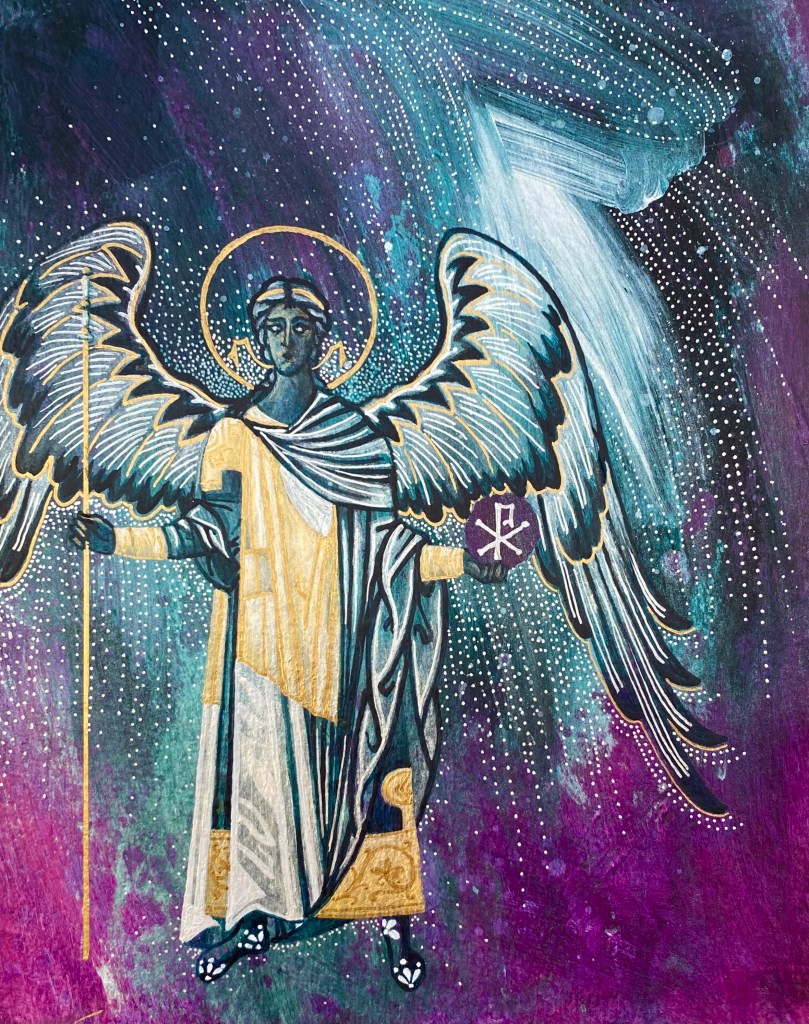
Divine Messenger by Michelle L Hofer — mixed media painting on paper, 8 x 10 inches, 2020 December 11, 2022 Lectionary Texts — Year A
Isaiah 35:1-10 • Psalm 146:5-10 or Luke 1:46b-55 • James 5:7-10 • Matthew 11:2-11Image description: The Archangel Gabriel stands confidently holding a long staff in the right hand and a ball/disk in the left bearing the Chi Rho symbol for Christ. The arms are open and the feet spread apart. Gabriel is dressed in regal embroidered robes, fancy shoes and a cloak draping mostly over his left arm. The facial expression is one of seriousness. The eyes glow. A simple gold line indicates a halo around the head. Large powerful wings fan out from behind Gabriel who is positioned to the left of center in the image. The background features an abstract smear and splattering of paint in deep purple and blue with pearlescent white. Silver dots highlight and follow the swash of paint behind the angel — the effect resembles the spray of fireworks in the sky.
So, with confidence and hope in this message, strengthen those with feeble hands, shore up the weak-kneed and weary. Tell those who worry, the anxious and fearful, “Take strength; have courage! There’s nothing to fear. Look, here — your God! Right here is your God! The balance is shifting; God will right all wrongs. None other than God will give you success. He is coming to make you safe.” — Isaiah 35:3
Blessed are those whose help comes from the God of Jacob, whose hope is centered in the Eternal their God — Psalm 146:5
For this reason, my brothers and sisters, be patient as you wait for the return of the Lord. Look! The farmer knows how to wait patiently for the land to produce vegetables and fruits. He cannot harvest a freshly planted seed. Instead, he waits for the early and the late showers to nourish the soil. You need this same kind of patience, so in the meantime, strengthen your resolve because the Lord will be coming soon. — James 5:7-8
While the angel form in artistic works certainly represents those beings who serve and administer for God, such depictions can also be understood as visual metaphors for the qualities of God us humans most need reminding of — hope, strength, courage, faith.
The angel form of Gabriel can therefore represent the delivery itself of God’s message to us. I enjoy working to create variations on Gabriel that exude God’s presence, power and rescue. This particular angel is based on the 13th century mosaic found in the Hagia Sophia Cathedral in Istanbul.
It strikes me how large the wings are on this Gabriel — much larger than other angel prototypes I utilize. I find this a point of significance in light of the texts this week. As wings on angel forms represent the swiftness and speed of message delivery, they also symbolize the ability of a message to go anywhere and everywhere. The message contained in these Scriptures is of the highest importance — God’s desire and promise to save us through the coming of Christ.
It can be humorous at times what might pop up as you explore image and Scripture. Of all the thoughts to occur, I found myself looking at Gabriel’s enormous wings and remembering a quote from the classic killer shark movie, Jaws. Upon meeting defeat in catching the terrorizing beast due to the inferiority of their equipment, Sheriff Brody delivers the famous line, “We’re gonna need a bigger boat.” A parallel conclusion came to me… “We’re gonna need bigger wings.”
Practicing Visio Divina:
- View the artwork
What do you see?
Note shapes – color – style – movement
What stands out for you?
What are you curious about?
What questions do you have?
Hold back any feelings – judgments – opinions - Read the accompanying scripture and look over the artwork again
What connections do you make?
Between the image and text?
What is coming to mind from your own experience?
What feelings are rising in you?
Are you uncomfortable with something?
There are no right or wrong answers - Read the scripture again and explore the artwork a third time
What do you hear?
What is God saying to you?
What do you wish to speak to God?
What blessing or prayer is rising in you?

- View the artwork
-
Second Sunday of Advent
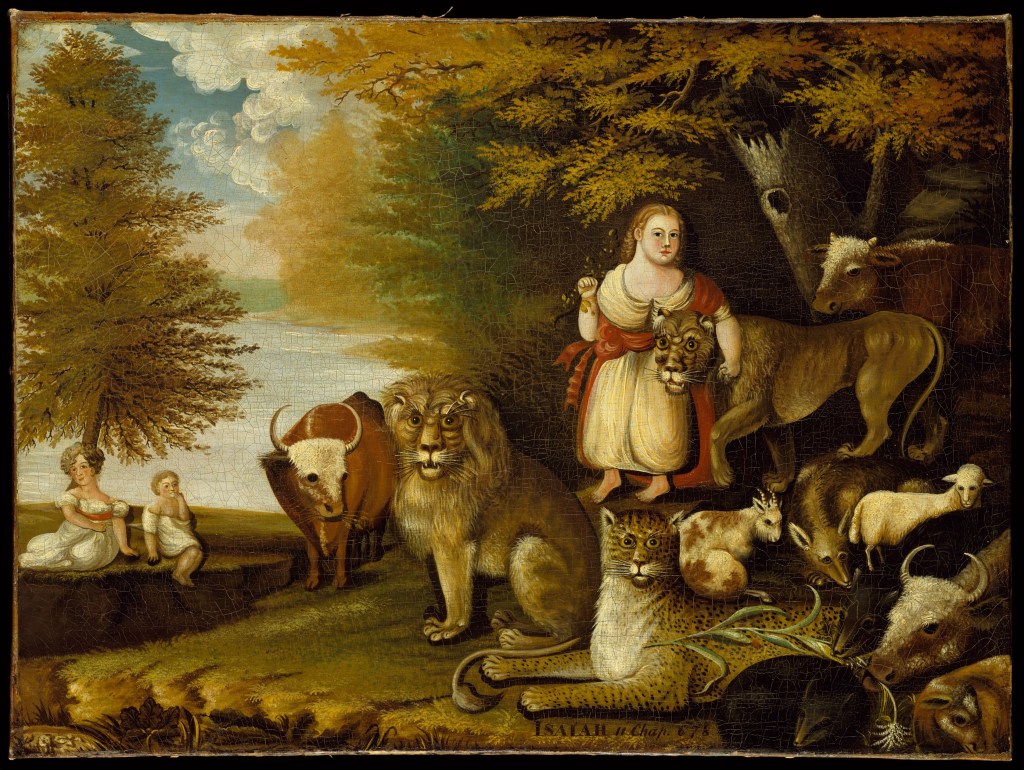
Peaceable Kingdom by Edward Hicks — oil on canvas, 17 7/8 x 23 7/8 inches, ca. 1830-1832. December 4, 2022 Lectionary Texts — Year A
Isaiah 11:1-10 • Psalm 72:1-7, 18-19 • Romans 15:4-13 • Matthew 3:1-12
View LectionaryImage description: A menagerie of animals fill most of the canvas and include lions, ox, cattle, cheetah, goat, sheep and calf. The animals have wide eyes. Some munch together on grain stalks. A young child stands among the animals with its arm around the neck of a lion. In the distance and off to the left of the painting sit two children — one older and the other a toddler. Both appear to have their hands over holes in the ground. A lake and trees occupy the background. A dead and fractured tree trunk can be seen among the trees. At the bottom of the canvas just below the cheetah is the text: “ISAIAH 11 Chap. 6 7 8”.
A day will come when the wolf will live peacefully beside the wobbly-kneed lamb, and the leopard will lie down with the young goat; The calf and yearling, newborn and slow, will rest secure with the lion; and a little child will tend them all. Bears will graze with the cows they used to attack; even their young will rest together, and the lion will eat hay, like gentle oxen. Neither will a baby who plays next to a cobra’s hole nor a toddler who sticks his hand into a nest of vipers suffer harm. All my holy mountain will be free of anything hurtful or destructive, for as the waters fill the sea, The entire earth will be filled with the knowledge of the Eternal. — Isaiah 11:6-9
I pray that God, the source of all hope, will infuse your lives with an abundance of joy and peace in the midst of your faith so that your hope will overflow through the power of the Holy Spirit. — Romans 15:13
Edward Hicks was obsessed with this concept/image of the peaceable kingdom. There are 62 versions of this painting done by him in existence. While there may be differences in the exact subjects included in the scene, all of Hicks works on this subject are explorations into how this visualization of the text plays out in the realities of life. Hicks was himself a Quaker minister and was deeply concerned over a split among the Society of Friends happening at the time. The splintered tree in this particular painting is said to be the representation of that break. Other versions include indigenous peoples interacting with European immigrants in background — another relationship in which Hicks hoped for peace.
Hicks was not trained in art and his unique style and expression has become an important contribution to American folk art.
Practicing Visio Divina:
- View the artwork
What do you see?
Note shapes – color – style – movement
What stands out for you?
What are you curious about?
What questions do you have?
Hold back any feelings – judgments – opinions - Read the accompanying scripture and look over the artwork again
What connections do you make?
Between the image and text?
What is coming to mind from your own experience?
What feelings are rising in you?
Are you uncomfortable with something?
There are no right or wrong answers - Read the scripture again and explore the artwork a third time
What do you hear?
What is God saying to you?
What do you wish to speak to God?
What blessing or prayer is rising in you?

- View the artwork
-
First Sunday of Advent
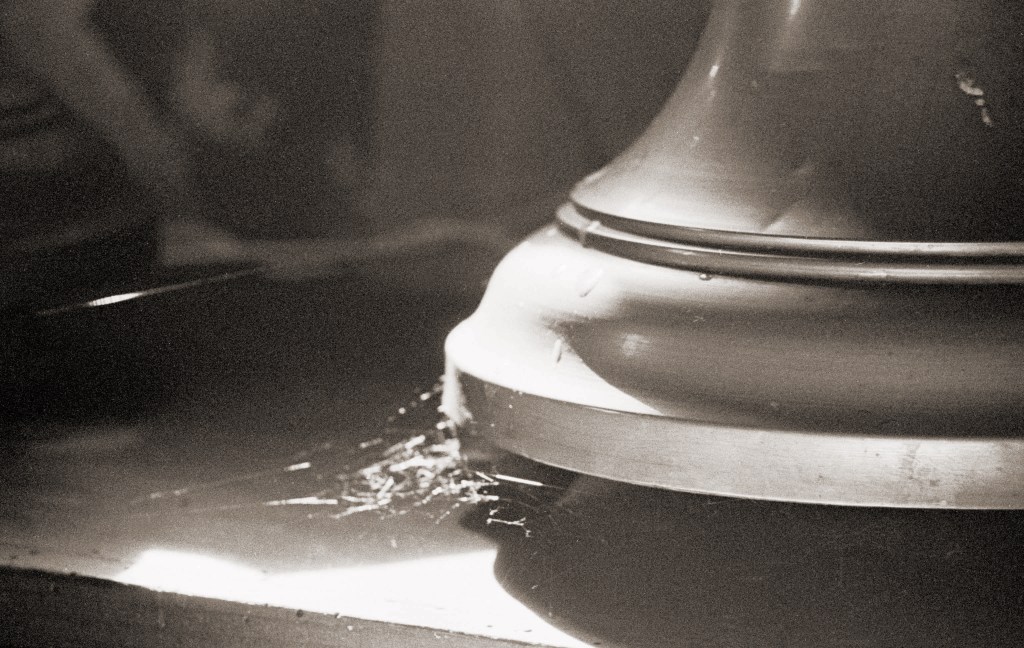
Church History by Michelle L Hofer — sepia toned silver gelatin print, 7 x 9 inches, 1998. November 25, 2022 Lectionary Texts — Year A
Isaiah 2:1-5 • Psalm 122 • Romans 13:11-14 • Matthew 24:36-44Image description: Closeup black and white photograph of the base of a brass candlestick on a church altar. Sunlight from a window above the altar hits the edge of the candlestick base and the table. Though mostly out of focus, a grid of cobwebs shimmers in the light between the candlestick and the table surface.
O house of Jacob — people of the promise — come, come walk with me by the light of the Eternal. — Isaiah 2:5
And now consider this. You know well the times you are living in. It is time for you to wake up and see what is right before your eyes: for salvation is nearer to us now than when we first believed. The darkness of night is dissolving as dawn’s light draws near, so walk out on your old dark life and put on the armor of light. — Romans 13:11-12
One of the joys of working in a darkroom developing prints from negatives is the length of time spent with a singular image — some images required many long hours to produce a quality print. It was this practice which opened me. I began seeing my pictures as metaphors for the spiritual life and journey. The potential for comparison and reflection between this week’s prophetic texts and this particular image is why I have chosen it. You may find the story behind the photo enlightening as well.
I took this photograph on a heritage tour across Europe visiting sites associated with Hutterites and Mennonites (my husband’s ancestry). While exploring a poverty stricken village in Slovakia, and old woman accommodated us by unlocking and letting us into a tiny chapel.
Silently, our group filled the pews to hear the story of the Habáner people — Hutterites who, having already fled Europe under religious persecution, were now unwilling to move again from this area of Slovakia because of mounting religious persecution. Instead, this group of people recanted their Anabaptist faith and accepted the sanctioned Catholic faith with the assistance of Catholic missionaries. The chapel we were sitting in was built by those missionaries while they were visiting the village.
At the time of our visit to Slovakia in 1998, few in the village practiced any religion at all having been under communist rule for many decades. The chapel sat locked up with its few remaining fixtures, among them a pair of wax dripped brass candlesticks, the rest having been looted.Practicing Visio Divina:
- View the artwork
What do you see?
Note shapes – color – style – movement
What stands out for you?
What are you curious about?
What questions do you have?
Hold back any feelings – judgments – opinions - Read the accompanying scripture and look over the artwork again
What connections do you make?
Between the image and text?
What is coming to mind from your own experience?
What feelings are rising in you?
Are you uncomfortable with something?
There are no right or wrong answers - Read the scripture again and explore the artwork a third time
What do you hear?
What is God saying to you?
What do you wish to speak to God?
What blessing or prayer is rising in you?

- View the artwork

 Visio Divina
You must be logged in to post a comment.