-
Pentecost Sunday
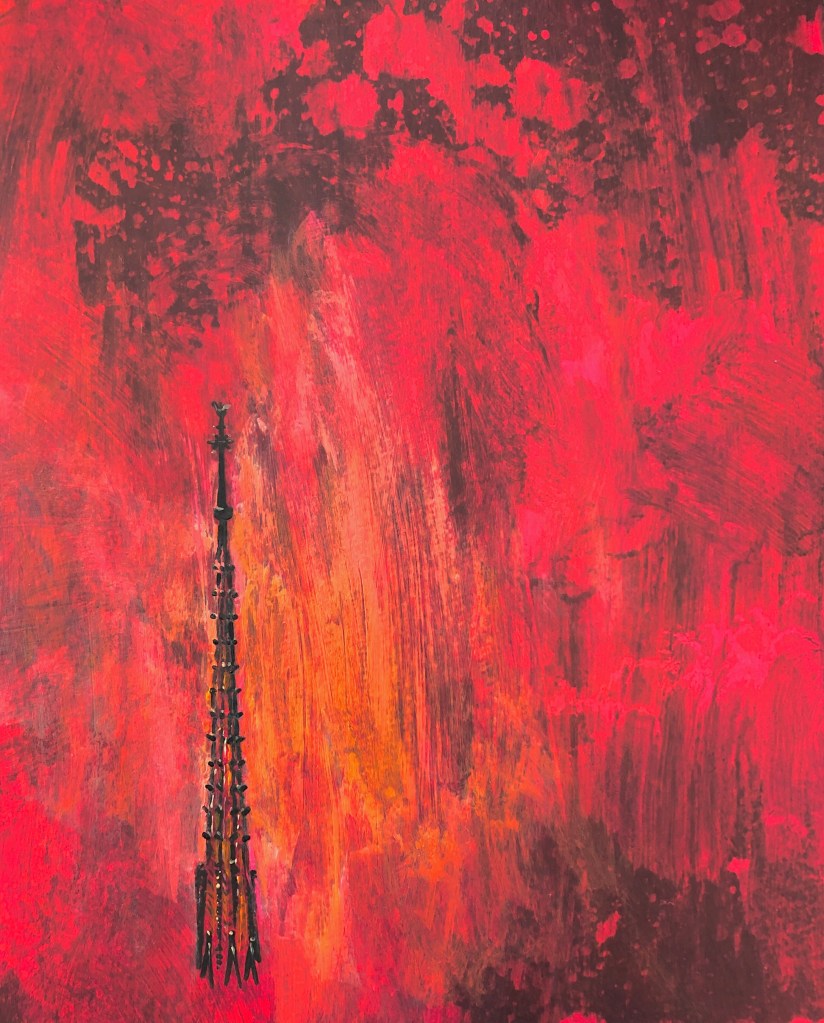
Notre Dame Cathedral by Michelle L Hofer — acrylic paint on paper, 8 x 10 inches, 2019. May 28, 2023 Lectionary Texts — Year A
Acts 2:1-21 or Numbers 11:24-30 • Psalm 104:24-34, 35b • 1 Corinthians 12:3b-13 or Acts 2:1-21 • John 20:19-23 or John 7:37-39Image description: Set on a fluorescent red and brown abstract background rises the spire of Notre Dame Cathedral. A flash of orange appears around the spire.
When the holy day of Pentecost came 50 days after Passover, they were gathered together in one place. Picture yourself among the disciples: A sound roars from the sky without warning, the roar of a violent wind, and the whole house where you are gathered reverberates with the sound. Then a flame appears, dividing into smaller flames and spreading from one person to the next. All the people present are filled with the Holy Spirit and begin speaking in languages they’ve never spoken, as the Spirit empowers them. — Acts 2:1-4
A young man ran to Moses…
Young Man: Eldad and Medad are prophesying in the camp! Joshua (Nun’s son and Moses’ assistant from the time he was little), also was alarmed.
Joshua: Moses, my lord, stop them!
Moses: Are you so agitated on my account? If only all of the Eternal’s people were prophets, that He would lay His Spirit on them. — Numbers 11:27-29May the glorious presence of the Eternal linger among us forever. And may He rejoice in the greatness of His own works— He, who rattles the earth with a glance; He, who sets mountains to smoking with a touch. I will sing to the Eternal all of my life; I will call my God good as long as I live. May the thoughts of my mind be pleasing to Him, for the Eternal has become my happiness. …As for the Eternal, call Him good, my soul. Praise the Eternal! — Psalm 104:31-35b
Each believer has received a gift that manifests the Spirit’s power and presence. That gift is given for the good of the whole community. The Spirit gives one person a word of wisdom, but to the next person the same Spirit gives a word of knowledge. Another will receive the gift of faith by the same Spirit, and still another gifts of healing — all from the one Spirit. One person is enabled by the Spirit to perform miracles, another to prophesy, while another is enabled to distinguish those prophetic spirits. The next one speaks in various kinds of unknown languages, while another is able to interpret those languages. One Spirit works all these things in each of them individually as He sees fit. — 1 Corinthians 12:7-11
I’ve chosen this painting for its symbolic potential as we celebrate Pentecost today. It is the piece I created upon hearing the news of the fire that ravaged the Notre Dame Cathedral in Paris, France in 2019. How then does it serve as a visual for the celebration of the arrival of the Holy Spirit? It’s coloration is the first connection — fire is the noted visual presence of the Holy Spirit coming upon those gathered together in the upper room. We must also consider the meaning and symbolism of this architectural component which distinctly adorns a Christian house of worship — the spire. Spires have been said to remind and point the viewer upward to heaven, the place we are to fix our thoughts on. The work, the coordination that building a cathedral required parallels the building of the kingdom. A cathedral project required the gifts of many individuals sometimes across several generations as does the work we are called to in the Spirit.
I am dedicating this post especially to my father who passed suddenly this week. He inspired my life and my faith. He encouraged/supported my own spiritual growth in countless ways including being an loyal weekly reader of these posts.
Practicing Visio Divina:
- View the artwork
What do you see?
Note shapes – color – style – movement
What stands out for you?
What are you curious about?
What questions do you have?
Hold back any feelings – judgments – opinions - Read the accompanying scripture and look over the artwork again
What connections do you make?
Between the image and text?
What is coming to mind from your own experience?
What feelings are rising in you?
Are you uncomfortable with something?
There are no right or wrong answers - Read the scripture again and explore the artwork a third time
What do you hear?
What is God saying to you?
What do you wish to speak to God?

- View the artwork
-
Seventh Sunday of Easter

St. George by Heinrich Lefler — color lithograph from a calendar published by Artaria and Co. for the Austrian Museum of Arts and Crafts, 1900. Image by Getty Research Institute May 21, 2023 Lectionary Texts — Year A
Acts 1:6-14 • Psalm 68:1-10, 32-35 • 1 Peter 4:12-14; 5:6-11 • John 17:1-11Image description: The image is comprised of three colored line-drawn panel illustrations. In the narrow upper left panel, two women with flowing hair and white robes pull ropes to ring three large golden bells atop a wooden scaffold. In a small square panel below them is a sun rising over a mountain under which appears the Latin phrase OCCINIT UT ORIATUR which translates: HE KILLS TO RISE. In the largest panel taking up the majority of the image is Saint George seen in profile and dressed in medieval armor with head bowed and hands clasped in prayer atop his black horse. On his hip hangs his shield – white with a red cross. The Christian banner (also white with a red cross) seen atop a long pole, rests against the saint’s far shoulder. Saint George appears through a stone archway featuring a small column topped with a crown-adorned eagle emblem and a sculpted crouching lion with an open mouth. Now dead, the head of large dragon hangs out the bottom of the archway. George’s sword is still stuck in its neck. A clawed foot rests on the column and the dragon’s large upward-pointing wings also frame the saint on his horse. On the stone below the archway appears the text, S. GEORGIUS — PATRON VON KRAIN.
When they had gathered just outside Jerusalem at the Mount of Olives, they asked Jesus,
Disciples: Is now the time, Lord—the time when You will reestablish Your kingdom in our land of Israel?
Jesus: The Father, on His own authority, has determined the ages and epochs of history, but you have not been given this knowledge. Here’s the knowledge you need: you will receive power when the Holy Spirit comes on you. And you will be My witnesses, first here in Jerusalem, then beyond to Judea and Samaria, and finally to the farthest places on earth. — Acts 1:6-8Sing songs of praise to the name that belongs to the True God! Let your voices ring out in songs of praise to Him, the One who rides through the deserted places. His name is the Eternal; celebrate in His glorious presence… To Him who rides high up beyond the heavens, which have been since ancient times, watch and listen. His voice speaks, and it is powerful and strong. Attribute power to the one True God; His royal splendor is evident over Israel, and His power courses through the clouds. O True God, You are awesome from the holy place where You dwell. The True God of Israel Himself grants strength and power to His people. Blessed be our God! — Psalm 68:4,33-35
So bow down under God’s strong hand; then when the time comes, God will lift you up. Since God cares for you, let Him carry all your burdens and worries. Most importantly, be disciplined and stay on guard. Your enemy the devil is prowling around outside like a roaring lion, just waiting and hoping for the chance to devour someone. — 1 Peter 5:6-8
Jesus (lifting His face to the heavens): Father, My time has come. Glorify Your Son, and I will bring You great glory because You have given Me total authority over humanity. I have come bearing the plentiful gifts of God; and all who receive Me will experience everlasting life, a new intimate relationship with You (the one True God) and Jesus the Anointed (the One You have sent). I have glorified You on earth and fulfilled the mission You set before Me. — John 17:1-4
The Legend of Saint George* has received attention and popularity for centuries. Countless artists across many cultures have chosen to render this victorious dragon slayer on his mighty horse. And for centuries, Saint George has been understood to symbolize Christ’s victory over death and his Enemy, Satan. The depiction I’ve chosen today is unique. Austrian artist, Heinrich Lefler portrays George in prayer just after he has conquered the beast. I found this particular image along side the women ringing the bells in celebration to offer connections with the texts for this week.
Here are a few questions to help you as you explore and meditate with this image:
The disciples wanted Jesus to be a real life “Saint George” —someone to conquer the evil and oppressive forces here on earth. How do we also desire such a deliverer?
If you think of this knight symbolically as Christ in prayer, and the women as angels giving praise, what thoughts arise? What feelings?
What do you make of the Latin phrase OCCINIT UT ORIATUR and its translation HE KILLS TO RISE? What might this mean?*The Legend of Saint George — An event with little historical documentation, the legend says that George rose from the dead to deliver the people of his native city in modern-day Beruit, from a dragon who had been terrorizing them. To keep the dragon at bay, the ruler declared that each day a child would be sacrificed after being chosen by drawing lots. On the day the ruler’s own daughter had been selected, as she stood weeping on the shore of the lake were the monster resided, valiant George, riding a gorgeous steed rushed in and gave the dragon a crushing blow, piercing it with a spear and trampling it with his horse.
Practicing Visio Divina:
- View the artwork
What do you see?
Note shapes – color – style – movement
What stands out for you?
What are you curious about?
What questions do you have?
Hold back any feelings – judgments – opinions - Read the accompanying scripture and look over the artwork again
What connections do you make?
Between the image and text?
What is coming to mind from your own experience?
What feelings are rising in you?
Are you uncomfortable with something?
There are no right or wrong answers - Read the scripture again and explore the artwork a third time
What do you hear?
What is God saying to you?
What do you wish to speak to God?

- View the artwork
-
Sixth Sunday of Easter
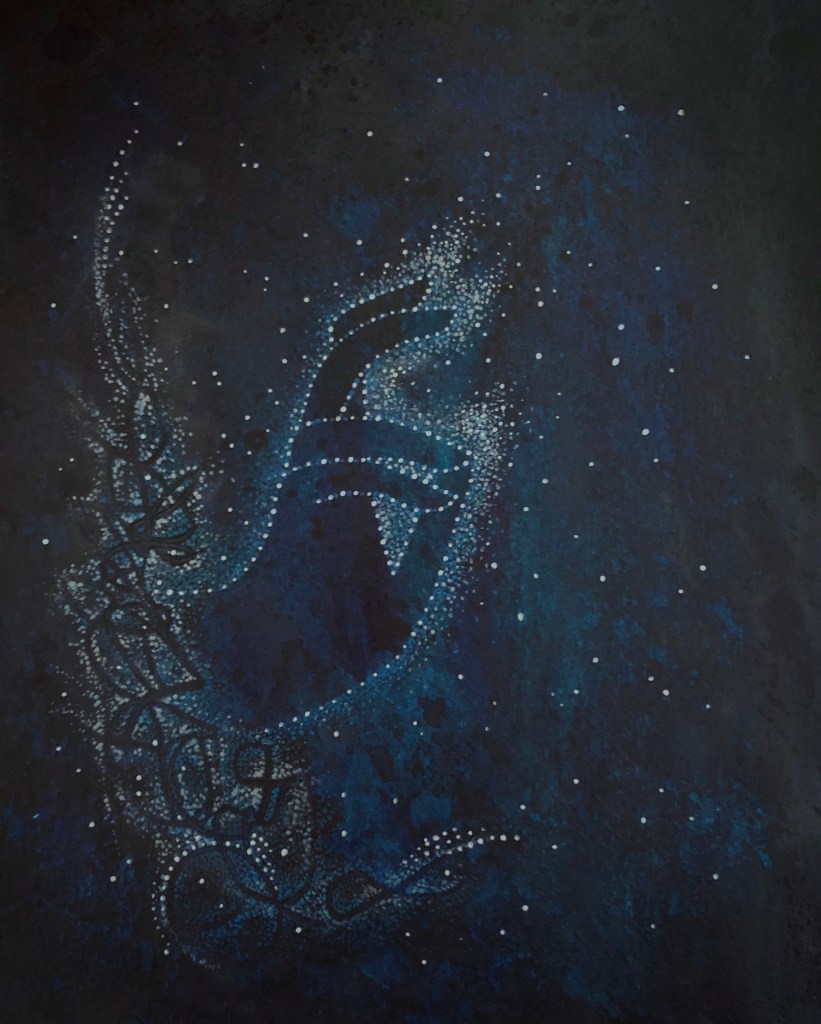
Divine Creator by Michelle L Hofer — mixed media painting on paper, 8 x 10 inches, 2018. May 14, 2023 Lectionary Texts — Year A
Acts 17:22-31 • Psalm 66:8-20 • 1 Peter 3:13-22 • John 14:15-21Image description: Set on a dark layered black-blue splattered background, a hand (outlined in silver dots) gesturing a blessing emerges from a tangle of scribbled lines. A scattering of silver dots on the background create a night sky glittering with stars. An aura of fine blue and silver dots surround the hand and give energy to the scribbles. The hand gesture is that of Christ as seen in Christian icons.
Paul: I have stopped again and again to examine carefully the religious statues and inscriptions that fill your city. On one such altar, I read this inscription: “TO AN UNKNOWN GOD.” I am not here to tell you about a strange foreign deity, but about this One whom you already worship, though without full knowledge. This is the God who made the universe and all it contains, the God who is the King of all heaven and all earth… His purpose in all this was that people of every culture and religion would search for this ultimate God, grope for Him in the darkness, as it were, hoping to find Him. Yet, in truth, God is not far from any of us. — Acts 17:23,24a,27
Everyone, bless our True God! Let praise-filled voices be heard near and far — at home and on foreign soil! Praise the One who gives us life and keeps us safe, who does not allow us to stumble in the darkness. May the True God be blessed, for He did not turn away from my prayer nor did He hold back His loyal love from me. — Psalm 66:8,9,20
Even if you should suffer for doing what is right, you will receive a blessing. Don’t let them frighten you. Don’t be intimidated, but exalt Him as Lord in your heart. Always be ready to offer a defense, humbly and respectfully, when someone asks why you live in hope. — 1 Peter 3:14-15
Jesus: In a little while, the world will not see Me; but I will not vanish completely from your sight. Because I live, you will also live. At that time, you will know that I am in the Father, you are in Me, and I am in you. The one who loves Me will do the things I have commanded. My Father loves everyone who loves Me; and I will love you and reveal My heart, will, and nature to you. — John 14:19-21
After selecting this painting for the week and meditating on the Lectionary Scriptures alongside it, my interpretation of this image has expanded. While I had fully intended this to be hand of Christ when I created it, I now see my own hand returning a blessing back to the True God as the Psalmist declares. I am reminded of my own capacity and ability to bless both God and others. It’s a beautiful reminder as well in light of Jesus’ words from John’s Gospel of our dwelling in Christ and His dwelling in us. As I receive this truth, it gives way to the precious hope mentioned by both Paul and Peter.
Practicing Visio Divina:
- View the artwork
What do you see?
Note shapes – color – style – movement
What stands out for you?
What are you curious about?
What questions do you have?
Hold back any feelings – judgments – opinions - Read the accompanying scripture and look over the artwork again
What connections do you make?
Between the image and text?
What is coming to mind from your own experience?
What feelings are rising in you?
Are you uncomfortable with something?
There are no right or wrong answers - Read the scripture again and explore the artwork a third time
What do you hear?
What is God saying to you?
What do you wish to speak to God?

- View the artwork
-
Fifth Sunday of Easter
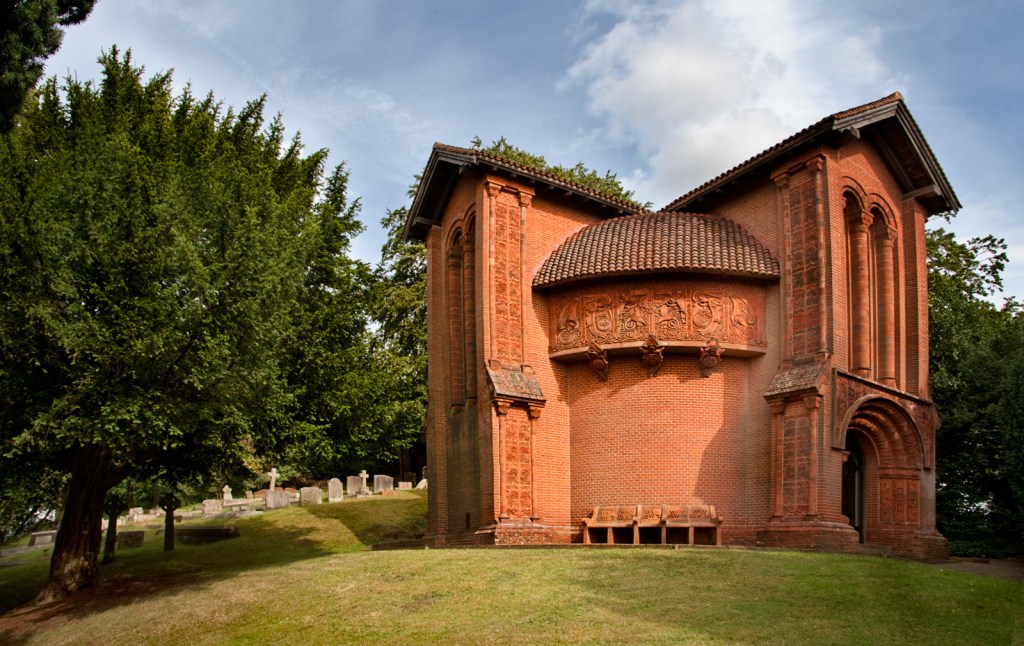
Watts Cemetery Chapel (village of Compton, England, United Kingdom) designed by Mary Seton Watts — terracotta building, 1895-1904. Image by TheSpaces.com May 7, 2023 Lectionary Texts — Year A
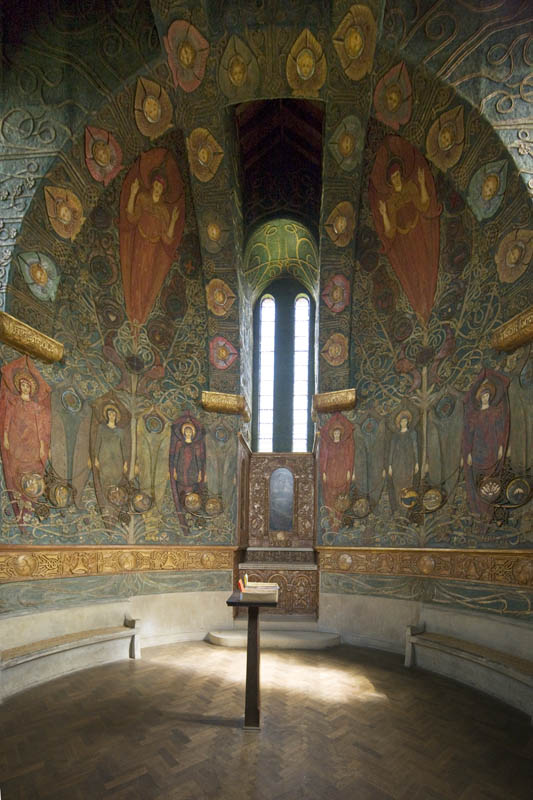
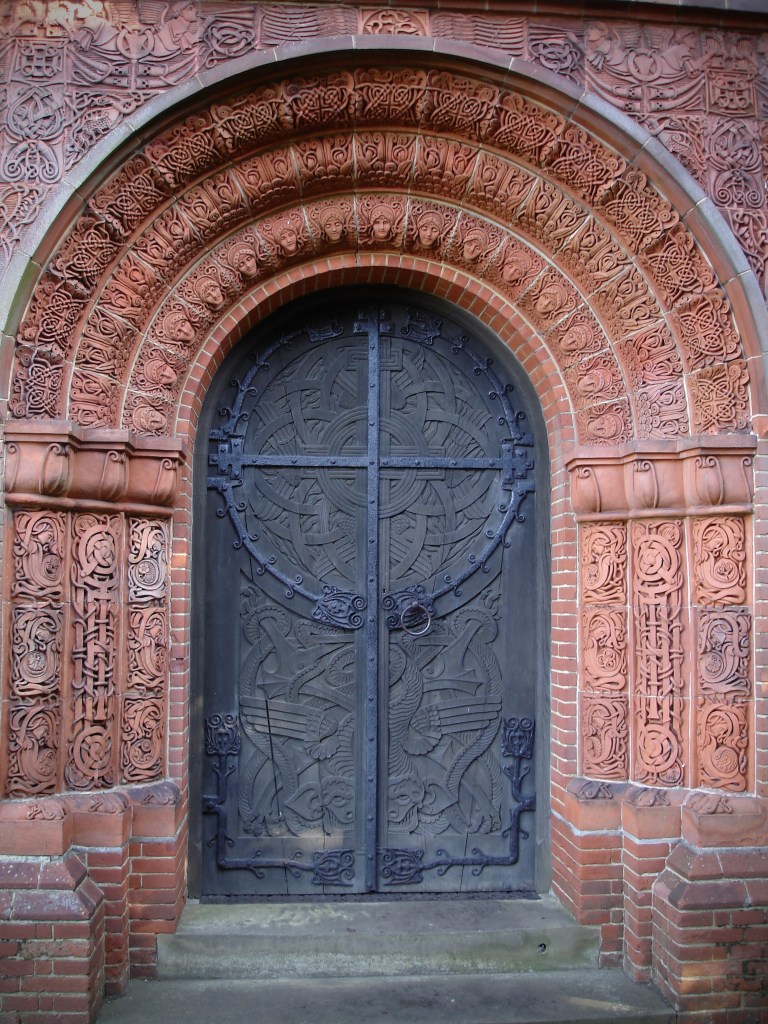
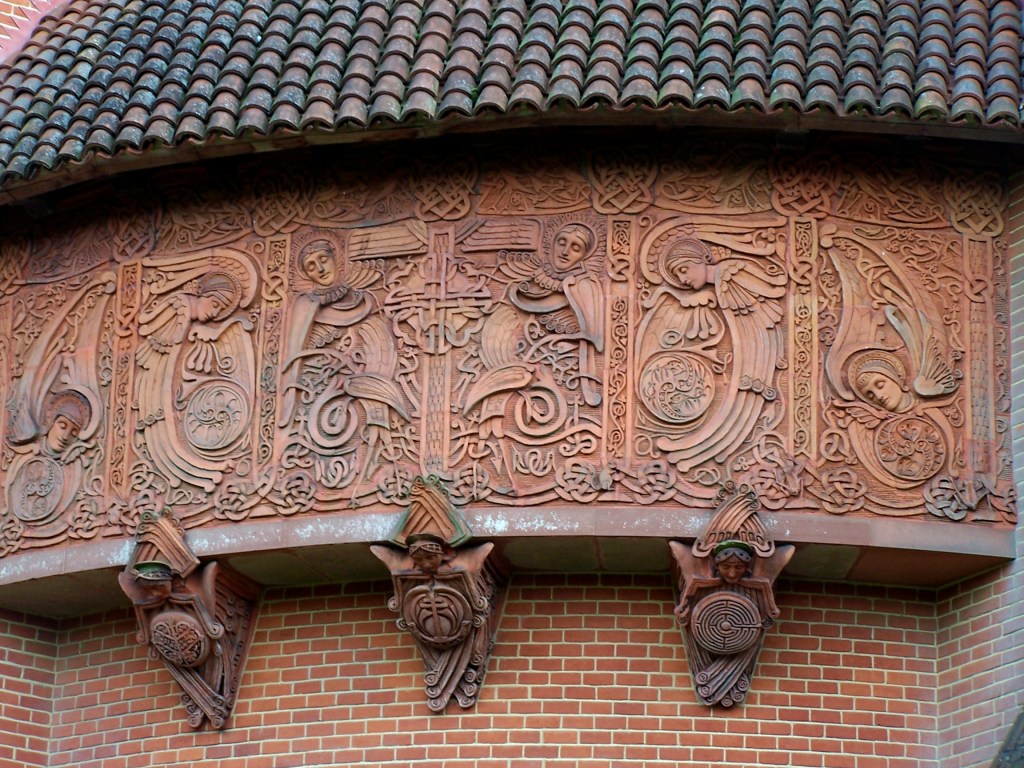
Acts 7:55-60 • Psalm 31:1-5, 15-16 • 1 Peter 2:2-10 • John 14:1-14Image Description: With a combined Byzantine and Celtic design, the Watts Chapel is a domed round brick structure with four rectangular gables. The exterior features four terracotta frieze panels following a Celtic-inspired Path of the Just with each section representing the spirits of hope, truth, love and life. The chapel entrance is framed by Celtic knot work terracotta tiles. The entrance doors display a carved Celtic cross and pair of winged dragons. The interior of the chapel is entirely decorated in colorful Celtic/Art Nouveau knot work and winged seraphim.
Stephen: Look, I see the heavens opening! I see the Son of Man standing at the right hand of God!
At this, they covered their ears and started shouting. The whole crowd rushed at Stephen, converged on him, dragged him out of the city, and stoned him. They laid their coats at the feet of a young man named Saul, while they were pelting Stephen with rocks.
Stephen (as rocks fell upon him): Lord Jesus, receive my spirit. — Acts 7:56-58You are my shelter, O Eternal One—my soul’s sanctuary! Shield me from shame; rescue me by Your righteousness. Hear me, Lord! Turn Your ear in my direction. Come quick! Save me! Be my rock, my shelter, my fortress of salvation! You are my rock and my fortress—my soul’s sanctuary! Therefore, for the sake of Your reputation, be my leader, my guide, my navigator, my commander. — Psalm 31:1-3
Come to Him — the living stone — who was rejected by people but accepted by God as chosen and precious. Like living stones, let yourselves be assembled into a spiritual house, a holy order of priests who offer up spiritual sacrifices that will be acceptable to God through Jesus the Anointed. — 1 Peter 2:4-5
Jesus: Don’t get lost in despair; believe in God, and keep on believing in Me. My Father’s home is designed to accommodate all of you. If there were not room for everyone, I would have told you that. I am going to make arrangements for your arrival. I will be there to greet you personally and welcome you home, where we will be together. You know where I am going and how to get there. — John 14:1-4
The Lectionary texts bring us to contemplate a number of things: stones used to kill, stones used to build, structures for safety, and structures for spending an eternity. In seeking an artwork for this week, I have chosen a unique architectural creation with an inspiring story.
Mary Seton Watts, an artist, designer and craftswoman proposed the building of a chapel for the village’s newly designated cemetery – a dream endeavor. In this grand project, Mary intended to foster spiritual enrichment and create a communal hymn to God. Indeed, Mary, along with nearly the entire village of Compton (some 74 individuals), designed, built and decorated this stunning masterpiece
Having found a vein of red clay in the local countryside, Mary assigned and then trained individuals for the exterior work in evening classes. Much of the interior decoration was completed by Mary herself, a task that took her six years. Through the efforts of many hands, Watts Cemetery Chapel is a place that offers hope to those in despair and comfort for those in grief.
To learn more about this beautiful sanctuary visit Watts Gallery Artists’ Village

Practicing Visio Divina:
- View the artwork
What do you see?
Note shapes – color – style – movement
What stands out for you?
What are you curious about?
What questions do you have?
Hold back any feelings – judgments – opinions - Read the accompanying scripture and look over the artwork again
What connections do you make?
Between the image and text?
What is coming to mind from your own experience?
What feelings are rising in you?
Are you uncomfortable with something?
There are no right or wrong answers - Read the scripture again and explore the artwork a third time
What do you hear?
What is God saying to you?
What do you wish to speak to God?
 1 Peter, Acts, art nouveau, celtic art, Christian architecture, clay sculpture, community art, hope, Jesus, John, Lectionary, life, living sactuary, living stone, love, Mary Seton Watts, Path of the Just, Psalms, sanctuary, seraphim, spiritual sacrifice, Stephen, terracotta, truth, visio divina, Watts Cemetery Chapel, Year A
 - View the artwork
-
Fourth Sunday of Easter
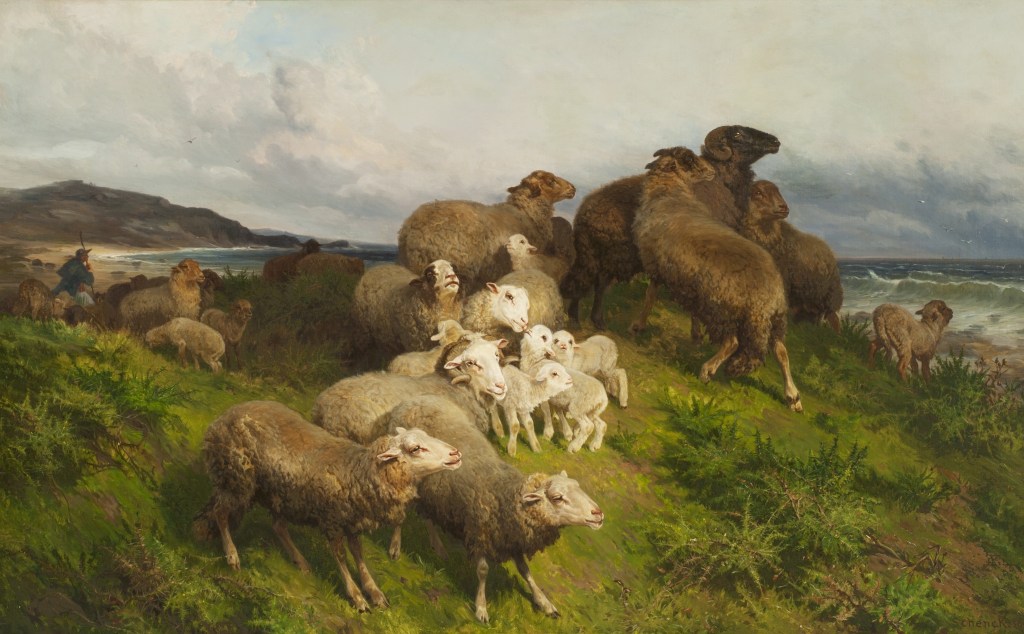
Sheep in a Meadow by August Friedrich Albrecht Schenck — oil on board, 36 x 57 inches, 1865. April 30, 2023 Lectionary Texts — Year A
Acts 2:42-47 • Psalm 23 • 1 Peter 2:19-25 • John 10:1-10Image description: A fine example of the realism of European 18th century Romanticism, a flock of sheep stand atop a green hillside overlooking the ocean with more sheep and a shepherd in the distance. The sky is partly cloudy with darker clouds appearing over the large waves approaching the shore. The sheep in the foreground and a group of lambs at center appear in a brighter patch of sunlight. Surrounding the sheep on either side are thick patches of thistles.
The community continually committed themselves to learning what the apostles taught them, gathering for fellowship, breaking bread, and praying. Everyone felt a sense of awe because the apostles were doing many signs and wonders among them. There was an intense sense of togetherness among all who believed; they shared all their material possessions in trust. — Acts 2:42-44
The Eternal is my shepherd, He cares for me always. He provides me rest in rich, green fields beside streams of refreshing water. He soothes my fears; He makes me whole again, steering me off worn, hard paths to roads where truth and righteousness echo His name. Even in the unending shadows of death’s darkness, I am not overcome by fear. Because You are with me in those dark moments, near with Your protection and guidance, I am comforted. — Psalm 23:1-4
When [Christ] was verbally abused, He didn’t return the abuse; when He suffered, He didn’t make threats to cause suffering in return; instead, He trusted that all would be put right by the One who is just when He judges. He took on our sins in His body when He died on the cross so that we, being dead to sin, can live for righteousness. As the Scripture says, “Through His wounds, you were healed.” For there was a time when you were like sheep that wandered from the fold, but now you have returned to the Shepherd and Guardian of your lives. — 1 Peter 2:23-25
So He explained further.
Jesus: I tell you the truth: I am the gate of the sheep. All who approached the sheep before Me came as thieves and robbers, and the sheep did not listen to their voices. I am the gate; whoever enters through Me will be liberated, will go in and go out, and will find pastures. The thief approaches with malicious intent, looking to steal, slaughter, and destroy; I came to give life with joy and abundance. — John 10:7-10Danish-born August Friedrich Albrecht Schenck became one the best European painters of animals during his lifetime. Many of his beautiful works found in museum collections world-wide include sheep, sheep dogs and crows. These works often portray animals exhibiting emotional capacity and expression such as fear, grief, love/affection and curiosity.
What do you imagine is happening in this scene?
What emotions do you sense in the sheep of this painting?
Practicing Visio Divina:
- View the artwork
What do you see?
Note shapes – color – style – movement
What stands out for you?
What are you curious about?
What questions do you have?
Hold back any feelings – judgments – opinions - Read the accompanying scripture and look over the artwork again
What connections do you make?
Between the image and text?
What is coming to mind from your own experience?
What feelings are rising in you?
Are you uncomfortable with something?
There are no right or wrong answers - Read the scripture again and explore the artwork a third time
What do you hear?
What is God saying to you?
What do you wish to speak to God?

- View the artwork
-
Third Sunday of Easter
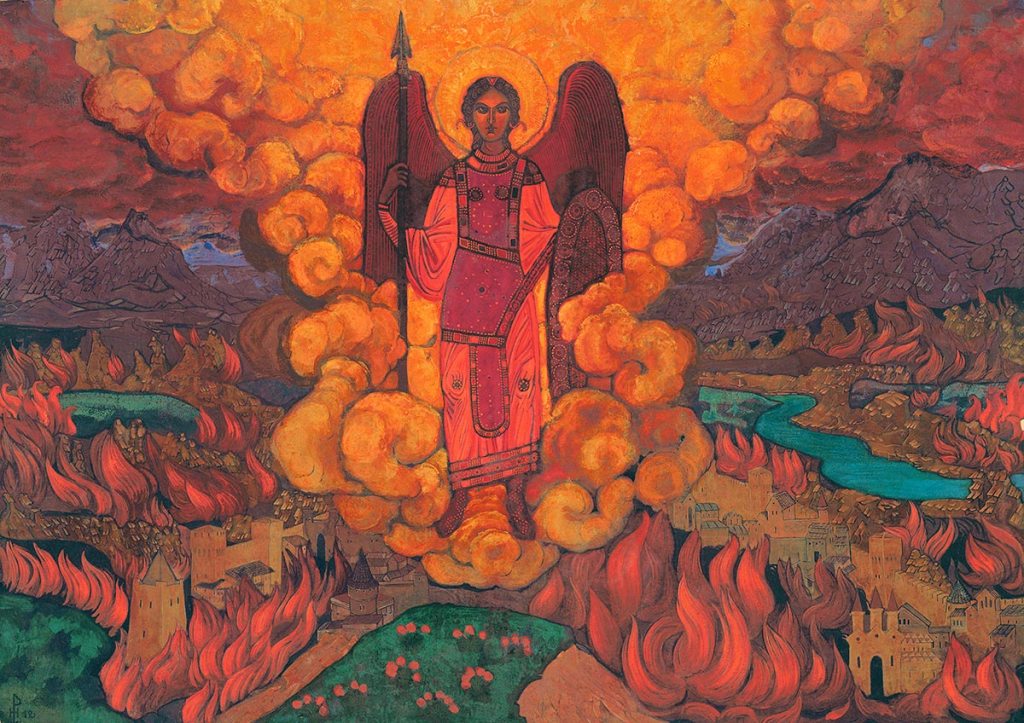
The Last Angel by Nicholas Roerich — Tempera on cardboard, 20 3/4 x 29 inches, 1912. Photo by the Nicholas Roerich Museum, New York. April 23, 2023 Lectionary Texts — Year A
Acts 2:14a, 36-41 • Psalm 116:1-4, 12-19 • 1 Peter 1:17-23 • Luke 24:13-35Image description: Dominating a vast landscape and sky in shades of vibrant red and orange is a large angel holding a spear and shield and standing on large rolling orange plumes of smoke which billow up behind the figure filling the sky. The landscape below is comprised of a city, brown and barren hills, purple mountains and a winding turquoise river. Throughout the landscape are open caverns from which erupt large red-orange flames of fire. Directly below the angel is an emerald green grassy hilltop dotted with red-orange flowers.
Peter: Reconsider your lives; change your direction. Participate in the ceremonial washing of baptism in the name of Jesus God’s Anointed, the Liberating King. Then your sins will be forgiven, and the gift of the Holy Spirit will be yours. Whoever made a place for his message in their hearts received the baptism; in fact, that day alone, about 3,000 people joined the disciples. — Acts 2:38,41
I love the Eternal; for not only does He hear my voice, my pleas for mercy, but He leaned down when I was in trouble and brought His ear close to me. So as long as I have breath, I will call on Him. Once I was wound in the wrappings of death; the terror of dying and the grave had a grip on me; I could not get away, for I was entombed in distress and sorrow. Then I called on the name of the Eternal: “O Eternal One—I am begging You—save me!” — Psalm 116:1-4
Now that you have taken care to purify your souls through your submission to the truth, you can experience real love for each other. So love each other deeply from a [pure] heart. You have been reborn—not from seed that eventually dies but from seed that is eternal—through the word of God that lives and endures forever. — 1 Peter 1:22-23
We had been hoping that He was the One — you know, the One who would liberate all Israel and bring God’s promises. Anyway, on top of all this, just this morning — the third day after the execution — some women in our group really shocked us. They went to the tomb early this morning, but they didn’t see His body anywhere. Then they came back and told us they did see something — a vision of heavenly messengers — and these messengers said that Jesus was alive. — Luke 24:21-23
When they sit down at the table for dinner, He takes the bread in His hands, He gives thanks for it, and then He breaks it and hands it to them. At that instant, two things happen simultaneously: their eyes are suddenly opened so they recognize Him, and He instantly vanishes — just disappears before their eyes. Two Disciples (to each other): Amazing! Weren’t our hearts on fire within us while He was talking to us on the road? Didn’t you feel it all coming clear as He explained the meaning of the Hebrew Scriptures? — Luke 24:30-32
I would venture to guess the scene depicted in this painting rises out of the prophesy found in the Book of Revelation. I could not locate an explanation for this beautiful painting by the Russian artist, Nicholas Roerich but he completed a number of artworks inspired by the icon tradition of Russia. We do not have a passage from Revelation in our texts this week, yet I have chosen this piece for its metaphoric potential.
I was drawn to the mentions of making a place for the message in one’s heart, hearts on fire and love from a pure heart along with the Peter’s preaching of gift of the Holy Spirit (who appeared as tongues of fire on Pentecost). When I began to search for an image that could represent these concepts, this one caught my curiosity and I began to explore whether Revelation’s vision of the angel throwing the censer of hot coals to the earth causing a commotion (Revelation 8) could not also be a symbolic image of the Holy Spirit coming upon large crowds of people the world over — in the wake of Christ’s resurrection, the earth is set ablaze with receiving hearts and the many prayers and praises of the people ascend like a billowing cloud of smoke.
The inclusion of something living and growing here also catches my attention — the greening hilltop below the angel on which bloom fiery red-orange flowers. I see it is a symbol of the new life we experience at the core of our being when our hearts are awakened.
Does this scene feel more like one of judgment and doom or one of renewal and life to you? Can it be both?
Practicing Visio Divina:
- View the artwork
What do you see?
Note shapes – color – style – movement
What stands out for you?
What are you curious about?
What questions do you have?
Hold back any feelings – judgments – opinions - Read the accompanying scripture and look over the artwork again
What connections do you make?
Between the image and text?
What is coming to mind from your own experience?
What feelings are rising in you?
Are you uncomfortable with something?
There are no right or wrong answers - Read the scripture again and explore the artwork a third time
What do you hear?
What is God saying to you?
What do you wish to speak to God?

- View the artwork
-
Second Sunday of Easter
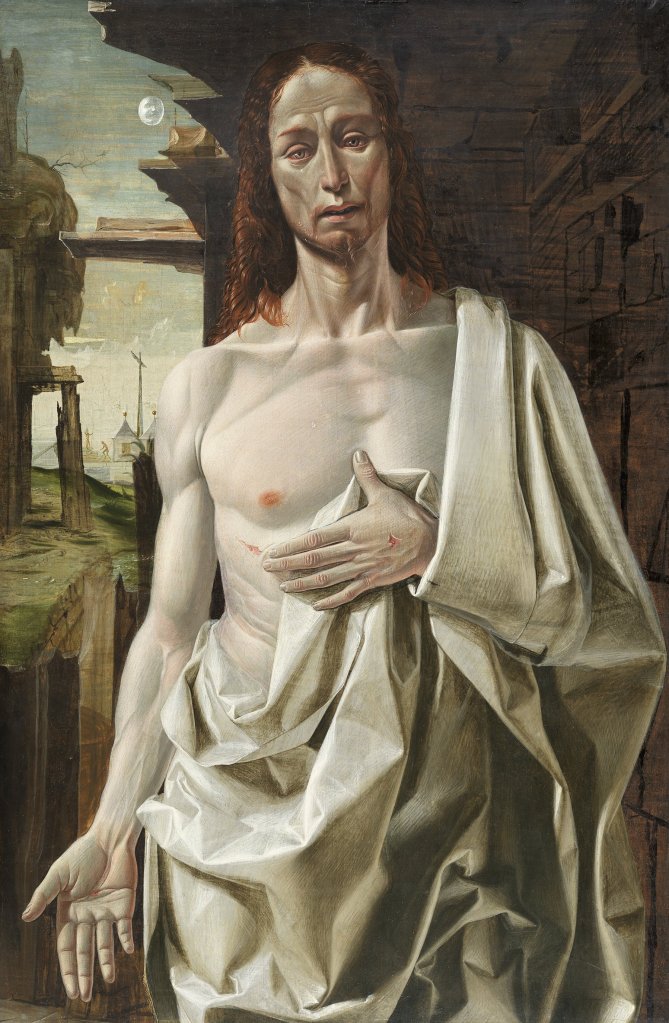
The Risen Christ by Bramantino (Bartolomeo Suardi) — Mixed media on panel, 109 x 73 cm, 1490. Image by Museo Nacional Thyssen-Bornemisza, Madrid. April 16, 2023 Lectionary Texts — Year A
Acts 2:14a, 22-32 • Psalm 16 • 1 Peter 1:3-9 • John 20:19-31Image description: His body glowing white and draped in a sheet of linen, the risen Christ looks directly at the viewer. He stands under an odd-looking stone-built structure that feels incomplete or even damaged. Beyond this is a landscape with more curious elements including a white orb representing the moon and possibly the cross-like mast of a ship. The wounds on Jesus’ hands and side appear faintly. His curly red hair and beard are parted in the middle – a nod to the Christian icon tradition where these elements indicate Christ’s dual nature: he is both God and man. The cheekbones of his face are sunken, his eyebrows raised over red and teary eyes. Jesus’ face is full of emotion. Tears roll down the right side of his face and drip onto his chest. The positioning of the hands, one pressed to his chest and the other open and down at his side, and the open mouth give the impression Christ is about to speak.
Here’s what David was seeing in advance; here’s what David was talking about — the Anointed One would be resurrected. Think of David’s words about Him not being abandoned to the place of the dead nor being left to decay in the grave. He was talking about Jesus, the One God has raised, whom all of us have seen with our own eyes and announce to you today. — Acts 2:31-32
Protect me, God, for the only safety I know is found in the moments I seek You. I told You, Eternal One, “You are my Lord, for the only good I know in this world is found in You alone.” — Psalm 16:1-2
Through faith, God’s power is standing watch, protecting you for a salvation that you will see completely at the end of things. You should greatly rejoice in what is waiting for you, even if now for a little while you have to suffer various trials. Suffering tests your faith which is more valuable than gold (remember that gold, although it is perishable, is tested by fire) so that if it is found genuine, you can receive praise, honor, and glory when Jesus the Anointed, our Liberating King, is revealed at last. — 1 Peter 1:5-7
On that same evening (Resurrection Sunday), the followers gathered together behind locked doors in fear that some of the Jewish leaders in Jerusalem were still searching for them. Out of nowhere, Jesus appeared in the center of the room.
Jesus: May each one of you be at peace.
As He was speaking, He revealed the wounds in His hands and side. The disciples began to celebrate as it sank in that they were really seeing the Lord. — John 20:19-20Eight days later, they gathered again behind locked doors; and Jesus reappeared. This time Thomas was with them.
Jesus: May each one of you be at peace.
He drew close to Thomas.
Jesus: Reach out and touch Me. See the punctures in My hands; reach out your hand, and put it to My side; leave behind your faithlessness, and believe.
Thomas (filled with emotion): You are the one True God and Lord of my life.
Jesus: Thomas, you have faith because you have seen Me. Blessed are all those who never see Me and yet they still believe. — John 20:26-29I do not know that I have seen a single other work of art depicting the risen Jesus in such a state of obvious emotion. There is that expression that fits what I see in his face: “I’ve been to hell and back.” Or to borrow an expression from my teenage children, “Jesus been through it.”
Being quite familiar with the John passage of Jesus appearing to the disciples in that locked room, I think I just assumed he was coming to them with utmost confidence – the cool, calm, and collected kind like a strong leader would.
Discovering this painting by the Italian artist, Bramantino, it immediately challenged my conceptions of Christ’s demeanor — his spiritual and emotional state post-resurrection. This has brought me into a place of curiosity about everything that happened to him and how he actually experienced it through his human side. Is it not possible he came to his disciples with this level of unrestrained emotion?
What new thoughts do you have in exploring this painting?
Practicing Visio Divina:
- View the artwork
What do you see?
Note shapes – color – style – movement
What stands out for you?
What are you curious about?
What questions do you have?
Hold back any feelings – judgments – opinions - Read the accompanying scripture and look over the artwork again
What connections do you make?
Between the image and text?
What is coming to mind from your own experience?
What feelings are rising in you?
Are you uncomfortable with something?
There are no right or wrong answers - Read the scripture again and explore the artwork a third time
What do you hear?
What is God saying to you?
What do you wish to speak to God?

- View the artwork
-
Easter Sunday
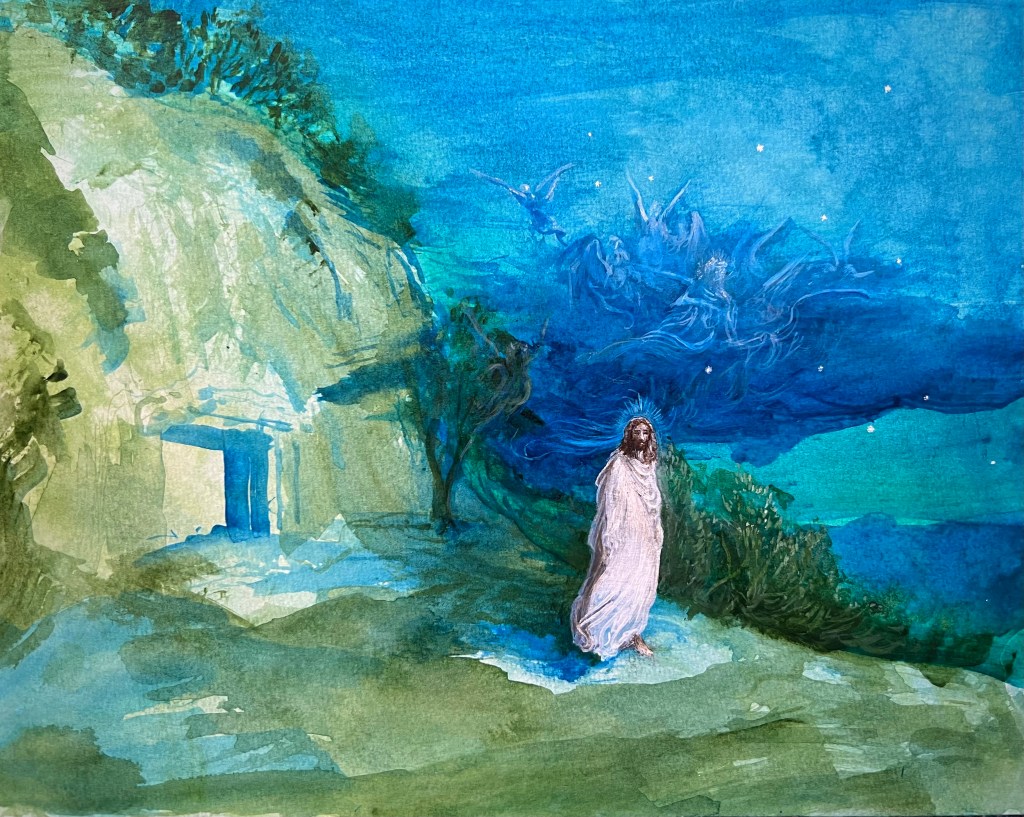
Christ Rising From the Tomb (after Doré) by Michelle L Hofer — acrylic painting on paper, 8 x 10 inches, 2023. Resurrection of the Lord — April 9, 2023 Lectionary Texts — Year A
Acts 10:34-43 or Jeremiah 31:1-6 • Psalm 118:1-2, 14-24 • Colossians 3:1-4 or Acts 10:34-43 • John 20:1-18 or Matthew 28:1-10Image description: Based on Le Christ sortant du tombeau by Gustave Doré (French, 1832-1883), Christ walks away from the tomb entrance carved into a steep rock face overlooking a valley. He is dressed in a flowing white garment. Jesus’ face is gentle as he looks directly at the viewer. A glowing halo appears behind his head. Above him is a dark cloud-like form filled chaotically with wings and angel forms. The last stars of early morning still hang in the sky.
The day will come when those who guard the land will cry out from the hills of Ephraim, ‘Get up! Let us go to Zion, dear Jerusalem, and worship the Eternal our God.’ — Jeremiah 31:6
He is my strength, and He is the reason I sing; He has been there to save me in every situation.
I will not die. I will live. I will live to tell about all the Eternal has done. — Psalm 118:14,17Your new life is now hidden, enmeshed with the Anointed who is in God. On that day when the Anointed One — who is our very life — is revealed, you will be revealed with Him in glory! — Colossians 3:3-4
You know God identified Jesus as the uniquely chosen One by pouring out the Holy Spirit on Him, by empowering Him. You know Jesus went through the land doing good for all and healing all who were suffering under the oppression of the evil one, for God was with Him. My friends and I stand as witnesses to all Jesus did in the region of Judea and the city of Jerusalem. The people of our capital city killed Him by hanging Him on a tree, but God raised Him up on the third day and made it possible for us to see Him. — Acts 10:38-40
Jesus: Dear woman, why are you sobbing? Who is it you are looking for?
She still had no idea who it was before her. Thinking He was the gardener, she muttered:
Mary Magdalene: Sir, if you are the one who carried Him away, then tell me where He is and I will retrieve Him.
Jesus: Mary!
Mary Magdalene (turning to Jesus and speaking in Hebrew): Rabboni, my Teacher! — John 20:15-16Mary Magdalene obeyed and went directly to His disciples.
Mary Magdalene (announcing to the disciples): I have seen the Lord . . . — John 20:18Years ago, I organized a display of Bibles for Lent and Easter for the church I attended. The largest Bible in the collection was brought by a woman and this particular Bible had been in her family many, many years. It was a beautiful volume containing over 200 illustrations by the French artist, Gustave Doré. Although he died at age 51, Doré had been extremely prolific. He was proficient in watercolor, oil painting and wood engraving. Doré’s art career began when he was hired to draw cartoons for a French newspaper at age 15.
As I continue to explore Doré’s vast body of work, I recently came upon a series of drawings depicting the death and resurrection of Christ. Today’s artwork is my interpretation of Le Christ sortant du tombeau (seen below).
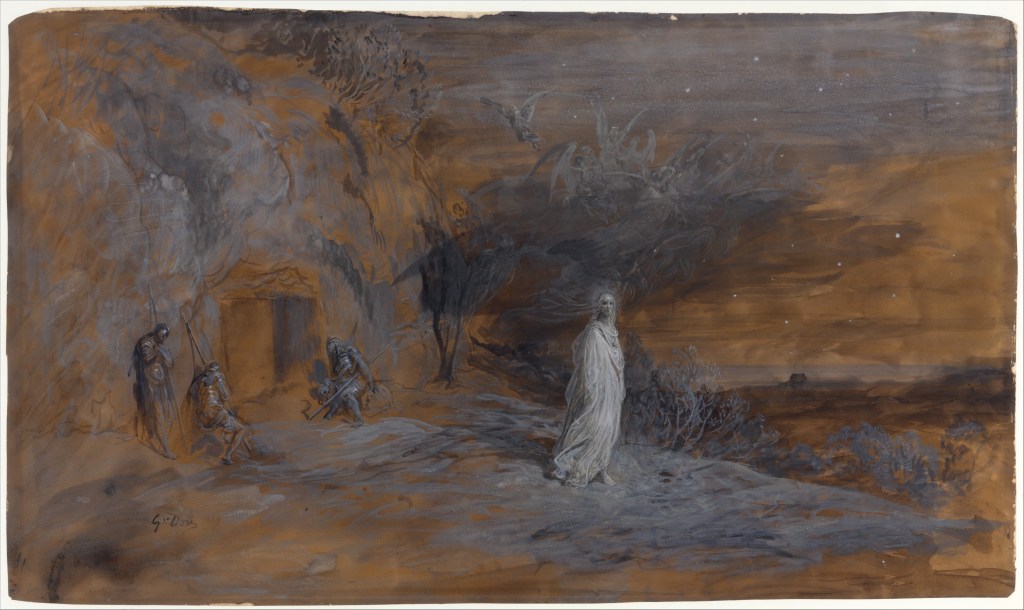
Le Christ sortant du tombeau by Gustave Doré — Gouache and brush and brown ink; over black chalk on brown paper, 20 3/16 x 34 5/16 inches, 1850-1883. I am most intrigued by what is happening above Jesus and what this might represent. I observe that it is dark overall and it feels chaotic. Are there both angels and demons here? Is this the battle, the final conquering of death?
I am also curious about the tree standing in the shadow. Do I see a figure hiding/rising out of it? Is Satan there sneering in defeat? Is it his shadow on the rock face behind?
Many blessings to you this Easter Day! I leave you with a prayer from the Vanderbilt Library’s Online Lectionary…
Resurrecting God,
you conquered death
and opened the gates of life everlasting.
In the power of the Holy Spirit,
raise us with Christ
that we, too, may proclaim
healing and peace to the nations. AMENPracticing Visio Divina:
- View the artwork
What do you see?
Note shapes – color – style – movement
What stands out for you?
What are you curious about?
What questions do you have?
Hold back any feelings – judgments – opinions - Read the accompanying scripture and look over the artwork again
What connections do you make?
Between the image and text?
What is coming to mind from your own experience?
What feelings are rising in you?
Are you uncomfortable with something?
There are no right or wrong answers - Read the scripture again and explore the artwork a third time
What do you hear?
What is God saying to you?
What do you wish to speak to God?
 acrylic painting, Acts, angels, battle of heaven, Christ Rising from the Tomb, Christian art, Colassians, conquer death, demons, Easter art, easter sunday, Gustave Doré, Jeremiah, Jesus Christ, John, Lectionary, Matthew, Michelle L Hofer, morning, new life, Psalms, resurrection, Resurrection of the Lord, stars, visio divina, Year A
 - View the artwork
-
Good Friday
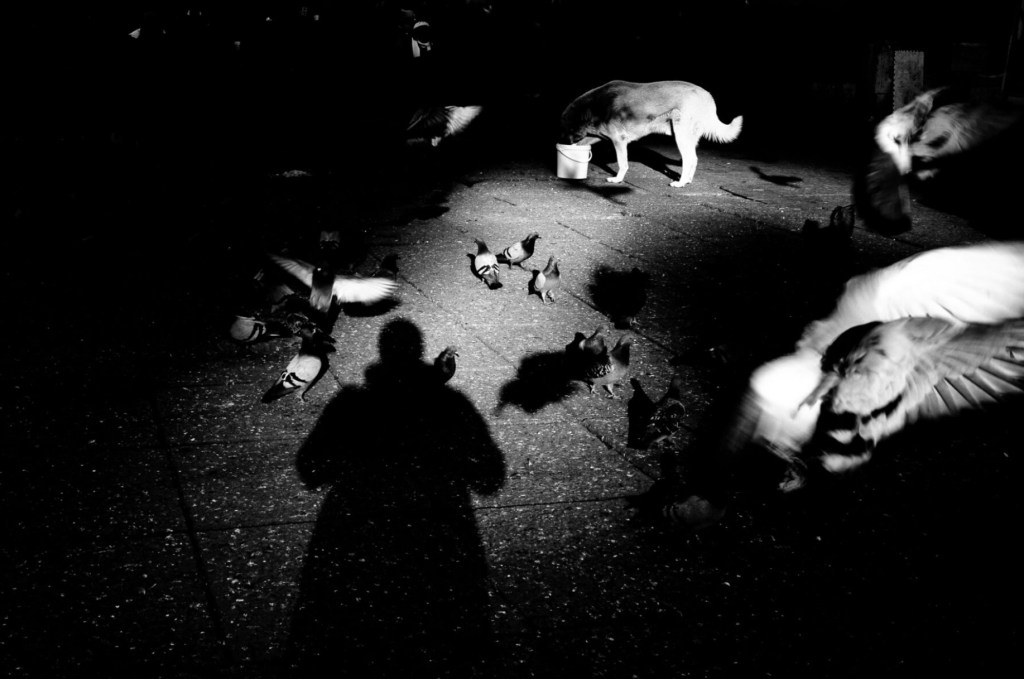
Dark Night by Soner Abaci, Turkey. Image by The Independent Photographer, 2022. April 7, 2023 Lectionary Texts — Year A
Isaiah 52:13-53:12 • Psalm 22 • Hebrews 10:16-25 or Hebrews 4:14-16; 5:7-9 • John 18:1-19:42Image description: Among congregating pigeons falls the shadow of a figure onto a paved pebble-encrusted surface. The night scene is only partially illuminated by an unknown light source from behind the figure. Several pigeons are in flight – the closest to the camera is a bright blur of wing feathers. In the distance is a dog — head down in white plastic bucket. A pigeon on the ground partially in the figure’s shadow appears as though it is sitting on it’s shoulder.
Out of emptiness he came, like a tender shoot from rock-hard ground. He didn’t look like anything or anyone of consequence—he had no physical beauty to attract our attention. So he was despised and forsaken by men, this man of suffering, grief’s patient friend. As if he was a person to avoid, we looked the other way; he was despised, forsaken, and we took no notice of him. — Isaiah 53:2-3
My God, my God, why have You turned Your back on me? Your ears are deaf to my groans. O my God, I cry all day and You are silent; my tears in the night bring no relief. A throng of evil ones has surrounded me like a pack of wild dogs; They pierced my hands and ripped a hole in my feet. But You, O Eternal, stay close; O You, my help, hurry to my side. Save my life from violence, my sweet life from the teeth of the wild dog. — Psalm 22:1,2,16,19,20
When Jesus was on the earth, a man of flesh and blood, He offered up prayers and pleas, groans and tears to the One who could save Him from death. He was heard because He approached God with reverence. Although He was a Son, Jesus learned obedience through the things He suffered. And once He was perfected through that suffering He became the way of eternal salvation for all those who hear and follow Him — Hebrews 5:7-9
So Pilate reentered the governor’s palace and called for Jesus to follow him.
Pilate: Are You the King of the Jews?
Jesus: Are you asking Me because you believe this is true, or have others said this about Me?
Pilate: I’m not a Jew, am I? Your people, including the chief priests, have arrested You and placed You in my custody. What have You done?
Jesus: My kingdom is not recognized in this world. If this were My kingdom, My servants would be fighting for My freedom. But My kingdom is not in this physical realm.
Pilate: So You are a king?
Jesus: You say that I am king. For this I have been born, and for this I have come into the cosmos: to demonstrate the power of truth. Everyone who seeks truth hears My voice. — John 18:33-37The image I’ve chosen to explore today is confusing and weird. What does it have to do with Good Friday and the death of Jesus? The answer on one level is… absolutely nothing. But on the levels of emotion, feeling and metaphor, there is potential to gain new understanding. I enjoy the challenge of an image such as this.
Looking at the main elements of the photo…
Who might the dark shadowy figure represent? Christ? The religious leaders?
Who do the pigeons represent?
What might the dog signify?
How does the image as a whole represent the chaos of Jesus’ night of arrest? a fallen world in need of a savior?
What in this photo embodies fear? betrayal? danger?Practicing Visio Divina:
- View the artwork
What do you see?
Note shapes – color – style – movement
What stands out for you?
What are you curious about?
What questions do you have?
Hold back any feelings – judgments – opinions - Read the accompanying scripture and look over the artwork again
What connections do you make?
Between the image and text?
What is coming to mind from your own experience?
What feelings are rising in you?
Are you uncomfortable with something?
There are no right or wrong answers - Read the scripture again and explore the artwork a third time
What do you hear?
What is God saying to you?
What do you wish to speak to God?
What blessing or prayer is rising in you?

- View the artwork
-
Palm/Passion Sunday
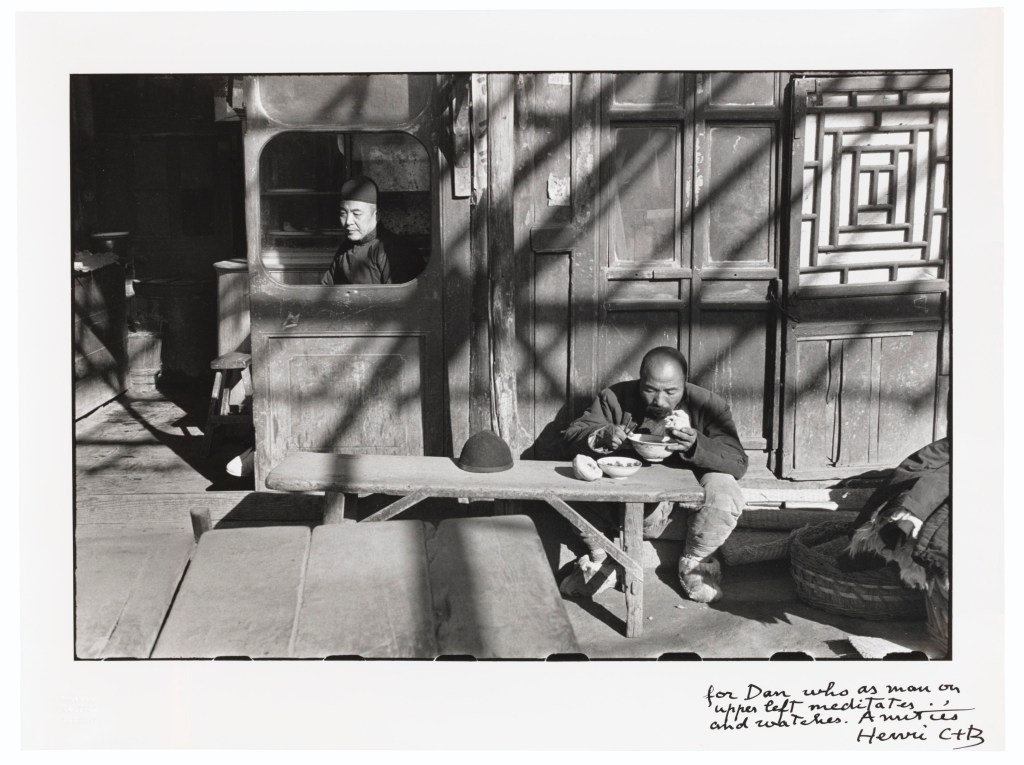
Last Days of the Kuomintang, Peking, 1949 by Henri Cartier-Bresson — gelatin silver print, printed later, 9 1/2 x 14 inches. Image by Christies.com April 2, 2023 Lectionary Texts — Year A
Liturgy of the Palms — Psalm 118:1-2, 19-29 • Matthew 21:1-11
Liturgy of the Passion — Isaiah 50:4-9a • Psalm 31:9-16 • Philippians 2:5-11 • Matthew 26:14-27:66 or Matthew 27:11-54Image description: Photographer Henri Cartier-Bresson was present in China during the civil war that ended in 1949 with a victory for the Chinese Communist party. The ousted Kuomintang, the Chinese Nationalist Party, retreated to Taiwan. Taken at midday, a man sits eating a meal at a crude bench. His hat rests on the bench and his coat has been tossed over a basket beside him. Heavy shadows of the canopy structure above fall on the paneled wall behind him. In a panel opening near the upper left of the image is another man who sits gazing out through the opening. The look on this man’s face could be calm, maybe pensive, or even blank — perhaps he is in deep thought or perhaps not.
Because the Lord, the Eternal, helps me I will not be disgraced; so, I set my face like a rock, confident that I will not be ashamed. — Isaiah 50:7
I give the moments of my life over to You, Eternal One. Rescue me from those who hate me and who hound me with their threats. Look toward me, and let Your face shine down upon Your servant. Because of Your gracious love, save me! — Psalm 31:15-16
In other words, adopt the mind-set of Jesus the Anointed. Live with His attitude in your hearts. — Philippians 2:5
When evening came, Jesus sat down with the twelve. And they ate their dinner.
Jesus: I tell you this: one of you here will betray Me.
The disciples, of course, were horrified.
A Disciple: Not me!
Another Disciple: It’s not me, Master, is it?
Jesus: It’s the one who shared this dish of food with me. That is the one who will betray Me. Just as our sacred Scripture has taught, the Son of Man is on His way. But there will be nothing but misery for he who hands Him over. That man will wish he had never been born. At that, Judas, who was indeed planning to betray Him, said,
Judas Iscariot: It’s not me, Master, is it?
Jesus: I believe you’ve just answered your own question. — Matthew 26:20-25Peter: Lord, maybe everyone else will trip and fall tonight, but I will not. I’ll be beside You. I won’t falter.
Jesus: If only that were true. In fact, this very night, before the cock crows in the morning, you will deny Me three times. — Matthew 26:33-34Then He took Peter and the two sons of Zebedee with Him, and He grew sorrowful and deeply distressed.
Jesus: My soul is overwhelmed with grief, to the point of death. Stay here and keep watch with Me.
He walked a little farther and finally fell prostrate and prayed.
Jesus: Father, this is the last thing I want. If there is any way, please take this bitter cup from Me. Not My will, but Yours be done. — Matthew 26:37-39And then, starting at noon, the entire land became dark. It was dark for three hours. In the middle of the dark afternoon, Jesus cried out in a loud voice.
Jesus: Eli, Eli, lama sabachthani—My God, My God, why have You forsaken Me? — Matthew 27:45-46Understanding the context of the photo we are exploring today will help in making connections with our texts. This image was taken by Henri Cartier-Bresson, a French pioneer in the art of photography. Cartier-Bresson is known for the “decisive moment” — an exact moment that when captured on film communicates most effectively the drama, the relationship, the tension, the beauty, the sorrow, etc. of an experience at given place and time. This photo is taken prior to the Chinese Communist Party taking control of the government of China in 1949. We see a man eating a hearty meal, an image standing in stark contrast the famine that would later starve 30 million people in China due to radical policies and economic mismanagement by the new regime.
I chose this photo for the feeling it evokes of impending darkness, suffering, unknowns. A similar woeful anticipation echoes in the events leading up to Christ’s death on the cross. As you explore this image, consider looking at the main components and asking how they serve as metaphors for elements within the lectionary texts.
These questions may help guide you:
Who might the man eating the meal represent? Christ? Judas? The other disciples? Myself?
What about the man behind the screen? Who might he represent? Christ? Peter? The Father? Judas? Myself?
What do the canopy shadows make you think of?
If we connect Jesus’ declaration of bread as his body and wine as his blood to the food being eaten by the man, what new thoughts come to mind?Practicing Visio Divina:
- View the artwork
What do you see?
Note shapes – color – style – movement
What stands out for you?
What are you curious about?
What questions do you have?
Hold back any feelings – judgments – opinions - Read the accompanying scripture and look over the artwork again
What connections do you make?
Between the image and text?
What is coming to mind from your own experience?
What feelings are rising in you?
Are you uncomfortable with something?
There are no right or wrong answers - Read the scripture again and explore the artwork a third time
What do you hear?
What is God saying to you?
What do you wish to speak to God?
What blessing or prayer is rising in you?
 betrayal, bread and wine, Chinese Communist Party, Chinese Nationalist Party, Christ, death of Christ, decisive moment, Henri Cartier-Bresson, Isaiah, Last Days of Kuomintang, last supper, Lectionary, Matthew, meditation, Palm Sunday, passion of Christ, Passion Sunday, Philippians, prayer, Psalms, starvation, visio divina, Year A
 - View the artwork

 Visio Divina
You must be logged in to post a comment.