Third Sunday After Epiphany — Year A Lectionary Texts
Isaiah 9:1-4 • Psalm 27:1, 4-9 • 1 Corinthians 1:10-18 • Matthew 4:12-23
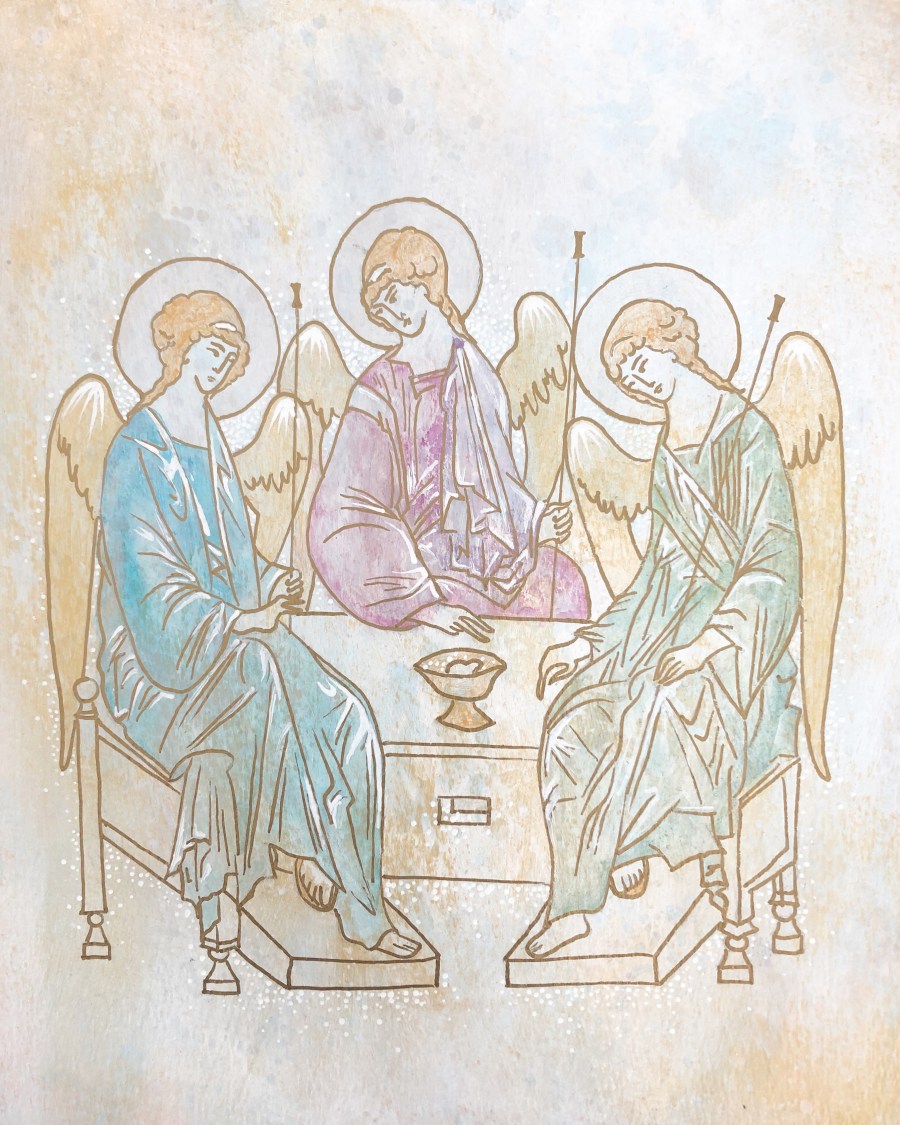
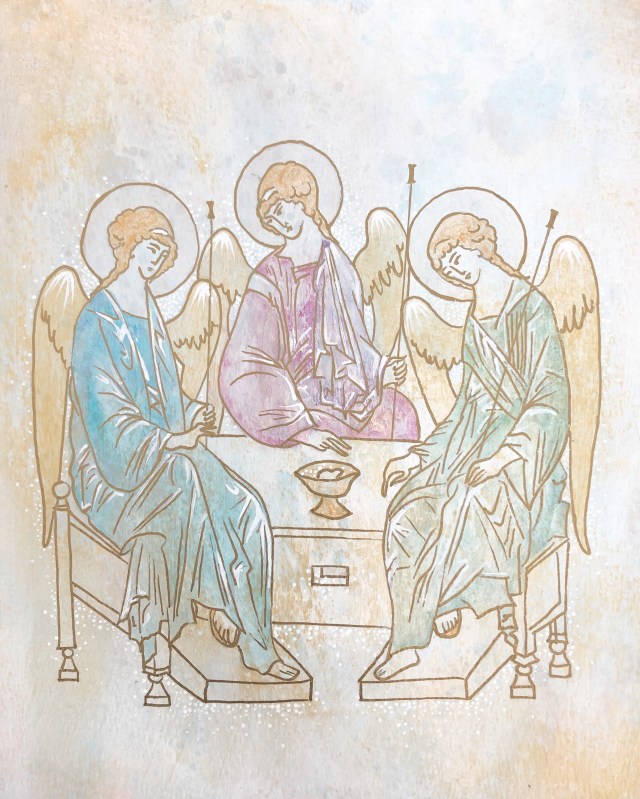
Image description: A bright pastel and gold iteration of Andrei Rublev’s well-known Hospitality of Abraham (Holy Trinity).* This icon-style image is an illustration from the story of God’s appearance to Abraham in the form of three beings (Genesis 18) delivering the news he and Sarah will have a son. Rublev expanded this image into a visual symbol for the triune nature of God. In the image, we see three haloed and winged figures holding long staffs and wearing different colored robes seated at a table. On the table rests a single pedestal-footed bowl of food (a nod to the oneness of the three while equally symbolic of Christ’s offering of his body and blood). We see platforms under the feet of the two figures sitting on either side of the table. The beings turn their faces to one another. Holding their staffs (a symbol of power and authority) in their left hands, each figure makes a gesture with their right hand. At the center of the table’s frontside is a small rectangular opening.
But there will be no gloom for those who were in anguish… The people who walked in darkness have seen a great light; those who lived in a land of deep darkness – on them light has shined. — Isaiah 9:1-2
The LORD is my light and my salvation; whom shall I fear? The LORD is the stronghold of my life; of whom shall I be afraid? One thing I asked of the LORD; this I seek: to live in the house of the LORD all the days of my life, to behold the beauty of the LORD, and to inquire in his temple. For he will hide me in his shelter in the day of trouble; he will conceal me under the cover of his tent; he will set me high on a rock. — Psalm 27:1,4-5
Now I appeal to you, brothers and sisters, by the name of our Lord Jesus Christ, that all of you be in agreement and that there be no divisions among you but that you be knit together in the same mind and the same purpose. — I Corinthians 1:10
From that time Jesus began to proclaim, “Repent, for the kingdom of heaven has come near.” — Matthew 4:17
The way in which these three figures are interacting with each other and the similarities/differences in the figures holds the invitation to enter a space of mystery and divine curiosity. Author Henri Nouwen described the evident communion here as a “circle of love”. How would you describe the facial expressions of the figures?
The figure on the left represents the Father-Mother. With the right hand, the Holy Parent gestures a sign of blessing toward the figure representing Christ at center. A band of gold across his shoulder distinguishes Christ as a ruler or king. Christ gestures towards the chalice with his right hand indicating his divine mission to become the sacrificial lamb who takes away the sins of the world. His gesture of two fingers is a reference to his dual nature – fully man and fully God. The Holy Spirit is represented by the figure who sits at left. Their hand gestures downward, perhaps to the small opening at the front of the altar table, a space indicating the customary placement of relics and the dwelling place of the saints as mentioned in the book of Revelation.
I have long treasured this quote in regards to that rectangular opening…
We must give all our attention to that open space because it is the place to which the Spirit points and where we become included in the divine circle… I come to the realization that this rectangular space speaks about the narrow road leading to the house of God. It is the road of suffering. While it’s four corners remind us that it represents the created order, including all people from the north, south, east, and west, its position in the altar signifies that there is room around the divine table only for those who are willing to become participants in the Divine sacrifice by offering their lives as a witness to the love of God. — Henri Nouwen
*Andrei Rublev was a Russian monk who devoted his life to the painting of icons and frescoes in and around Moscow, Russia. He painted the Hospitality of Abraham in 1411 in memory of Saint Sergius, the founder of Russia’s Monastery of the Holy Trinity. Saint Sergius had a wonderful vision that all Russia should be united around the Name of God. In this unity of faith and love, the Russian people would conquer “the devouring hatred of the world by the contemplation of the Holy Trinity.”
Practicing Visio Divina:
- View the artwork
What do you see?
Note shapes – color – style – movement
What stands out for you?
What are you curious about?
What questions do you have?
Hold back any feelings – judgments – opinions - Read the accompanying scripture and look over the artwork again
What connections do you make?
Between the image and text?
What is coming to mind from your own experience?
What feelings are rising in you?
Are you uncomfortable with something?
There are no right or wrong answers - Read the scripture again and explore the artwork a third time
What do you hear?
What is God saying to you?
What do you wish to speak to God?
 Visio Divina